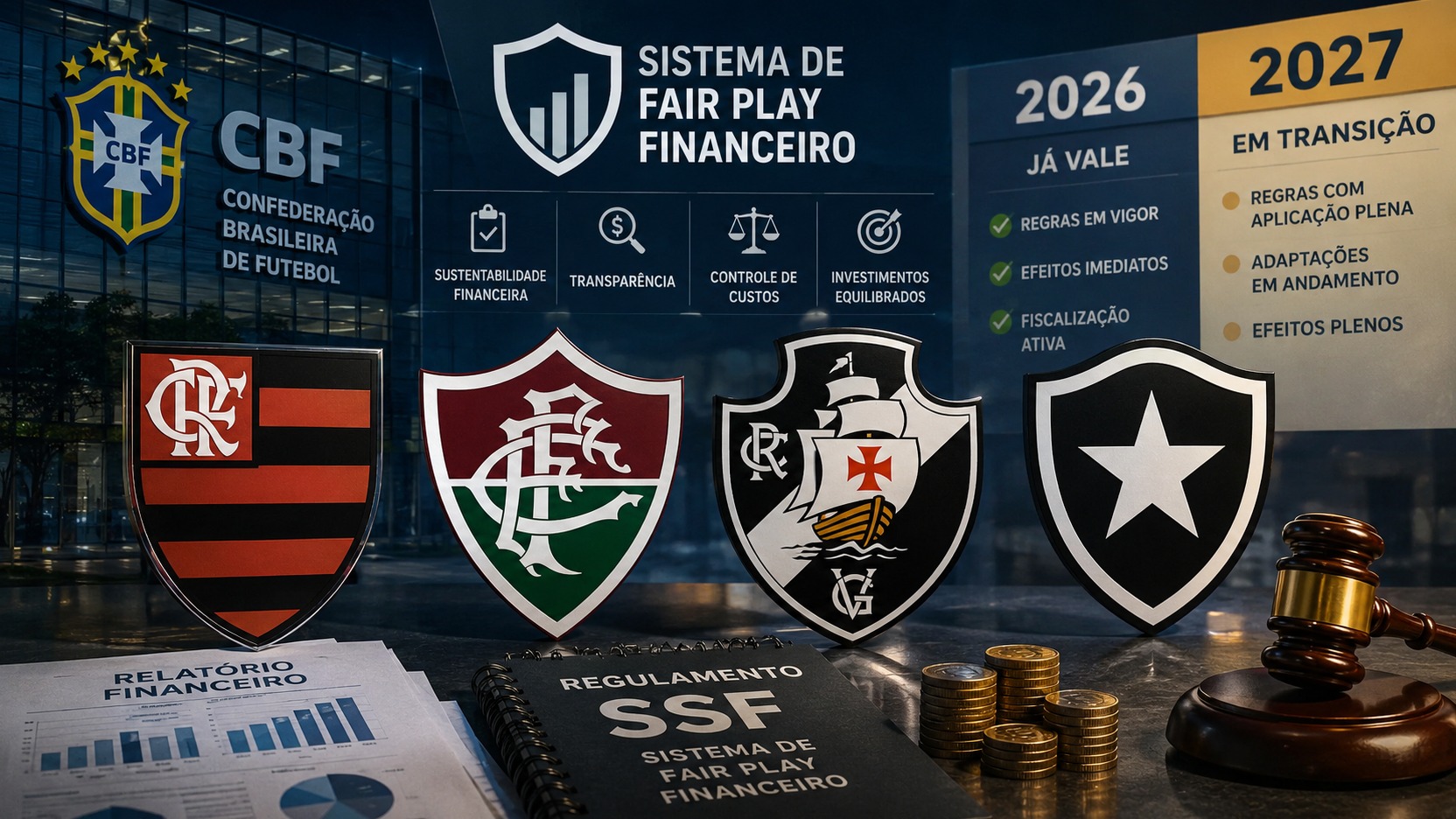
CBF financial fair play is already operating in 2026, but it does not work as a single test that places each club in an “approved” or “failed” column. The Financial Sustainability System, the SSF, combines obligations that already have immediate effect with indicators that are still going through an adaptation phase. This difference in timing is the key to understanding why Flamengo, Fluminense, Vasco and Botafogo appear in such different news stories under the same regulation.
Since January 1, 2026, clubs in Série A and Série B have been subject to the system and to oversight by the National Agency for Football Regulation and Sustainability, ANRESF. The most immediate part is solvency: obligations assumed from January 1, 2026 onward are already fully effective, while earlier commitments received an adaptation period through November 30, 2026. At the same time, financial statements, corporate information, periodic compliance declarations and budgets began to follow their own regulatory timetable.
The major structural indicators - operating balance, squad cost and short-term indebtedness - should not be read in 2026 as though their final limits were already an instant pass-fail yardstick. There are reference financial years, filing dates in the following year and progressive transition stages. That is why a warning received now can prove that the regulatory procedure is already in force without meaning that the club has failed every axis of the SSF.
The first key: the SSF runs on more than one clock
To follow financial fair play without mixing up rules, it helps to separate three dates. The first is the date on which the financial obligation arose. This is decisive for solvency, because debts assumed before 2026 receive transitional treatment through November 30, while new commitments can already trigger the set of sanctions provided for in the regulation in the event of non-payment.
The second date is the financial year being analyzed. When ANRESF refers, for example, to squad cost for the 2026 financial year, it is referring to what happened between January and December 2026. The third is the reporting and analysis date: statements for a financial year are filed in the following year, generally by April 30. As a result, part of what happens financially in 2026 will only be formally calculated and reported in 2027.
This design explains a frequent source of confusion. Saying that a rule “only applies in 2027” can be imprecise. In several cases, conduct is already measured in 2026, but the calculation reaches ANRESF in 2027. In others, 2026 and 2027 are transition years and full application of the structural limit comes even later.
What already truly applies in 2026
Solvency of new obligations
The solvency pillar is the clearest example of a rule that already produces effects. ANRESF requires contractual instruments to be registered and monitors payments to other clubs, employees and public authorities. Clubs also file compliance declarations at three points in the year: March 31, July 31 and November 30, each with its own cut-off dates.
For obligations assumed before January 1, 2026, the system granted an adaptation period through November 30, 2026 and, during that interval, limited the consequence of those older debts to a warning. For obligations assumed from January 1 onward, ANRESF’s official solvency page is explicit: they are already fully effective. Therefore, an installment on a transfer contracted in 2026 is not waiting until 2027 to come under scrutiny.
ANRESF itself publishes transactions from the 2026 transfer window that are already being monitored. Among them are deals involving all four of Rio’s major clubs. This does not mean there is an irregularity; it simply means that the commitments recorded in those transactions already belong to the new system’s oversight universe.
Reporting, audit and transparency
The regulatory timetable is also operating now. ANRESF established solvency filings in March, July and November, full financial statements and corporate-control data in April, and a budget for the following financial year in December. The statements must be accompanied by an independent audit.
This part of the SSF is not a promise for the future. Fluminense’s case showed that concretely: in June, ANRESF warned the club because its 2025 financial documentation had been submitted without the signature of an independent auditor. Fluminense later said it had corrected the issue, with the final signed version sent on May 29. The episode matters because it shows a real regulatory consequence in 2026, but one related to documentation and transparency - not an overall rejection of Fluminense’s financial health.
Special rules for court-supervised reorganization
There is also a set of rules that took effect specifically on April 30, 2026: the treatment of insolvency events. The regulation covers situations such as the granting of court-supervised reorganization proceedings and provides specific safeguards intended to reduce the risk that a financial restructuring becomes a competitive advantage.
According to ANRESF, once the event is characterized, the club becomes subject to a historical cap on monthly spending on so-called Relevant Persons, based on the average of the previous six months, and to a “zero-to-zero” transfer-market logic during transfer windows: spending on
new signings must be limited to what was raised through player sales during the period. In addition, the club must negotiate a restructuring agreement with the Agency. These rules are different from the general squad-cost and short-term-debt indicators; they form a special regime tied to insolvency.
What is still in transition
Operating balance
The SSF seeks to make clubs maintain sustainable operations by comparing relevant revenue and expenses while allowing deductions for investments considered structural, such as youth development, women’s football, infrastructure, social projects, and Olympic and Paralympic sports. If there is a deficit not covered by equity contributions, the analysis may move to an aggregate result over three financial years.
For Série A clubs, the CBF presented the tolerance as the greater of R$30 million or 2.5% of relevant revenue over the aggregate period. But the official presentation of the system itself placed 2026 and 2027 inside a transition and indicated full effectiveness in 2028, using figures referring to 2027. Therefore, it is not correct to take an estimated deficit for Flamengo, Fluminense, Vasco or Botafogo in August 2026 and declare, on that basis alone, that the club has “breached financial fair play” in the definitive sense of this pillar.
Squad cost
Cost control measures the relationship between spending on the first-team squad and adjusted revenue capacity. The numerator includes salaries, image rights, payroll charges, player amortization and intermediary costs. The denominator includes operating revenue, valid equity contributions and an adjusted measure of transfer results.
The relevant point for 2026 is that there is a soft landing. ANRESF’s current page states a transitional limit of 90% for the 2026 financial year, filed in April 2027, and 80% for the 2027 financial year, filed in April 2028. At the same time, that same page contains wording that calls 70% for Série A and 80% for Série B the permanent rule “from 2027,” which does not fit perfectly with the sequence shown immediately above it.
The CBF’s official presentation at the launch of the SSF is more linear: it treated 2026 and 2027 as transition years, indicated 80% for Série A and Série B in the stage reported in 2028, and the final limit of 70% in Série A and 80% in Série B in the following stage. For a cautious editorial reading, the main conclusion is this: 70% should not be used as a definitive test for 2026. The 2026 financial year already matters, but it will be reported in 2027 within a transitional band.
Short-term indebtedness
The indicator’s ultimate objective is to limit net short-term obligations relative to revenue. The CBF announced a structural ceiling of 45%, but it also provided for a step-by-step adaptation path. In its official November 2025 presentation, the organization indicated a transition through 2027, followed by 60% in 2028, 50% in 2029 and 45% from 2030 onward.
ANRESF’s current explanatory page uses language that is not entirely consistent with that timetable, including a passage stating that the 45% limit would be fully required in 2029. For that reason, when comparing clubs today, the safest approach is not to turn the final 45% target into a 2026 verdict. Debt data remains relevant for management and monitoring, but the compliance timetable is progressive.
Flamengo: the SSF already reaches transactions and has also become a tool for complaints
Flamengo is subject to the same general solvency, registration, transparency and reporting obligations as the other Série A clubs. ANRESF’s public list of monitored transfers in 2026 includes both incoming and outgoing transactions involving the club, reinforcing that commitments entered into this season are already within the system.
The most recent public development, however, placed Flamengo in the role of the party prompting the Agency to act. On August 18, the club notified ANRESF and requested an analysis of Vasco’s economic and financial situation. Flamengo’s submission argues that the combination of financial difficulties, a search for emergency financing and activity in the transfer market should be examined in light of SSF rules and competitive balance.
That move does not turn Flamengo’s allegation into a regulatory decision. ANRESF must analyze the facts and apply its own procedure. Nor does it justify the opposite conclusion that Flamengo has received a general seal of approval. What the episode demonstrates is that the system has already created an institutional channel for financial disputes and questions among championship participants.
Fluminense: a documentation warning shows the procedure is not just on paper
Among the four clubs, Fluminense provides the simplest example of a consequence that has already materialized in 2026. The warning related to the absence of an independent auditor’s signature on the 2025 financial statements showed that the Agency is enforcing the new documentation standard.
The club said it corrected the issue and sent the final signed version on May 29. The regulatory meaning is specific: there was a problem with the required form for submitting the financial statements and an order to regularize it. It is not correct to use that warning to claim that Fluminense failed the operating-balance test, the squad-cost limit or the short-term-debt indicator.
At the same time, Fluminense also appears in the 2026 transfers listed by ANRESF, which places it, like the others, under the solvency regime applicable to new commitments.
Vasco: court-supervised reorganization and corporate structure put 2026 rules at the center of the case
Vasco requires more care because different layers of oversight are happening at the same time. The club is in court-supervised reorganization, a situation that brings the case close to the special insolvency rules in force since April 30. This means the discussion cannot be reduced to the future general 70% squad-cost limit or to an isolated debt percentage.
In addition, ANRESF has already entered the analysis of a possible sale of the SAF. On August 5, Vasco responded to an Agency request for information about the transaction involving Marcos Lamacchia and argued that the deal does not violate the SSF. The issue also involves rules on control and significant influence in more than one club, designed to prevent conflicts of interest and multi-club ownership problems. At that point, the transaction was still under review, with no final decision on the merits published.
On August 18, Flamengo added another dimension to the case by asking the Agency to assess its rival’s economic and financial situation. That request must be separated from the already existing process concerning the corporate structure and, especially, from court decisions in the reorganization proceedings. ANRESF and the Judiciary may examine related facts, but they exercise different powers.
For that reason, the question “can Vasco sign players?” is not answered by a single SSF percentage. In 2026, what matters most immediately is the solvency regime for new obligations, the reporting obligations and, because of the court-supervised reorganization, the special insolvency safeguards provided for in the regulation. The structural limits on balance, cost and indebtedness remain subject to the transition timetable.
Botafogo: solvency, documents and court-supervised reorganization have already produced concrete effects
At Botafogo, ANRESF’s activity was even more visible in the first half of the year. On May 15, the club was notified for failing to submit, within the deadline then in force, information about debts incurred in 2026. The Agency gave the club an opportunity to respond before a final decision, reinforcing that the procedure should not automatically be confused with a definitive sanction.
In early June, another warning followed, related to the submission of documents requested by ANRESF. The reported decision provided a final deadline of ten days and the possibility of a R$100,000 fine, plus a daily fine of R$20,000, if the order was not complied with. The documents requested included information about financial transactions examined by the Agency.
There is also an important dividing line: on May 15, the court granted the processing of Botafogo SAF’s court-supervised reorganization. Because the SSF’s special rules for insolvency events had been in force since April 30, this fact places the club within a regulatory regime that already exists in 2026, with its own safeguards on payroll, transfers and restructuring.
It is also important not to mix systems. Any transfer bans imposed by FIFA arise from separate international rules and proceedings. A FIFA restriction is not, by itself, an ANRESF punishment, although the same financial obligation may have effects in more than one sphere depending on the case.
The four-club picture without creating an artificial ranking
The correct comparison is not to ask which of the four “passed financial fair play.” Flamengo, Fluminense, Vasco and Botafogo are all subject to the SSF in 2026, but the public incidence observed so far is different.
At Flamengo, the general rules and monitoring of new commitments already apply, and the club used ANRESF as a channel to question Vasco. At Fluminense, a transparency and audit obligation has already generated a warning and subsequent regularization. At Vasco, court-supervised reorganization, financing, solvency and review of the corporate structure make the SSF appear in a more complex way. At Botafogo, there have been proceedings over documentation and solvency, in addition to the regulatory impact of a court-supervised reorganization granted after the special insolvency rules came into force.
None of this allows the conclusion, based on public data available through August 25, 2026, that any club is fully “approved” or “failed” across all four pillars. A warning may be limited to
a specific issue; an investigation may end without a sanction; and the absence of a public decision does not function as a certificate of compliance.
What actually changes when 2027 arrives
The shift to 2027 matters for two reasons. First, the transitional protection granted to older obligations under the solvency pillar ends: the adaptation period for commitments predating 2026 expires on November 30, 2026. In 2027, therefore, that distinction loses the protective effect it had during much of the system’s first year.
Second, 2027 is the year in which figures from the 2026 financial year formally reach ANRESF in the annual statements. This makes visible calculations produced throughout 2026, especially in the sustainability, cost and indebtedness indicators. But “reaching ANRESF in 2027” does not mean that every final limit starts applying at that moment.
For operating balance, the CBF indicated full effectiveness in 2028 using figures referring to 2027. For squad cost, there is a transition by financial year and reporting cycle, and the current explanatory documentation itself requires careful reading because it contains wording that is not perfectly uniform. For short-term indebtedness, the CBF’s official presentation set out a staircase that continues beyond 2027.
Therefore, the move from 2026 to 2027 increases the weight of the data and ends some grace periods, but it does not turn the entire SSF into a single definitive yardstick.
How to follow the next cases without drawing the wrong conclusions
Whenever a financial fair play story appears, the first question should be which rule is being applied. Is it solvency because of an overdue debt? A documentation failure? Court-supervised reorganization? Corporate control? Squad cost? Operating balance? Short-term indebtedness? Each answer leads to a different timetable and different consequences.
The second question is which date matters. An obligation contracted in February 2026 receives different treatment from a debt inherited from 2025. Spending incurred in 2026 may be measured in the current financial year, filed in April 2027 and still fall within a transition band. A court-supervised reorganization granted after April 30, 2026 already triggers its own special rules.
This separation is what makes comparison among Flamengo, Fluminense, Vasco and Botafogo more useful than a scoreboard of “complied” or “did not comply.” In 2026, the CBF’s financial fair play already has teeth in specific areas, especially solvency, information obligations and insolvency events. At the same time, the major structural limits are still being introduced in stages. The most precise reading is to identify which axis was triggered, on what date and at which stage of effectiveness before turning an isolated case into a diagnosis of a club’s entire financial situation.