In 2026, the Feast of Saint Francis of the Stigmata in Canindé, Ceará, will take place from October 7 to 17. The change does not establish a new permanent date for the pilgrimage. The Sanctuary itself said the move is exceptional and was made because of Brazil’s national election calendar. The key point is that the first round of the 2026 elections will be held on October 4, the very day on which the Canindé festival normally ends.
What changed in the Canindé Saint Francis Festival calendar
The traditional period for the celebration is September 24 to October 4. This window appears in official Sanctuary materials and was maintained, for example, in 2024 and 2025. An official 2024 press kit even notes that the date may be changed depending on the election period.
In 2026, the overlap is direct: according to Brazil’s Superior Electoral Court, the first round of the general elections will take place on October 4. When announcing the 2026 edition, the Sanctuary said that, because of the national election calendar, the festival would not be held in its traditional period and would be moved to October 7–17. The stated aim was to allow the faithful to take part in the days of prayer, devotion and fellowship without a calendar conflict.
The official sources are available in the Sanctuary announcement and the Superior Electoral Court’s 2026 election rules.
Why the new window is October 7–17
The Sanctuary officially attributes the change to the election calendar, but it does not give a detailed explanation for each endpoint of the new window. What can be observed is that the edition preserves the traditional length: September 24 to October 4 is 11 days, and October 7 to 17 is also 11 days, counting both the starting and ending dates.
The new window also begins after the first round on October 4 and ends before a possible second round, which the electoral calendar sets for October 25. That helps explain how the dates fit together, but it should be treated as an observation based on the official calendars — not as an additional reason attributed to the Sanctuary.
What the 800th anniversary of Saint Francis’s death has to do with the edition
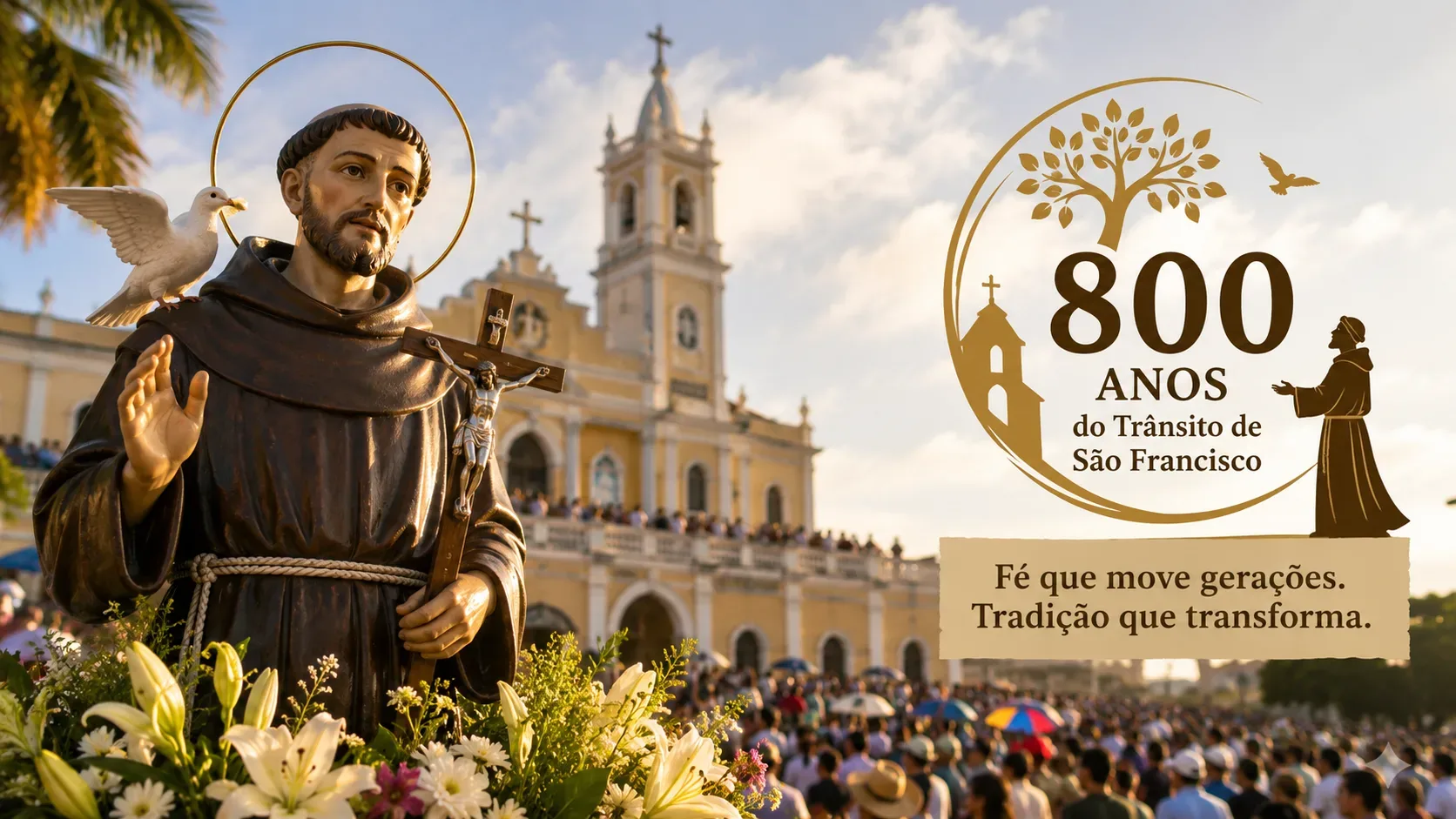
The 800th anniversary explains the commemorative and spiritual context of the 2026 festival. Saint Francis of Assisi died on October 3, 1226, at the Portiuncula in Assisi. In Franciscan language, this passage from earthly life is called the “Transitus”. Therefore, 2026 marks the Eighth Centenary of the Transitus of Saint Francis.
On January 10, 2026, the Vatican opened a special Year of Saint Francis connected to this eighth centenary. Official documents describe the anniversary as the culmination of a sequence of Franciscan centenaries devoted to important events in the final years of the saint’s life.
In Canindé, the centenary appears directly in the theme of the 2026 festival: “Saint Francis: from life to death, a call to holiness”. The official festival website says that the edition is in harmony with the Eighth Centenary of the blessed Transitus of Saint Francis. The context can be checked on the official 2026 festival website and in Pope Leo XIV’s letter for the Eighth Centenary.
“Transitus” is not the reason for the date change
It is important to separate two explanations that happen in the same year. The election calendar is the stated reason for moving the pilgrimage from September 24–October 4 to October 7–17. The centenary of the Transitus, by contrast, is the historical and religious framework that shapes the edition’s theme. One explains when the festival will be held; the other helps explain what the 2026 edition is meant to remember.
Saint Francis’s liturgical feast remains October 4
Moving the local pilgrimage does not change the liturgical feast day of Saint Francis of Assisi, which is celebrated on October 4. In 2026, therefore, readers may encounter two correct dates in different contexts: October 4 as the saint’s liturgical feast and October 7–17 as the exceptional period for the Canindé Festival and Pilgrimage.
This distinction avoids the impression that Canindé has “changed Saint Francis’s day.” What changed was the organizational calendar of the local celebration in a specific election year.
What the 2026 program looks like
The official website lists the opening on October 7 at 4 a.m., with the raising of the flags and a Eucharistic celebration. Novenas and the Way of the Cross are scheduled from October 8 to 16. The closing takes place on October 17, with a Solemn Mass in the morning and a procession with the image of São Francisquinho at 5 p.m.
These times show that the devotional structure of the festival has been maintained within a new calendar window. Travelers should still check the updated official program close to the date, as the Sanctuary may publish operational adjustments.
A timeline for understanding 2026 without confusion
- September 24 to October 4: the traditional period of the Feast of Saint Francis of the Stigmata in Canindé.
- October 3, 1226: the death of Saint Francis of Assisi, remembered in Franciscan tradition as his Transitus.
- October 4: the liturgical feast of Saint Francis of Assisi and, in 2026, the date of the first round of Brazil’s general elections.
- October 7 to 17, 2026: the exceptional period chosen for the Canindé Festival and Pilgrimage.
- 2026: the year of the Eighth Centenary of the Transitus of Saint Francis, the context inspiring the edition’s theme.
In short: the election explains the dates; the centenary explains the theme
The 2026 change makes more sense when the two layers are kept separate. Canindé’s Saint Francis Festival is exceptionally leaving its traditional period because the first round of the elections coincides with October 4, the day that normally closes the pilgrimage. The 800th anniversary of Saint Francis’s death did not cause the transfer; it gives the edition its commemorative context, expressed in a theme about life, death and the call to holiness.