If you are flying and need special assistance, the first practical step is to identify what kind of support you will need. Under Brazil's ANAC Resolution No. 280/2013, in its consolidated text, the notice period depends on the situation: 72 hours before the scheduled departure time when a companion is required under the regulation or when medical documentation may be required; and 48 hours for other types of assistance. Ideally, state the need when purchasing the ticket and confirm the procedures directly with the airline.
72 hours or 48 hours: which deadline applies?
| Situation | Minimum notice | What to confirm |
|---|---|---|
| Need for a companion in the situations covered by the Resolution | 72 hours | Whether the airline will provide a companion or how a companion chosen by the passenger will be handled. |
| Possible requirement for MEDIF or another medical document | 72 hours | Accepted form, medical documentation, review time and any additional requirements. |
| Other assistance, such as mobility and airport movement support | 48 hours | The assistance code or service recorded, meeting points and airport procedures. |
The rule is set out in Article 9 of ANAC Resolution No. 280/2013. Notice must be given to the air operator. If the passenger does not provide notice within the deadline, this does not automatically make travel impossible: the regulation allows travel if the passenger agrees to be transported with the assistance that is available, subject to health and safety conditions.
When may the airline request MEDIF?
MEDIF is the Medical Information Form. The Resolution does not say that every passenger with a disability, reduced mobility or another special assistance need must submit MEDIF. The air operator may require MEDIF or another medical document to assess situations in which the passenger:
- needs to travel on a stretcher or in an incubator;
- needs to use oxygen or another medical device; or
- has a health condition that may pose a risk to themselves or others, or may require extraordinary medical attention during air travel.
The medical document or MEDIF must be reviewed by the airline's medical service, specialized in aviation medicine, and the Resolution provides a 48-hour response period. For permanent and stable conditions, when the documentation has already been submitted to the same operator, the operator must adopt measures that make exemption from resubmission possible.
In practice, forms, submission channels, document validity and device details can vary by airline. Anyone in one of the medical situations above should therefore start the process early and keep the case or protocol numbers.
Quick decision tree: what assistance should I request?
- Do I need help moving through the airport, boarding, disembarking or reaching my seat? Request mobility assistance; as a rule, use the 48-hour deadline.
- Do I need to travel on a stretcher or in an incubator, or use oxygen/medical equipment? Contact the airline at least 72 hours in advance and ask about MEDIF or another medical document.
- Does my condition require a companion under ANAC's specified situations? Give at least 72 hours' notice.
- Will I bring a wheelchair, cane, crutches, walker or another mobility aid? Provide the item's characteristics and confirm how it will be stowed and returned on arrival.
- Will I bring a battery-powered device, oxygen or another item subject to safety rules? Confirm technical compatibility and restrictions in advance; items classified as dangerous goods are subject to specific air transport requirements.
What assistance must the airline provide at the airport and during the journey?
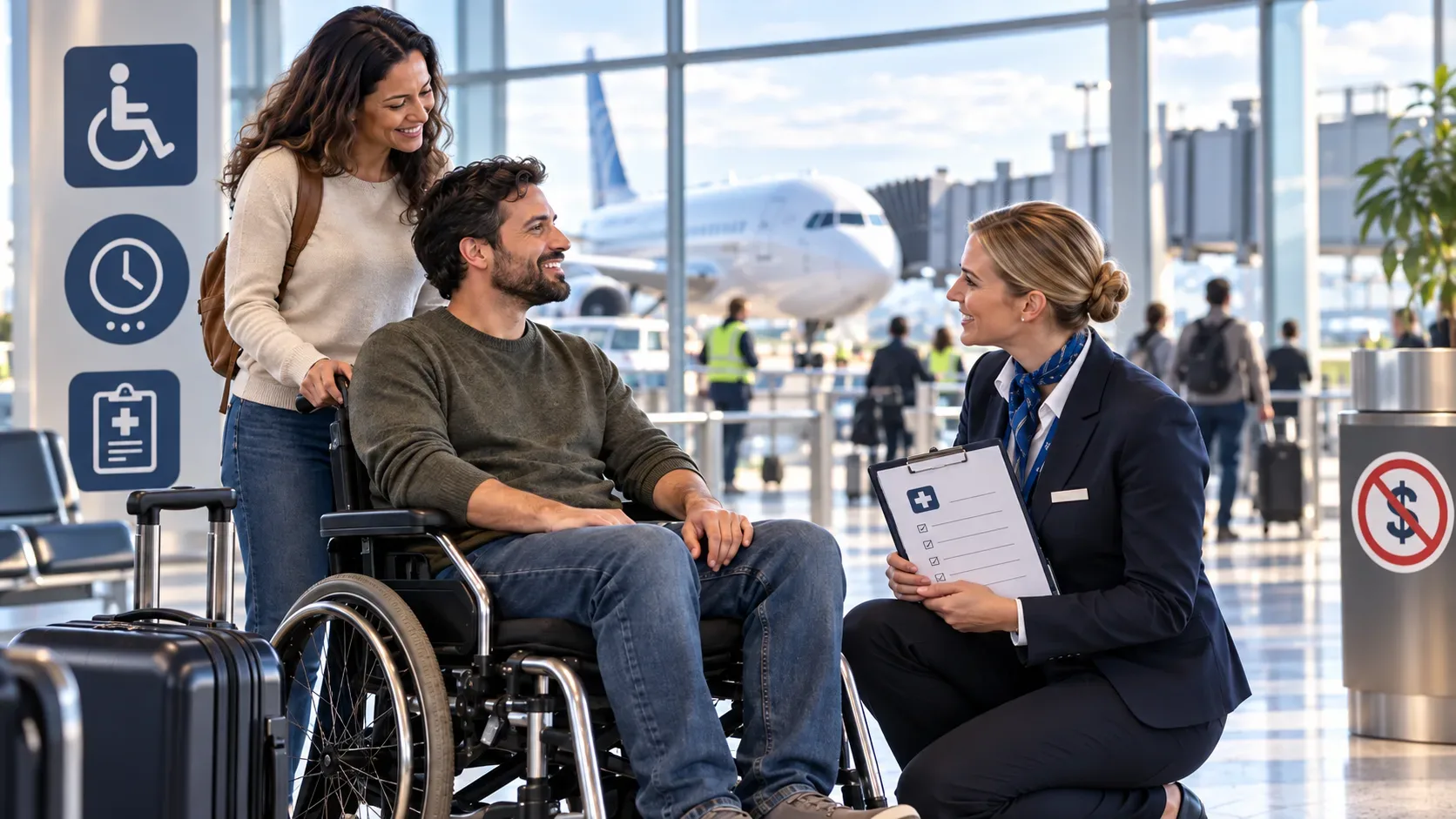
The Resolution lists a chain of support that includes check-in and baggage drop, movement from the check-in counter to the aircraft, passage through security and border controls, boarding and disembarking, seating assistance, help stowing cabin baggage, movement to baggage reclaim, exit to the public area, guidance to restroom facilities, connections and other relevant measures.
Special assistance starts being made available when the passenger presents for check-in. A passenger who checked in through an app or website should identify themselves to an airline representative upon arriving at the airport. As a rule, a passenger needing special assistance presents for check-in with the same lead time as other passengers, although the airline may establish a different reporting time for certain medical situations listed in Article 10.
Passengers needing special assistance must receive boarding priority over all other passengers. Disembarkation generally takes place after other passengers, unless a short connection or another circumstance justifies priority.
Which services cannot be charged?
The Resolution's general rule is clear: special assistance must not create a charge for the passenger needing special assistance. In other words, the operational support required by the regulation — such as assistance moving through the airport, boarding, disembarking and the other assistance activities — must not be turned into an extra fee.
There are, however, exceptions and specific chargeable situations that must be distinguished from ordinary assistance:
- the general free-of-charge rule does not necessarily cover medical arrangements related to travel on a stretcher or in an incubator and the use of oxygen or other medical equipment;
- if additional seats are needed to accommodate the passenger, mobility aids or medical equipment, the amount charged for each additional seat must be no more than 20% of the ticket price paid by the passenger needing special assistance;
- for excess baggage used exclusively to carry indispensable mobility aids or medical equipment, the airline must provide a discount of at least 80% on the excess-baggage charge.
So the useful question before travel is not only “is assistance free?” but also “does my case involve a medical service, an additional seat or excess baggage?”. Ask the airline to itemize any charge.
Companion: when does the rule apply and how much may it cost?
The Resolution requires a companion for a passenger with a disability or reduced mobility when the passenger travels on a stretcher or in an incubator, when a mental or intellectual impairment prevents understanding flight-safety instructions, or when the passenger cannot attend to their physiological needs without assistance.
In these situations, the air operator must provide a companion at no additional charge or require the passenger to travel with a companion of their choice. If the passenger chooses the companion, that person's seat may be charged, but at no more than 20% of the ticket price paid by the passenger needing special assistance. The airline must provide a written response to companion requests within 48 hours. The companion must be at least 18 years old, be able to provide the necessary assistance, travel in the same class and sit in an adjacent seat.
Wheelchairs, mobility aids and medical equipment
Mobility aids and medical equipment may be used in the security-restricted area and taken to the aircraft door, provided they undergo airport security screening. The airline must carry one mobility aid used for locomotion free of charge, in the cabin when suitable space is available or in the baggage compartment, and make it available to the passenger on disembarkation.
When a mobility aid or medical device is checked, it must be treated as a fragile and priority item and travel on the same flight as the passenger. It must be declared and identified, and the airline must provide a receipt. In the event of loss or damage, the regulation provides for immediate replacement with an equivalent item upon arrival, in addition to specific rules for loss, unusability and compensation.
If medical equipment must be used during the flight, it must be carried in the cabin when necessary. Aircraft compatibility, batteries, power supply and dangerous-goods rules should be confirmed with the airline in advance.
Pre-trip checklist
- When buying the ticket, state that you need special assistance and describe the need functionally: movement, boarding, transfer, equipment, communication or companion.
- Determine whether your case requires 72-hour or 48-hour notice.
- If there is a medical situation, ask explicitly whether MEDIF or another document will be required and which channel should be used for submission.
- Provide information about a wheelchair, mobility aid or medical device, including dimensions, weight, battery type and need for in-flight use when applicable.
- Ask for confirmation of the service recorded and keep the protocol number, email or request screen.
- Confirm whether any charge applies and why: ordinary assistance must not be charged; medical arrangements, additional seats and excess baggage have their own rules.
- Check the reporting time and meeting point at the airport. For certain medical situations, the airline may require earlier presentation.
- For connections, confirm how transfer between flights and return of the mobility aid will work.
What if the request is made after the deadline?
Missing the 72- or 48-hour deadline does not, by itself, automatically remove the right to travel. The Resolution allows transport when the passenger agrees to the assistance that is available, subject to health, operational safety and aviation-security requirements. Even so, early notice reduces the risk that equipment, medical review or coordination between the airport and airline will not be ready.
Confirm your airline's procedure before the flight
ANAC Resolution No. 280/2013 establishes the regulatory baseline, but practical implementation depends on factors such as aircraft type, medical equipment, batteries, airport and itinerary. Consult the consolidated version of Resolution 280 on ANAC's website and confirm with the airline the forms, channels, internal deadlines and requirements that apply to your case. This article is informational and does not replace medical assessment or official guidance from the airline or ANAC for an individual situation.