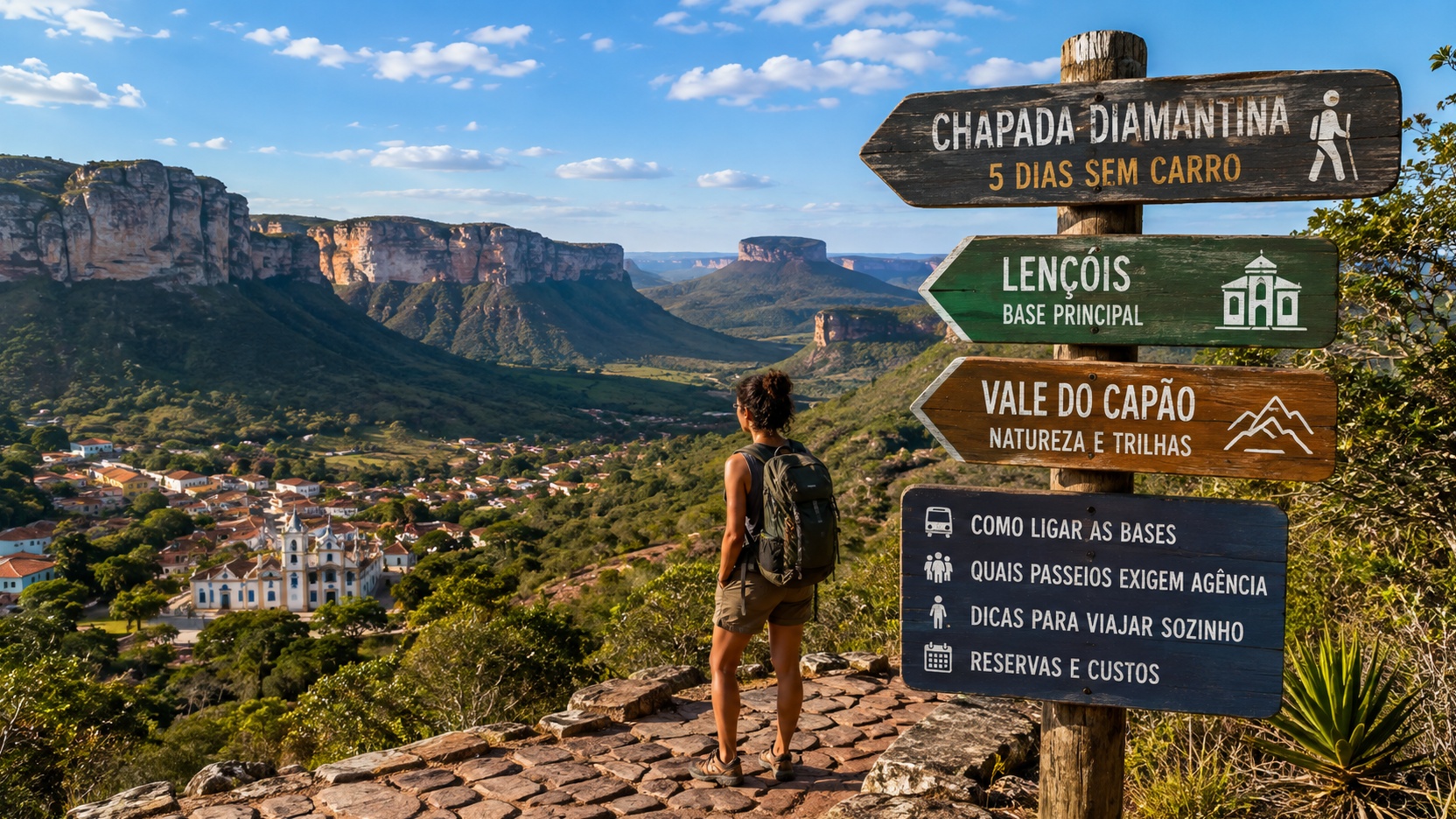
Travelling around Chapada Diamantina for five days without a car is feasible, but it works better when accommodation is chosen based on logistics, and not just the list of attractions. Lençóis and Vale do Capão are in the same northern region of the National Park, but fulfill different roles: Lençóis concentrates arrival, accommodation, agencies and road tours; Capão puts the traveler closer to trails like Cachoeira da Fumaça and reduces the wear and tear of trying to do everything in one round trip.
The main decision is simple. For a short first trip, especially alone, staying in Lençóis for five days is the most predictable option. Splitting your stay between Lençóis and Capão makes more sense when Cachoeira da Fumaça and the rhythm of the valley are real priorities, because it avoids spending a long day just going to and from the same base.
There is an important point before putting together any itinerary: in Chapada, "needing an agency" doesn't mean just one thing. In some attractions, it is mandatory to be accompanied by a local guide; in others, the guide is recommended for safety; and on many tours the agency becomes useful mainly because it solves a transport problem. Without a car, these three situations need to be separated.
What changes when traveling without a car
ICMBio informs that Lençóis and Palmeiras, the municipality to which Vale do Capão belongs, are accessible by regular buses, but it also recognizes that intercity transport around the park is limited and that some sections depend on private vans. The same official guidance recommends checking the specific logistics of each attraction before traveling.
In practice, this means that Lençóis works best as a base for those who want to buy shared tours and leave accommodation in the center. The city also allows you to visit some attractions on foot. Capão is excellent when the intention is to walk from the valley itself, but requires more attention to the connection with Palmeiras and the departure time at the end of the trip.
The road between Palmeiras and Capão also deserves reconfirmation. The ICMBio visitation page still describes this access as a stretch of dirt road, while the Government of Bahia reported that paving will be carried out on the connection in 2026. For the traveler, the practical conclusion is not to assume floor conditions, travel time or van frequency too far in advance: confirm everything close to the date.
How to connect Lençóis and Vale do Capão without a car
The safest connection for those who do not want to hire a car with a driver is made in two stages. First, bus from Lençóis to Palmeiras. Then, van, private minibus or transfer from Palmeiras to Vale do Capão. ICMBio confirms the existence of regular buses to both cities and vans on the Palmeiras-Capão section.
Ticket queries carried out in August 2026 show that the Lençóis-Palmeiras section appears at more than one time on certain dates, lasting close to an hour. This should not be turned into a fixed time in the itinerary: frequency, class, price and departure may change. Buy the ticket for the actual date and, before leaving Lençóis, confirm who will do the second leg to Capão.
Vans to the valley should not be treated as a high-frequency urban line. Local information indicates that they tend to align with some bus arrivals in Palmeiras, especially during busy periods, but supply may decrease in the low season. Those traveling alone gain security by booking or at least confirming the transport contact the day before.
There is also an alternative on foot. ICMBio officially records a one-day crossing between Lençóis and Vale do Capão with 18.6 kilometers, of which 9.5 kilometers are within the National Park. It should not be confused with a simple "shortcut" between accommodations. The park's trails do not have continuous signage, there are sections that are poorly marked and there is no cell phone signal. For a solo traveler with a backpack, the crossing should be treated as a trekking activity, not as improvised transportation.
Lençóis or Capão: which base to choose
Stay in Lençóis for five days
Lençóis is the most functional choice for those who arrive without a car, want to reduce accommodation changes and prefer to arrange tours through local agencies. The city is highlighted by state tourism as one of the main gateways to the region and has road and air access. In the center, travelers will find accommodation, food and tours that include transportation.
The advantage is logistics. One day can be dedicated to nearby attractions, another to the cave circuit and Pai Inácio, another to trails in Lençóis and another to a longer trip. For those traveling alone, the formation of groups by agencies is especially useful: local companies publish group trips and accept solo travelers, making the cost of transport and guide shared between participants when there is demand.
The disadvantage appears if Cachoeira da Fumaça is a priority. It is possible to book a tour or transfer to the Capão region, but turning this into a day trip leaves the day dependent on the road, group schedule and connection. In five days it is executable; It's just not the most comfortable way to get to know the valley.
Divide Lençóis and Vale do Capão
The division that usually makes the most sense on a five-day trip is to concentrate the road trips in Lençóis first and leave the last days for Capão. This way, the base change happens once and Cachoeira da Fumaça can be done without the burden of returning to Lençóis the same night.
This design works best for those who accept a little more planning. It is necessary to combine a bus to Palmeiras with a van or transfer to the valley and, in the end, take the opposite route to continue the journey. The reward is having a free morning or afternoon in Capão without being tied to a day trip schedule.
5-day itinerary based solely in Lençóis
Day 1: Lençóis and Muritiba Park
Use the first day to absorb the city and take a trip that doesn't depend on the road. Lençóis City Hall highlights the Muritiba Municipal Park and the attractions close to the center, such as Serrano, Cachoeirinha, Primavera and viewpoints. It's a good opening because it allows you to adjust the pace of your trip without spending the first morning commuting for a long time.
For this group, agency is not a transportation requirement. The value of a guide is in reading the terrain, local history and safety, especially if there is rain or if the traveler wants to go beyond the most obvious spots. Those who arrive late can reduce the circuit and save energy for the following days.
Day 2: Lapa Doce, Pratinha and Morro do Pai Inácio
This is the day when the lack of a car becomes more evident. The attractions are outside the Lençóis walkable network and the simplest way to do them is to take part in a transport tour or hire a car with a driver. Local agencies sell this tour in groups, which is convenient for solo travelers.
At Gruta da Lapa Doce, the visit is led by a guide from the attraction itself. The official website informs that all routes inside the cave are guided and recommends booking on holidays, weekends and high season. Therefore, even if the visitor arrives by private transport, entry into the cave is not a free tour.
Fazenda Pratinha is a private complex with its own concierge and activities. Morro do Pai Inácio is a municipal conservation unit and should not be confused with the National Park. As access rules, capacity and ticket sales can be adjusted by the municipality, confirm the current operation before visiting. Without a car, the central point remains transport: agency or transfer solves the journey between the three attractions.
Day 3: Ribeirão do Meio and Cachoeira do Sossego
Ribeirão do Meio is one of the simplest exits from Lençóis and appears among the municipality's traditional attractions. The walk does not require a car to begin, which makes the location interesting for those looking to reduce transportation costs.
Cachoeira do Sossego changes the level of the day. It requires a longer walk, with terrain that can become more technical depending on the conditions. For those traveling alone and don't know the route, hiring a driver is a safety decision, not just comfort. ICMBio recommends drivers on less marked and more difficult trails and specifically advises not to go out alone in the park areas.
If the objective is a less physical trip, stick to Ribeirão do Meio and spend the rest of the day in Lençóis. Trying to "fit" long trails just to fill the itinerary is one of the mistakes that most wear out a short trip.
Day 4: Vale do Capão and Cachoeira da Fumaça on a day trip
In single-base architecture, this is the most sensitive day. Cachoeira da Fumaça above is part of the Campos region, in the Capão Valley. ICMBio describes approximately 5 kilometers of trail to the top and informs that the Association of Visitors Drivers of Vale do Capão remains receptive near the beginning.
The agency is not presented by ICMBio as a universal obligation for this trail, but the agency itself recommends a driver, warns that there is no cell phone signal and asks that visitors not go out alone. For a solo traveler, the most coherent operational solution is to join a group with a guide or hire a local driver.
Doing the Fumaça from Lençóis requires dedicated transport or a tour set up for this purpose. Relying only on a bus to Palmeiras plus a van to Capão and repeating everything in the opposite direction on the same day creates the risk of missing a connection. If Smoke is an absolute priority, the split trip is better.
Day 5: light stroll or safety reserve
The last day should have fewer dependencies. If leaving Lençóis in the afternoon, a short circuit close to the city works best. If there is a full day, it is possible to book an additional road tour, such as Cachoeira do Mosquito, Poço do Diabo or Marimbus, depending on interest and operating conditions.
It is also useful to keep this day as a safety margin. Rain, river levels, group formation and changes in transport can change a tour. On a short trip, having a flexible day prevents a change in weather from destroying the entire itinerary.
5-day itinerary dividing Lençóis and Vale do Capão
Days 1 and 2: focus on what depends on Lençóis
On the first day, do Lençóis and Muritiba. In the second, focus on the road circuit of Lapa Doce, Pratinha and Pai Inácio. This order takes advantage of the city's structure for what it does best: organized departures and access to attractions spread across the northern region.
Day 3: short trail in Lençóis and base change
Use the morning for Ribeirão do Meio or another tour that ends early. Then, take the bus to Palmeiras and connect with a van or transfer to Capão. Don't plan a long trail before the exchange: delays in the hike or lunch could make you miss the transportation window.
The alternative is to hire a direct transfer from Lençóis-Capão. It costs more, but reduces the number of connections and may make sense for those traveling alone on a date when there is a low availability of vans or carrying larger luggage.
Day 4: Cachoeira da Fumaça without rush
Sleeping in Capão changes the experience of Fumaça. You can start early, arrange the driver or group locally and return to your accommodation without facing the road to Lençóis at the end of the day. The start of the trail is in the Campos region, and the drivers association maintains a presence close to the access.
Even though it is one of the best-known day trips, do not treat Fumaça as an urban trail. The park does not offer regular cell phone coverage and signage is limited. For those who are alone, joining a group is the decision most in line with ICMBio's safety guidelines.
Day 5: Riachinho, Capão and departure
Palmeiras City Hall informs that Cachoeira do Riachinho is about 4 kilometers from the village of Caeté-Açu and has short access to the attraction. It is a suitable option for the last day if departure time permits.
The care is logistical: do not book a tour that touches the time of your van to Palmeiras. The Capão-Palmeiras connection is the weakest link in the itinerary without a car, so the return trip must be confirmed in advance, especially if you still have a long-distance bus on the same day.
Practical matrix: base, displacement, guide and reserve
Muritiba and Serrano Park
Most logical base: Lençóis. Travel: on foot from the center, depending on the chosen point. Agency: not necessary to resolve transportation. Guide: optional for the simplest sections, but can add context and security. Reservation: normally not the critical step; confirm municipal rules and conditions of the day.
Ribeirão do Meio
Most logical base: Lençóis. Travel: walk from the city. Agency: not necessary for access, although there are guided tours. Guide: useful for solo travelers or first-time visitors, without being a typical case of mandatory transport. Reservation: only relevant if you hire a guide or join a group.
Sossego Waterfall
Most logical base: Lençóis. Travel: long trail from the Lençóis region. Agency: not the main point; the important thing is the driver. Guide: strongly recommended for those who don't know the route, especially alone. Reservation: it is worth arranging in advance on weekends and busy periods.
Lapa Doce Cave
Most logical base in five days: Lençóis. Travel: by road to Iraquara. Agency: very useful without a car, but transport can be arranged in other ways. Guide: mandatory within the attraction; Lapa Doce itself informs that the itineraries are conducted. Reservation: recommended and requested by the attraction on holidays, weekends and high season.
Fazenda Pratinha
More logical base: Lençóis on the same circuit as Iraquara. Travel: road. Agency: practice without a car, because there is no simple public connection between the attractions. Guide: depends on the chosen internal activity; follow the rules of the complex. Reservation: confirm tickets, activities and availability on the date.
Morro do Pai Inácio
Base: Lençóis or Capão, depending on the itinerary. Travel: by road to the municipal park. Agency: not an obligation in itself, but it solves access without a car and works well
with the cave circuit. Guide: should not be assumed to be mandatory without consulting the current municipal rule. Reservation: confirm ticket, capacity and time before leaving.
Fumaça Waterfall from above
Most efficient base: Vale do Capão. Travel: to the Campos region and then trail. Agency: not universally mandatory; can be replaced by a local driver or group. Guide: recommended due to the park's security context and especially important for those traveling alone. Reservation: confirm group or driver on busy dates and check weather conditions.
Clear Waters
Base: Capão or Lençóis with transport to the starting point. Travel: combines road and long trail. Agency: useful for resolving transport and group. Guide: recommended, because the route is part of the park's extensive and poorly marked trails. Reservation: advisable to guarantee driver and transport, especially traveling alone.
Lençóis-Capão Crossing
Base: is the very connection between the two. Travel: 18.6 kilometers on foot according to ICMBio. Agency: not the central concept; The important thing is to organize a driver, water, schedule and luggage. Guide: highly recommended and, for solo travelers, the official guidance against going out alone makes it inappropriate to treat this trail as a simple autonomous journey. Reservation: arrange driver and luggage destination in advance.
What to book before traveling alone
The first item is accommodation, especially if the itinerary is split. Then, confirm the bus that effectively serves your date and the connection from Palmeiras to Capão. It's not enough to know that "vans exist"; You need to know if there will be one compatible with your bus schedule.
Group tours also require advance notice when traveling alone. Agencies in Lençóis publish shared departures and inform that the formation of the group depends on the operation of the agency. This is an advantage because it reduces cost, but it also means that the order of the tours can change. If an attraction is essential, make it clear when booking and don't rely on deciding the night before during a holiday or high season.
For Lapa Doce, the attraction itself requires booking during busier periods. For Pai Inácio, Riachinho and other municipal or private attractions, entry rules and opening hours may change; reconfirm directly with the person responsible. For National Park trails, check recent conditions and, if you are alone, prioritize group or driver.
What needs to be reconfirmed closer to the trip
Transportation is the most volatile item. Bus, van, transfer and even boarding point times may change. The condition of the Palmeiras-Capão road is also subject to works and weather. Check again a few days before.
Trail conditions come next. Water volume, rainfall, fires, maintenance and local restrictions can alter access and safety. ICMBio maintains contact with the administration of the National Park in Palmeiras and publishes visitation guidelines; Use this information as an official reference before embarking on long trails.
Also reconfirm timetables and tickets for private or municipal attractions. In Chapada, an attraction can be outside the National Park and follow its own rules. The fact that the National Park does not charge admission does not mean that all tourist attractions in the region are free.
Which architecture is best for five days
If the priority is simplicity, predictable cost and ease of joining groups, choose Lençóis as the only base. It's the best combination for a first trip without a car and allows you to create very different days without changing accommodation.
If the priority is to visit Cachoeira da Fumaça calmly and experience Vale do Capão, split the trip. Three nights in Lençóis and two in Capão form a balanced plan, as long as the final departure from Capão is planned in advance. The gain is not in "seeing more places", but in reducing bad trips.
The decisive point for those traveling alone is safety. ICMBio warns that the trails in the National Park do not have continuous signage, do not have a cell phone signal and recommends drivers on poorly marked or difficult routes. In five days, the best trip is not the one that accumulates the most waterfalls, but rather the one that uses Lençóis and Capão as complementary bases and turns transportation, guide and reservation into part of the itinerary - not a last-minute improvisation.