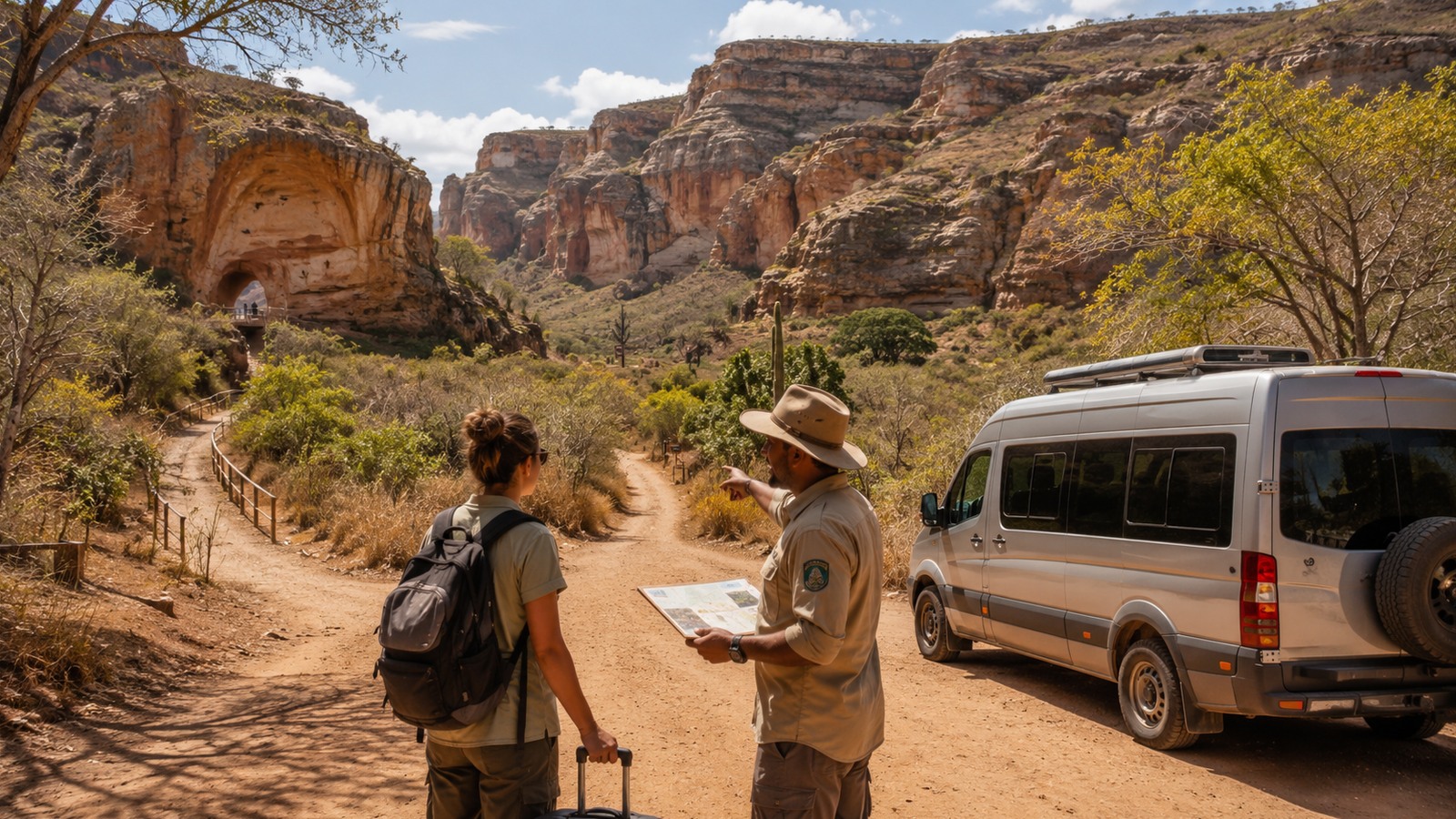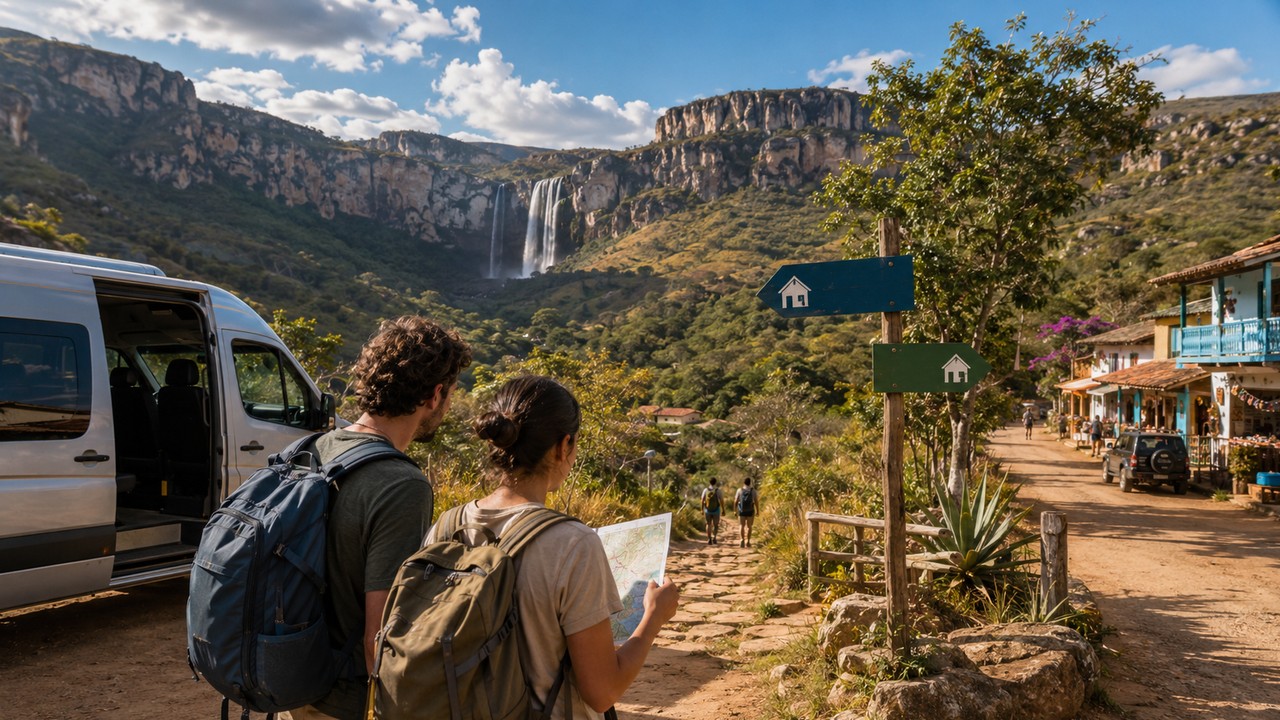
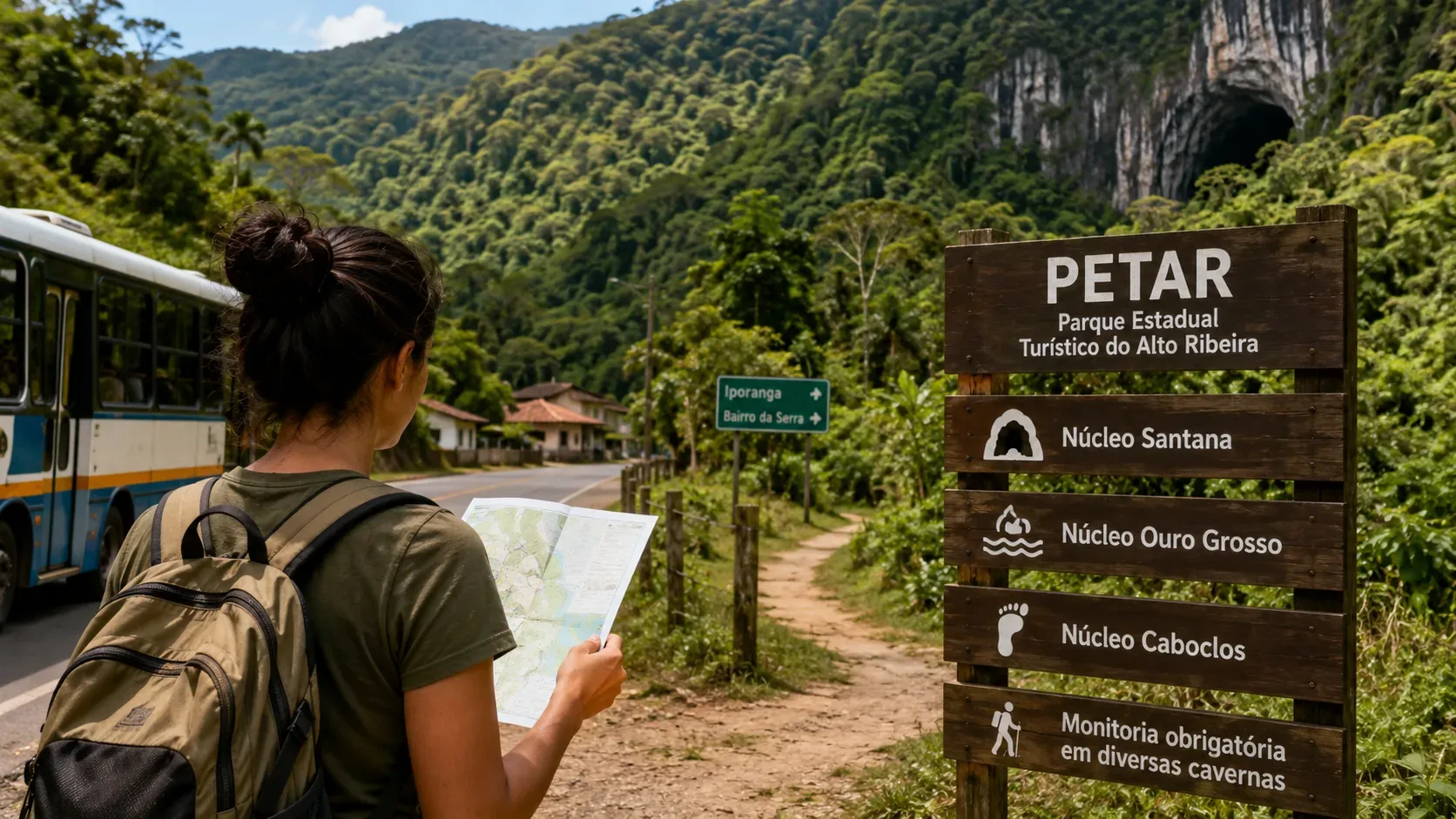
If you are visiting PETAR without a car and plan to focus on the park's most popular attractions, Bairro da Serra is usually the most practical base. It sits along the SP-165 corridor where the Santana and Ouro Grosso nuclei are located, reducing the need for daily transfers from central Iporanga. Iporanga itself works better when urban services matter, when Casa de Pedra is a major part of the itinerary, or when you prefer to reach town first and then arrange a transfer, taxi or agency transport.
The key point is that “getting to PETAR” and “getting to the park nuclei” are different tasks. Even travelers who reach Iporanga or Apiaí by bus still need to solve the last leg to their accommodation and, for several routes, to the gate or trailhead. If you are not driving, that should be arranged before the trip.
Short answer: choose your base by nucleus, not only by town
| Base | Advantage without a car | Limitation | Best use |
|---|---|---|---|
| Bairro da Serra | On the same corridor as Santana and Ouro Grosso, with accommodation, guides and operators focused on PETAR. | You still need transport for some attractions and for nuclei outside this axis. | First visit focused on caves, Santana and Ouro Grosso. |
| Iporanga | Urban services and better positioning for Casa de Pedra. | The town center is not next to Santana or Ouro Grosso; daily transport to those nuclei must be arranged. | Itineraries including Casa de Pedra, a more urban stay or arrival through town. |
| Apiaí | Can be useful as an arrival point and for access toward Caboclos. | Not the simplest base for several days in Santana/Ouro Grosso. | Caboclos-focused trips or bus connections ending in Apiaí. |
Why Bairro da Serra makes Santana and Ouro Grosso easier
The official guide lists Santana nucleus at SP-165 km 159, in the Serra area of Iporanga. Ouro Grosso nucleus is on the same road at km 156. The guide itself describes Ouro Grosso as being in the Betari River valley, in Bairro da Serra, a community with activities connected to guiding, lodging and camping.
In practice, this makes Bairro da Serra the most efficient choice for reducing taxi and transfer costs. It does not mean every attraction is walkable: entry times, terrain, trail length and the return after a hike make it risky to assume that staying in the neighborhood eliminates all logistics. The real advantage is shortening the distance to the main visitor corridor and making local guide and transport arrangements easier.
Santana includes caves and trails such as Caverna Santana, Morro Preto, Água Suja and Trilha do Betary. Ouro Grosso includes attractions such as the Ouro Grosso and Alambari de Baixo caves. For a first car-free trip, those two nuclei can usually fill two days without changing base.
When Iporanga is the better base
Central Iporanga can be more convenient if you want groceries, restaurants and town services, or if Casa de Pedra nucleus is a major priority. The official page states that the Casa de Pedra base is 10 km from Iporanga.
But Iporanga should not be treated as if it were right at Santana's gate. Local access information points to roughly 16 km between town and the Santana/Ouro Grosso corridor. Without a car, that changes the budget: a seemingly convenient stay downtown may require paid transport every park day.
Choose Iporanga when the itinerary justifies the town. If most of the trip is centered on Santana and Ouro Grosso, Bairro da Serra usually reduces the number of transfers.
Caboclos should be planned as a separate logistics day
Caboclos nucleus is officially accessed via SP-250 and Estrada do Espírito Santo, in the municipality of Apiaí. It should not be treated as simply another nucleus near Bairro da Serra.
Some attractions also involve long internal movements. The Caverna Temimina trail, for example, lists its access gate 6 km from the Caboclos entrance, while the Cachoeira Maximiliano trail notes that part of the route can be done by car. For a traveler without a vehicle, Caboclos is precisely the day when a pre-arranged transfer or a guide service that includes transport is most likely to be worth the cost.
If Caboclos is a priority, build the day around it from the start instead of trying to improvise transport on the morning of the hike.
Getting to PETAR without a car: solve the last mile before departure
You can reach the region by intercity bus, but the road journey alone does not solve park access. Services are sold to towns in the Ribeira Valley and through Apiaí/Iporanga, but timetables and connections change. PETAR does not operate a regular tourist shuttle linking bus stations, lodging and park nuclei.
The safest plan is to split the trip into two reservations:
- arrival in the region: intercity bus to the point that best matches your itinerary;
- last mile: taxi, accommodation transfer, agency transport or a guide who also provides transport.
Do not depend on a tight same-day connection without direct confirmation. In a rural region, a bus delay can make you miss a trail time or entry window. For cave itineraries, sleeping near your base the night before is much more robust than arriving in the morning and trying to continue directly to the nucleus.
When a guide is actually mandatory
Guiding is not a single rule for every trail. The São Paulo state parks regulation allows a protected area to require environmental monitors on specific routes. When a guide is mandatory and the park does not provide its own service, visitors hire a registered independent environmental monitor or an authorized organization directly.
| Attraction | Nucleus | Guiding in the official guide |
|---|---|---|
| Caverna Santana | Santana | Mandatory |
| Caverna Morro Preto | Santana | Mandatory |
| Trilha do Betary | Santana | Mandatory |
| Mirante do Vale do Rio Betari | Santana | Self-guided |
| Cachoeira do Couto | Santana | Self-guided |
| Caverna Alambari de Baixo | Ouro Grosso | Mandatory |
| Caverna Temimina | Caboclos | Mandatory |
| Portal da Casa de Pedra | Casa de Pedra | Mandatory |
| Circuito Casa de Pedra | Casa de Pedra | Self-guided |
The practical consequence for car-free travelers is important: mandatory guiding and transport are two separate needs, but one provider may solve both when that service is offered. Before booking, confirm whether the price covers only trail guidance or also pickup at your lodging, transport to the gate and return.
When guide-plus-transport packages are worth it
Drivers can easily separate guiding from transportation. Without a car, a combined service tends to be most valuable in four cases:
- your first day, before you know local distances;
- Caboclos, because of its separate access and internal distances;
- Casa de Pedra, if you are not staying in Iporanga or near the base;
- routes with early entry windows, where improvised transport increases the chance of missing a booking.
For Santana and Ouro Grosso, staying in Bairro da Serra can make arrangements simpler. Even so, ask your accommodation or guide how you will actually reach the meeting point. “Near the nucleus” does not mean “no vehicle needed” for every excursion.
Booking, tickets and opening hours: what to confirm
When checked on August 31, 2026, the official pages for Santana, Ouro Grosso, Caboclos and Casa de Pedra all indicated advance booking, opening from 8 a.m. to 5 p.m. Tuesday through Sunday, and a R$19 admission price for Brazilian visitors. Individual trails, however, can have their own departure windows and daily visitor limits.
The official PETAR page in the Protected Areas Guide is the safest place to recheck nucleus status, ticketing and updated links. Park admission should not be confused with guide service: when guiding is mandatory, it may be contracted separately.
Because caves and trails can face restrictions due to rain, river levels, maintenance or safety, confirm the itinerary shortly before travel. A good car-free booking should specify not only the attraction, but also who takes you to the start, where the meeting point is and what happens if the park changes visitation conditions.
A simple three-day car-free itinerary
- Day 0 — arrival: reach the region and sleep in Bairro da Serra if Santana/Ouro Grosso are your main focus. Avoid relying on a same-morning bus connection for the first excursion.
- Day 1 — Santana: reserve a route that matches your fitness and confirm whether guiding is mandatory. Arrange departure from your lodging in advance.
- Day 2 — Ouro Grosso: keep the same base and choose a nucleus route such as Alambari de Baixo, with a guide where required.
- Day 3 — logistics choice: Casa de Pedra if you have a transfer to the base; Caboclos only if dedicated transport is already arranged. Otherwise, repeating a route in the Santana/Ouro Grosso corridor is better than building a fragile transfer plan.
Checklist before buying your bus ticket
- Decide which nuclei you really want to visit first.
- If Santana and Ouro Grosso dominate the itinerary, prioritize lodging in Bairro da Serra.
- If Casa de Pedra and town services matter more, consider Iporanga.
- For Caboclos, treat transport as part of the excursion.
- Check the official guide to see whether each attraction requires an environmental monitor.
- Book park admission and guide separately when necessary.
- Get written confirmation of whether transport is included and where pickup and return take place.
- Recheck times, rain conditions and nucleus operations the day before.
In short: PETAR without a car is feasible, but it works best when accommodation is chosen according to the geography of the nuclei and transportation is treated as something to book, not improvise. For most first-time cave-focused visitors, Bairro da Serra is the most efficient base; Iporanga becomes stronger when Casa de Pedra and urban services are central to the itinerary.