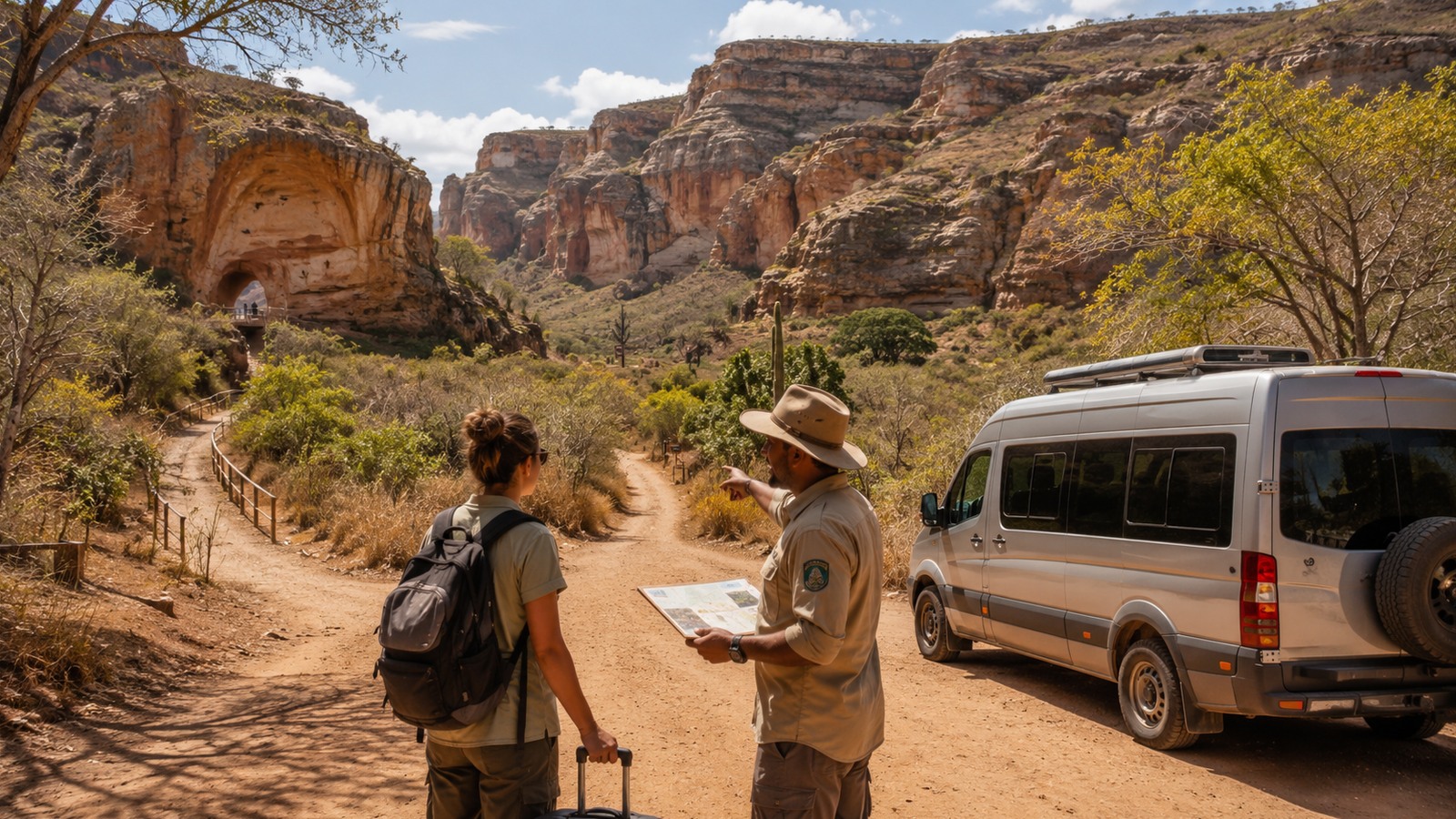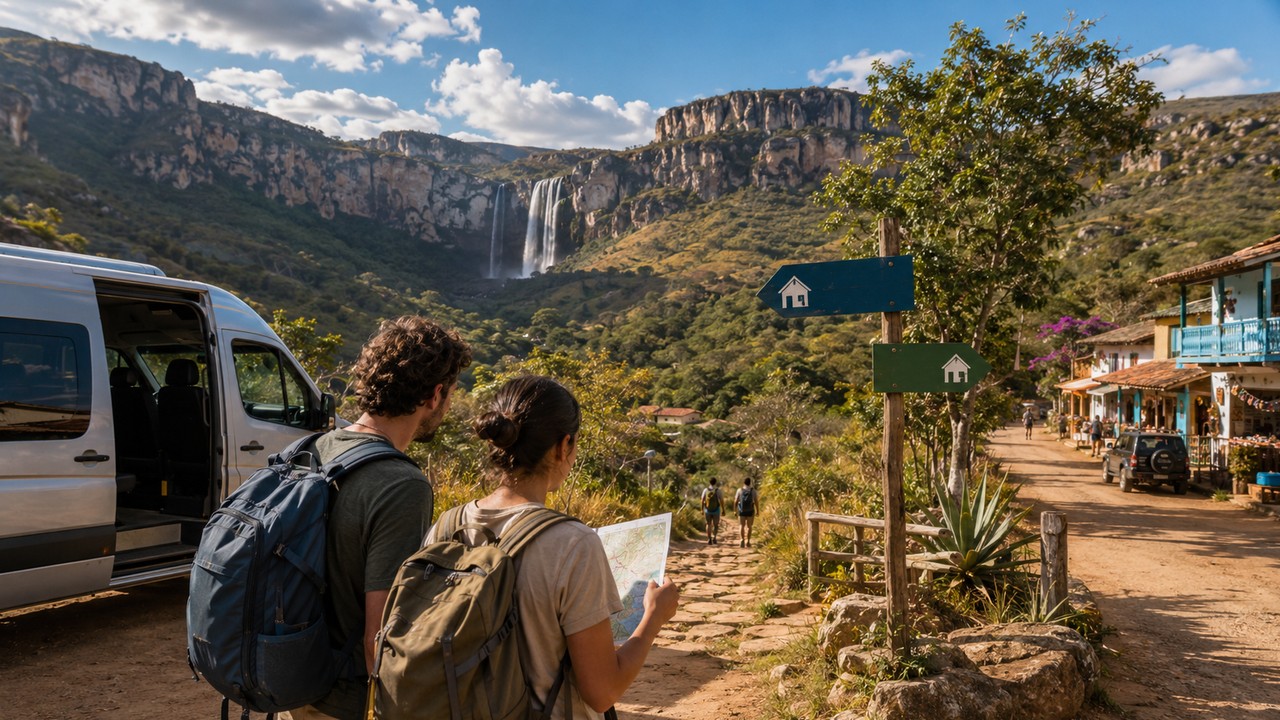
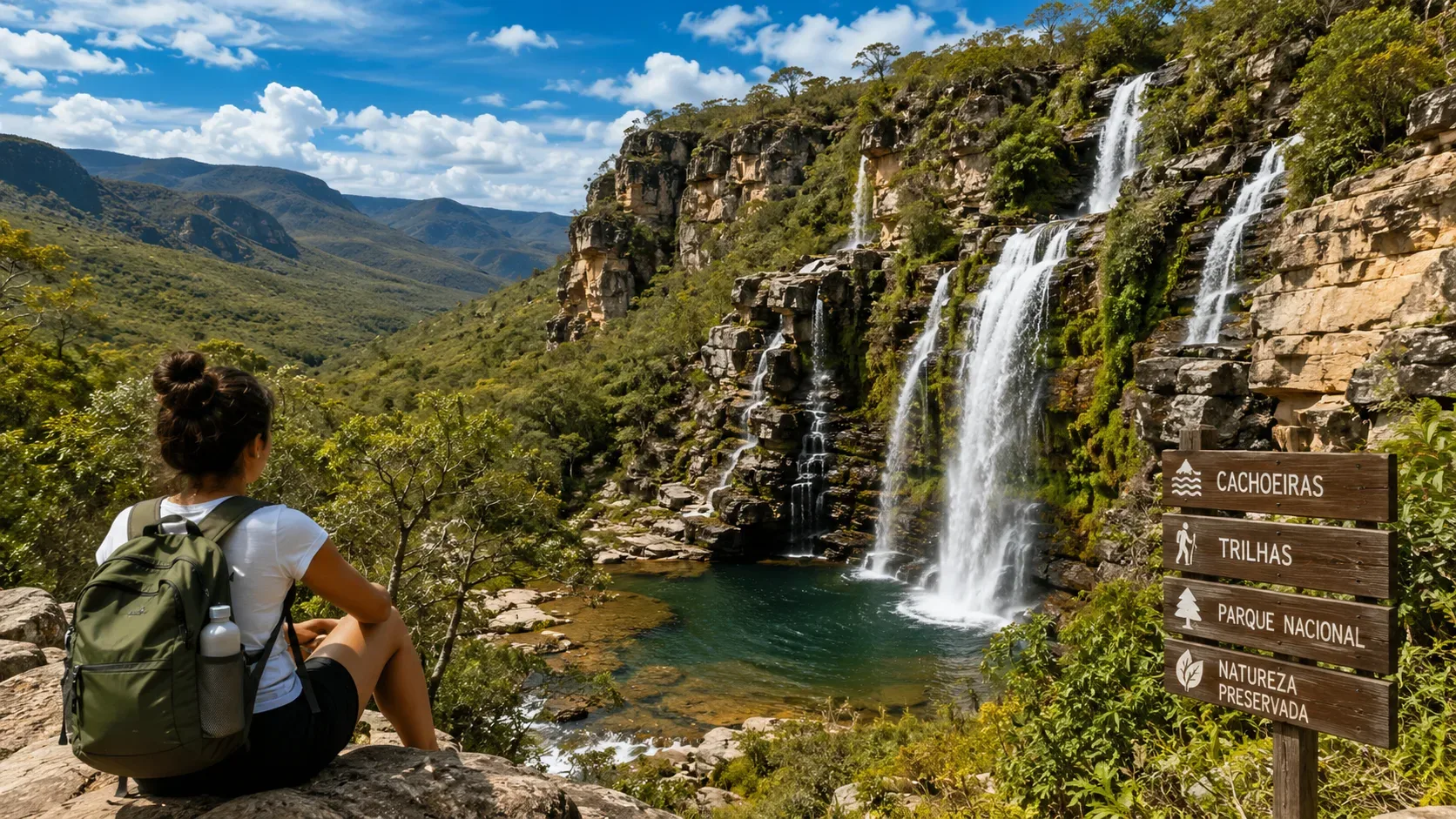
Short answer: Serra do Cipó works without a car, but not as a destination where you arrive by bus and spend the day hopping from waterfall to waterfall. The most efficient plan is to use the Serra do Cipó district (Cardeal Mota) as your base, stay close to the MG-010 corridor and book a taxi/transfer for access roads that branch away from it. This lets you combine attractions almost directly on the highway with one or two days inside the National Park without driving.
Where to stay without a car: Cardeal Mota is the most practical base
For a first trip without your own vehicle, the best base is the urban center of the Serra do Cipó district, also widely known by its former name, Cardeal Mota. A local transport guide describes the built-up stretch along MG-010 roughly between km 95 and 100 and lists bus-stop landmarks along this corridor. This is where most shops, restaurants, accommodation and access points to well-known attractions are concentrated.
When choosing a guesthouse, do not stop at an address that simply says “Serra do Cipó.” Ask for the MG-010 kilometer marker, the actual distance to the highway and whether the property can arrange a taxi/transfer. Without a car, a difference of 3 or 4 km can completely change the trip logistics.
- Km 97–99: the best compromise for restaurants, services and short trips within the urban center.
- Near km 95: better for Cachoeira Grande and the lower end of the district.
- Near km 100: better for Véu da Noiva and minimizes the trip to that waterfall.
Santana do Riacho (the municipal seat) and Lapinha da Serra, however, are different bases. Lapinha is excellent for a trip focused on the village itself, but the final access includes an unpaved road and requires a planned taxi/local ride, so it is not the most efficient base for visiting the park gates and waterfalls around Cardeal Mota.
How to travel from Belo Horizonte to Serra do Cipó by bus
Saritur operates the Belo Horizonte–Serra do Cipó route, departing from Belo Horizonte’s bus terminal and listing the Serra do Cipó arrival as a local boarding/drop-off point. Because the district does not work like a city with one central bus station, confirm before traveling which drop-off point is closest to your accommodation.
A local guide records landmark stops along MG-010, including Cachoeira Grande, the central area and Véu da Noiva. Treat that list as local guidance, not an operating guarantee: schedules, routes and stops may change. The best procedure is to confirm the ticket with the operator and send your expected arrival time to the property so staff can indicate the most convenient stop.
- Buy or confirm a ticket to “Serra do Cipó.”
- Ask your accommodation for its exact kilometer marker and best drop-off point.
- Confirm with the bus company whether that stop can be used on your service.
- If you arrive at night or with heavy luggage, pre-book a taxi.
Access matrix: what you can do without a transfer and what needs a local ride
The key distinction is between reaching the entrance gate and doing the trail. Inside the National Park, the official distances below start at the gate. Arriving tired after several extra kilometers of road walking can turn a manageable trail into an unnecessarily long day.
| Attraction | Access to the entrance | After the entrance | Without a car? |
|---|---|---|---|
| Cachoeira Grande | Entrance on MG-010 at km 95, according to the official Minas Gerais tourism portal. | A local attraction guide reports roughly 1 km on foot from the gate to the waterfall. | Yes, with planning. It is one of the best choices if you stay near km 95 or can get dropped nearby. From the central district, a short taxi ride may be more comfortable than walking beside the highway. |
| Véu da Noiva | Entrance at km 100 of MG-010; the Minas Gerais tourism portal places it about 3 km from the district’s central square. | A short internal trail and paid access on private property. | Yes, especially if you stay near km 100. From the center, a short taxi may be preferable to relying on a highway walk. |
| National Park – Areias Gate | The park access road branches off MG-010; a federal tourism publication describes about 4 km of paved access to the headquarters/gate. | The ICMBio Attraction Menu lists, from the Areias Gate: Lakes Circuit 2 km each way, Mirante do Bem 2.2 km, Capão dos Palmitos 5 km, Farofa Waterfall 8 km and Bandeirinhas Canyon 12 km. | A transfer is strongly recommended. Adding the access road to the trail wastes energy, especially for Farofa or the canyon. Arrange both drop-off and pickup time at the gate. |
| National Park – Retiro Gate | The gate lies away from the main MG-010 corridor on local streets/roads; the park’s own official page keeps a specific “How to get there – Retiro Gate” link. | According to ICMBio: Bambuzal 2.2 km each way; Gavião and Andorinhas 7 km; Tombador 11 km. | A transfer is recommended. You may be relatively close in urban terms, but starting a 14–22 km round trip after a long approach on foot is not the best strategy. |
| Serra Morena | The Minas Gerais tourism portal instructs visitors to turn near km 104 and continue about 5 km on an unpaved road to the gate. | An internal walk leads to the waterfalls on private property. | In practice, you need a taxi/transfer. Do not assume scheduled public transport will take you to the gate after the dirt-road section. |
| Lapinha da Serra | This is a separate tourism village. Local Lapinha sources describe access via Santana do Riacho with an unpaved final section. | Its attractions start from the village and follow a different travel logic from Serra do Cipó/Cardeal Mota. | Possible without a car only with transport arranged in advance. It works better as its own stay than as an improvised day trip from Cardeal Mota. |
The National Park distances above are gate-to-attraction, one way. ICMBio’s own material also gives round-trip totals and estimated times. Trail, river and operating conditions can change, so confirm current status before leaving.
Why the Areias Gate is where a transfer is most worthwhile
Areias concentrates some of the National Park’s most popular routes. The problem without a car is not the trail itself: it is reaching the gate after already adding several road kilometers to your legs. Farofa Waterfall, for example, is 8 km from the gate and ICMBio estimates 16 km round trip, with walking or cycling possible on permitted sections. Bandeirinhas Canyon reaches 24 km round trip.
The smartest use of your transport budget is therefore to pay for the guesthouse-to-gate section and save your energy for the park. If you want to use a bicycle, confirm in advance whether rentals are available and whether your chosen route allows cycling as far as you intend; do not assume equipment will be waiting at the entrance.
Retiro: close on the map, but do not treat the approach as “free” mileage
The Retiro Gate serves the Bocaina Valley. The official National Park website keeps the Attraction Menu and “How to get there” links for both Areias and Retiro. Official material lists 14 km round trip for Gavião and Andorinhas and 22 km for Tombador.
If your goal is only Bambuzal, walking the approach may be acceptable depending on your guesthouse location and road conditions. For Gavião, Andorinhas or Tombador, a transfer is the safer logistical choice: it reduces total mileage, lets you start earlier and avoids finishing a long hike while still trying to find transport.
Park timing matters even more when you depend on transport
ICMBio’s Attraction Menu sets latest entry times by route: 12:00 for Bandeirinhas Canyon and Tombador; 14:00 for Farofa, Capão dos Palmitos, Gavião and Andorinhas; and 16:00 for Mirante do Bem, Lakes Circuit and Bambuzal, with everyone required to leave the park by 18:00. The Serra do Cipó Tourism Region page also currently lists the attractions served by the Areias and Retiro gates.
Operational rules can change because of rain, fire risk, maintenance or management decisions, so confirm the day before through the park’s channels. On a car-free trip, do this before paying for a transfer, because a gate change or attraction closure alters the whole day.
A 3-day car-free itinerary that does not depend on improvisation
Day 1: arrival + an MG-010 corridor attraction
Get off near your accommodation, leave your luggage and choose Cachoeira Grande or Véu da Noiva based on the kilometer marker where you are staying. Do not try to walk to both just because they look close on a map; assess the highway section and use a short taxi ride if needed.
Day 2: National Park through Areias Gate
Book an early transfer. For moderate fitness, Farofa is the most obvious full-day route; for a lighter day, choose Lakes Circuit, Mirante do Bem or Capão dos Palmitos according to your fitness level and the park’s current conditions. Schedule the pickup with a buffer before closing time.
Day 3: Retiro or Serra Morena
Choose Retiro if your priority is hiking inside the National Park; choose Serra Morena if you prefer a private waterfall reached after a dirt-road approach. In both cases, pre-arranged local transport avoids relying on last-minute availability.
When traveling without a car stops being worthwhile
The plan becomes inefficient if you want to visit many distant waterfalls in a few days, switch attractions spontaneously, make day trips to Lapinha/Tabuleiro/other areas or travel as a large group with lots of luggage. In that profile, several rides can cost as much as a dedicated transport solution.
But for a two- to four-day trip with one base in Cardeal Mota, intercity bus + well-located accommodation + one or two transfers is a fully workable combination.
Checklist before booking
- Choose accommodation by its real kilometer/location, not only by the name “Serra do Cipó.”
- Confirm the Belo Horizonte–Serra do Cipó bus directly with the operator.
- Ask the property for the best drop-off point and whether it can arrange a reliable local taxi.
- Book a transfer for Areias, Retiro or Serra Morena when they are part of your plan.
- Check opening status, gate and latest entry time through the park’s official channel.
- Carry water, food, sun protection and an offline map; do not rely on cell coverage to call your ride back.
- In the rainy season, treat flash-flood risk as a reason to change plans, not as a minor detail.
So, is Serra do Cipó worth visiting without a car?
Yes. The trip works well if you concentrate your stay in Cardeal Mota and accept that “without a car” does not mean “without local transport.” Cachoeira Grande and Véu da Noiva can require little logistics when your accommodation is well positioned; Areias, Retiro and Serra Morena are where a transfer turns a tiring or uncertain day into a predictable itinerary. The mistake is to book a distant guesthouse, arrive by bus and only then discover that the trail starts several kilometers beyond the pavement.