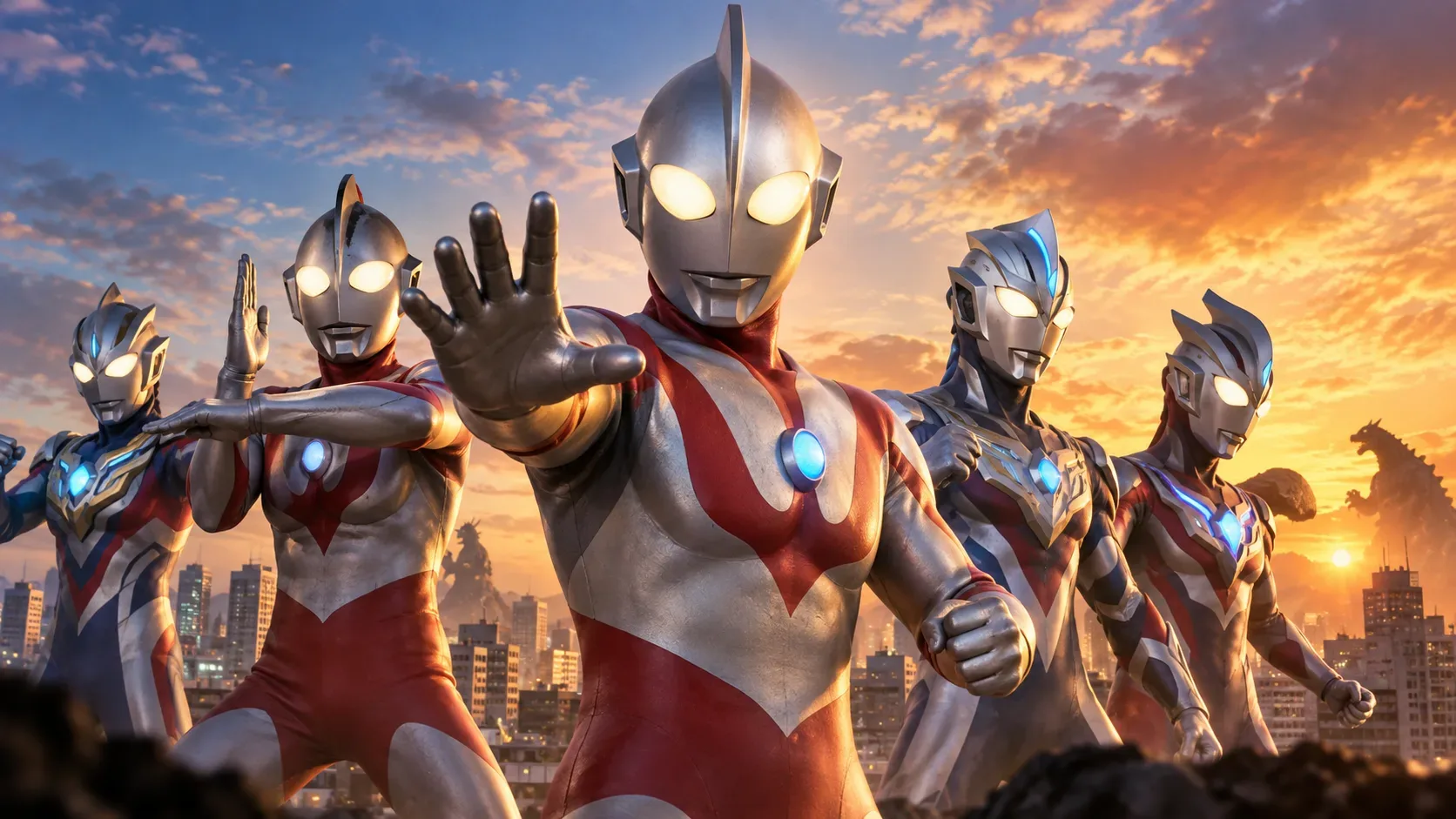
Short answer: you do not need to watch Ultraman from 1966 onward or follow one single chronology to understand the franchise. The most practical way to start is to choose a series that matches your taste: the founding classic, a more serious science fiction show, the major Heisei revival, a modern accessible entry point, or a recent series with very little continuity baggage.
The franchise's own history supports this approach. The classic shows gradually developed more connections, while many Heisei titles created worlds of their own. In the New Generation period, which began with Ultraman Ginga in 2013 according to Tsuburaya Productions, new heroes often debut in settings that can be followed without a previous marathon. So the more useful question is not “what is the complete order?”, but “which Ultraman fits what I want to watch right now?”.
Five entry points into Ultraman
| Series | Era | Length | Tone | Continuity required | Start here if... |
|---|---|---|---|---|---|
| Ultraman (1966) | Classic / Showa | 39 episodes, about 25 min each | Science fiction adventure, monster of the week stories, and the franchise's original formula | None | you want to understand the foundation and are comfortable with 1960s television pacing |
| Ultraseven (1967) | Classic / Showa | 48 episodes in the current global catalog, about 25 min each | More austere science fiction, alien invasions, and planetary defense conflicts | Very low | you want the classic period but prefer a more cerebral science fiction angle |
| Ultraman Tiga (1996) | Heisei | 52 episodes, about 24 min each | Franchise revival, defense team drama, ancient mystery, and ensemble storytelling | None to begin | you want a long, complete series that represents the franchise's 1990s modernization |
| Ultraman Z (2020) | New Generation | 25 episodes, about 25 min each | Fast action, humor, defense robots, and references to earlier heroes | Low | you want a modern, short, easy to follow entry point |
| Ultraman Blazar (2023) | New Generation | 25 episodes | More realistic science fiction, military kaiju response, and an adult protagonist | Very low | you are wary of franchise baggage and want a recent show with its own identity |
1. Ultraman (1966): start with the original formula
Ultraman from 1966 has 39 episodes with an average running time of 25 minutes in Tsuburaya's official global catalog. The premise already contains almost everything that would become recognizable across the franchise: a scientific team investigating strange phenomena, monster and alien threats, a human bonded to a Giant of Light, and battles that combine special effects, adventure, and science fiction.
This is the clearest entry point for viewers who want to recognize the franchise's original grammar instead of jumping directly to a modern reinterpretation. It does require some tolerance for 1960s pacing, performance styles, and television conventions. The SagaList Showa guide also treats Ultraman as the most direct starting point rather than recommending Ultra Q, the earlier black and white monster anthology that does not feature a title Ultraman hero.
2. Ultraseven (1967): classic Ultraman for science fiction fans
Ultraseven shifts the focus to the Ultra Guard and confrontations with alien life in a setting shaped by interstellar conflict. Tsuburaya's current global page lists 48 episodes with an average running time of 25 minutes. Some historical lists use a different count, so it is worth checking which catalog is being used when you encounter conflicting numbers.
As an entry point, Ultraseven is especially useful for viewers who associate tokusatsu with science fiction ideas, invasion paranoia, military decisions, and more serious dilemmas. SagaList describes it as nearly standalone and suggests that someone who does not connect with the pacing of 1966 Ultraman can begin here without losing the essentials. The heavier links of the classic shared universe matter more in later series, so there is no need to study the Ultra Brothers family tree before episode one.
3. Ultraman Tiga (1996): the major Heisei entry point
Ultraman Tiga arrived in 1996 with 52 episodes of about 24 minutes each. The show repositioned Ultraman for a new generation by combining a defense team, technology, contemporary threats, and an ancient civilization mystery tied to Tiga himself.
For newcomers, the key advantage is independence. The SagaList Heisei guide notes that Tiga takes place in its own universe and requires no Showa knowledge. That means you can watch the season as a complete story and, if you want to continue in that specific continuity, move on to Ultraman Dyna, the direct sequel set years later.
Choose Tiga if you want to feel the clear transition between classic television and a more modern style, but still prefer a long season with room to develop its team, world, and changes in tone.
4. Ultraman Z (2020): the compact modern entry point
Ultraman Z runs for 25 episodes of about 25 minutes each. Its setup combines Haruki Natsukawa, Ultraman Z, and the anti monster force STORAGE, which uses giant robots to respond to recurring threats. The result delivers action, humor, team dynamics, and the franchise's contemporary visual language without demanding dozens of episodes.
There are connections to earlier characters and concepts. The official synopsis itself introduces Z as Ultraman Zero's disciple, and SagaList notes that an important link to Ultraman Orb works more as a reward for returning viewers than as a barrier for newcomers. That is why the continuity is “low” rather than nonexistent: you can tell that a larger universe exists, but the main story remains understandable.
Start with Z if your priority is to test Ultraman through a short season, current pacing, and a broad mix of action before deciding whether to explore older titles.
5. Ultraman Blazar (2023): enter with very little franchise baggage
Ultraman Blazar has 25 episodes and follows Gento Hiruma, captain of the SKaRD unit, in a world where kaiju disasters are an institutional defense problem. In the series' global announcement, Tsuburaya said that Blazar marked ten years of the New Generation line and would explore a “completely different” style from earlier entries. Lead director Kiyotaka Taguchi also described the project as an attempt at realistic science fiction.
That framing helps viewers who assume Ultraman requires decades of names, families, combinations, and crossovers. Blazar still carries the franchise's identity, but its situation, team, and hero are introduced from within the show itself. It is a strong fit for viewers who want a recent production, an adult protagonist, and a kaiju defense approach that feels like a starting point rather than chapter twenty of a larger saga.
Do I need to choose an era before I start?
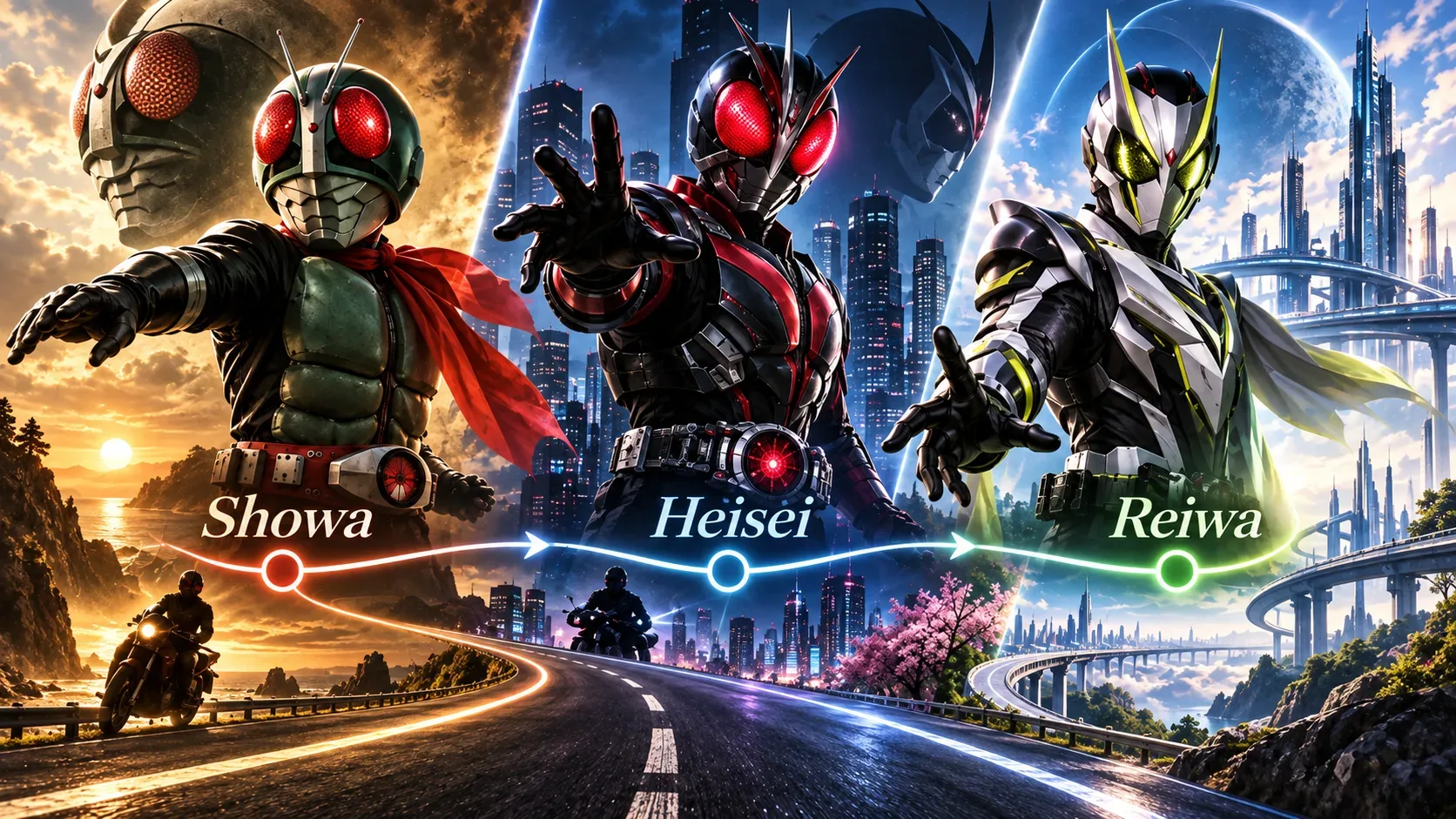
No. “Showa”, “Heisei”, and “New Generation” are useful labels for production periods and creative trends, but they do not operate as three seasons of one uninterrupted story. In the classic period, shared continuity becomes stronger in later shows. In the Heisei period, several titles build separate worlds. In New Generation, Tsuburaya itself uses the name for the line that began with Ginga in 2013, but that does not turn every show into one linear narrative.
A common beginner mistake is treating the franchise as if everything earlier must be completed first. For these five entry points, the practical fact is simpler: Ultraman, Ultraseven, Tiga, Z, and Blazar all introduce their basic situation to their own viewers.
What to watch after each entry point
- If you started with Ultraman (1966): continue to Ultraseven, then notice how Return of Ultraman more clearly binds the classic heroes into a shared universe.
- If you started with Ultraseven: you can go back to 1966 Ultraman or move forward through the classic block. Ultraman Leo gains extra value after Ultraseven.
- If you started with Tiga: Ultraman Dyna is the most natural direct continuation. Ultraman Gaia follows in production history but belongs to another universe.
- If you started with Z: Ultraman Orb adds context to one character connection, while other New Generation series can be selected by style without committing to a total order.
- If you started with Blazar: Z provides a useful contrast with a New Generation series that is more visibly linked to earlier legacies; you can also continue with other recent standalone friendly titles without rewinding through the entire franchise.
Final shortcut: which of the five fits you?
- I want the origin: Ultraman (1966).
- I want classic Ultraman with more science fiction: Ultraseven.
- I want a major Heisei season: Ultraman Tiga.
- I want a modern, short, accessible series: Ultraman Z.
- I want something recent, more realistic, and light on baggage: Ultraman Blazar.
This profile based choice solves the main problem facing newcomers: Ultraman is huge, but it does not have to be consumed as one queue. Pick one of these five shows, finish it or sample a few episodes, then use its connections as paths for further exploration.