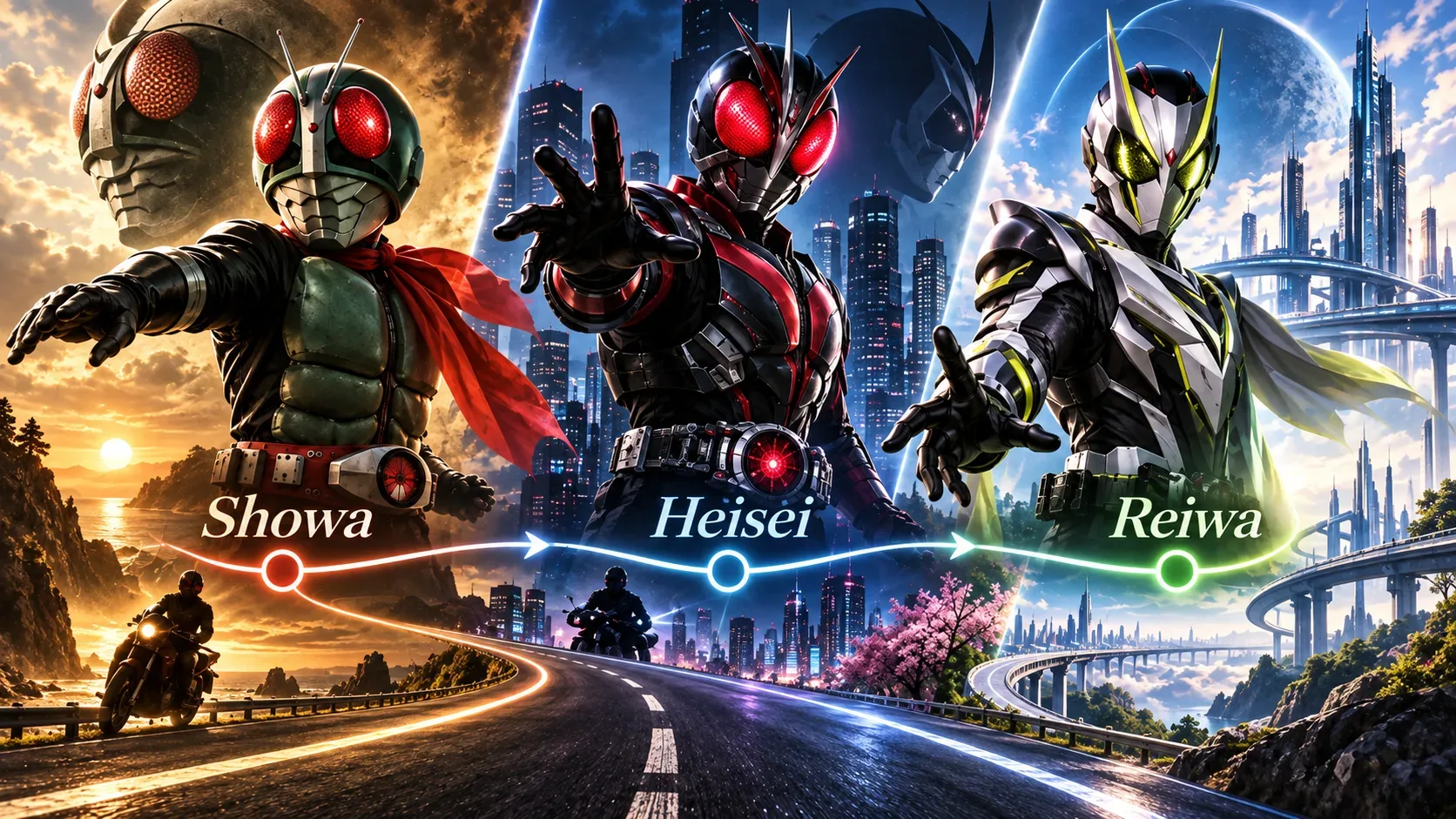
You do not need to watch Kamen Rider from 1971 onward to understand the franchise. The practical rule is almost the opposite: choose a series that matches the kind of story you want, and treat the Showa, Heisei and Reiwa eras as entry doors rather than a mandatory queue. SagaList groups 37 series and more than 1,700 episodes and makes the same key point: almost every television season works as a self-contained story with a new cast, new villains and a new premise.
The short answer: where should you start?
If you want a fast recommendation, four paths cover very different tastes:
- Kamen Rider BLACK if you want the classic era without necessarily starting with the 1971 show.
- Kamen Rider Kuuga if you want a more grounded drama with police investigation and a modern rebuilding of the formula.
- Kamen Rider W if you want a balanced entry point with mystery, humor, local cases and an easy-to-follow mythology of its own.
- Kamen Rider Zero-One or Kamen Rider Geats if you want more recent visual language and concepts that are immediately clear.
Your choice depends more on your taste than on chronology. The main trap is treating an anniversary season packed with references to older Riders as the ideal first sample of the franchise.
The era map in 60 seconds
| Era | Television reference | What you will usually find | Good entry point |
|---|---|---|---|
| Showa | From the original 1971 series through BLACK RX, which ended in 1989 | Classic hero formula, recurring monsters, practical effects and the pacing of an earlier television era | Kamen Rider BLACK or the original series |
| Heisei | From Kuuga in 2000 through Zi-O in 2019 | More serialization, personal conflicts, investigation, multiple Riders and a wide range of tones | Kuuga or W |
| Reiwa | Starting with Zero-One in 2019 | More recent production, strong season-by-season concepts, larger casts and faster action | Zero-One or Geats |
The division is useful, but there is a historical nuance. Kamen Rider BLACK RX aired from October 1988 to September 1989, so it crossed the change of Japanese calendar era. Even so, Toei's own official guide commonly describes it as the last Showa Rider. Kamen Rider Kuuga, which aired from January 2000 to January 2001, marked the return of a regular television series after BLACK RX ended.
If you want classic Kamen Rider
There are two simple ways into the Showa era. The first is to go to the origin: Kamen Rider, broadcast from 1971 to 1973 for 98 episodes. It establishes foundational elements such as a transformed hero fighting a secret organization and the iconography of a Rider on a motorcycle. It is the best choice if you want to see how the language of the franchise was born and you are comfortable with episodic pacing typical of early 1970s Japanese television.
The second is to start with Kamen Rider BLACK, broadcast from 1987 to 1988 for 51 episodes. The premise of Kotaro Minami, transformed by the Gorgom organization and tied to Shadow Moon, delivers a more concentrated narrative and an aesthetic that is often easier for a modern newcomer to absorb. If you like it, BLACK RX is the logical next step because it is a direct sequel with the same protagonist.
If you want a more serious drama and a sense of a fresh start
Kuuga is one of the most natural choices. Toei identifies it as the first Kamen Rider television series of the Heisei phase. The story follows Yusuke Godai and the police as they face the Grongi, with investigation, victims, consequences and a gradual progression of powers. That makes Kuuga a strong entry for viewers who prefer a grounded story before moving into seasons with larger casts, more elaborate transformation systems and many Riders at once.
It also has a structural advantage: it was produced as a new television beginning, not as a season that requires detailed memory of the Showa phase. You get historical context without homework.
If you want the most balanced entry point
Kamen Rider W, broadcast from 2009 to 2010 for 49 episodes, is a very accessible Heisei option. The series revolves around the city of Fuuto, a detective agency and the duo Shotaro and Philip, who transform into a single Rider. Its format combines relatively self-contained cases with a larger plot about the Gaia Memories.
That helps viewers who are still learning the franchise's grammar. You get transformations, forms, monsters, investigation, comedy and drama without depending on another season. It is also a good bridge between the more grounded style of early Heisei and the later phase, where visual concepts and item systems become even more prominent.
If you want something modern from episode one
Kamen Rider Zero-One opened the Reiwa phase in September 2019. Its starting point involves artificial intelligence, robotics and a technology company, so the core concept is easy to identify immediately. For anyone who wants to discover Kamen Rider through a recent production, it works as a clean era marker.
Another option is Kamen Rider Geats, broadcast from 2022 to 2023. Its premise places participants in a game called the Desire Grand Prix, with Riders competing and facing threats through successive stages. It is a suitable entry point for viewers who enjoy competition, mystery, twists and action governed by explicit rules.
Starting in Reiwa does not force you to jump back to Heisei or Showa immediately. If one season works for you, use what you liked about it as the filter for choosing the next one.
Which series are better saved for later?
Two seasons deserve special attention because they were built as legacy celebrations.
- Kamen Rider Decade: the story travels through nine parallel worlds connected to earlier Heisei Riders. You can understand its basic plot without seeing everything, but many ideas work better when you recognize the material being remixed.
- Kamen Rider Zi-O: the official synopsis itself describes the protagonist meeting past Heisei Riders while traveling across franchise history. As a first season, it presents many references before you have the background to fully enjoy them.
BLACK RX is also not the most logical first stop if you intend to follow Kotaro Minami's story, because Toei presents it as a sequel to BLACK. In that specific pair, order really does matter.
Reunion movies, anniversary specials and large crossovers can wait until after your first series. They are not required to find out whether the franchise works for you.
Release order is not a mandatory watch order
Toei's official timeline is excellent for seeing when each production appeared, but that does not mean a beginner needs to reproduce that sequence. In an anthology franchise, production chronology and best entry point solve different problems.
Use this decision map:
- Want to understand the origin? Start with the 1971 Kamen Rider.
- Want a classic series with a more concentrated narrative? Start with BLACK.
- Want serious drama and a historically important reboot? Start with Kuuga.
- Want a balance of cases, characters and a mythology of its own? Start with W.
- Want technology and the beginning of the Reiwa phase? Start with Zero-One.
- Want competition, mystery and modern pacing? Start with Geats.
What should you watch after your first season?
After finishing one series, follow the feature that interested you most. If you liked BLACK, continue directly to BLACK RX. If you liked Kuuga's tone, explore other early Heisei titles. If W was your entry point, try other independent series from the same broad phase without following a rigid sequence. If Zero-One or Geats worked best for you, keep moving through Reiwa as a collection of different premises.
This method keeps the franchise from turning into a task list. You build context gradually and only seek out anniversary seasons when you already have enough references for the returns and callbacks to carry more weight.
A simple starting point if you are still undecided
If you have no clear preference, W is an efficient middle ground. If the classic aesthetic is part of the appeal, BLACK is a practical shortcut into Showa. If you want the most important rebuilding of the franchise for modern television, Kuuga is the most direct choice. And if your goal is to see how Kamen Rider works in a recent production, Zero-One or Geats will do that without requiring an earlier marathon.
The central point is simple: Kamen Rider does not need to be watched as one single story of more than a thousand episodes. The eras organize the history of the brand, but the best entry point is the season whose tone and premise make you want to watch the next episode.
Sources and criteria for this guide
Dates, episode counts and cited premises were checked against Toei's official Kamen Rider Web and its timeline. The observation that the franchise is largely self-contained was also checked against the SagaList guide. The entry-point suggestions are editorial recommendations based on structure, continuity dependence and type of experience, not an official viewing order.