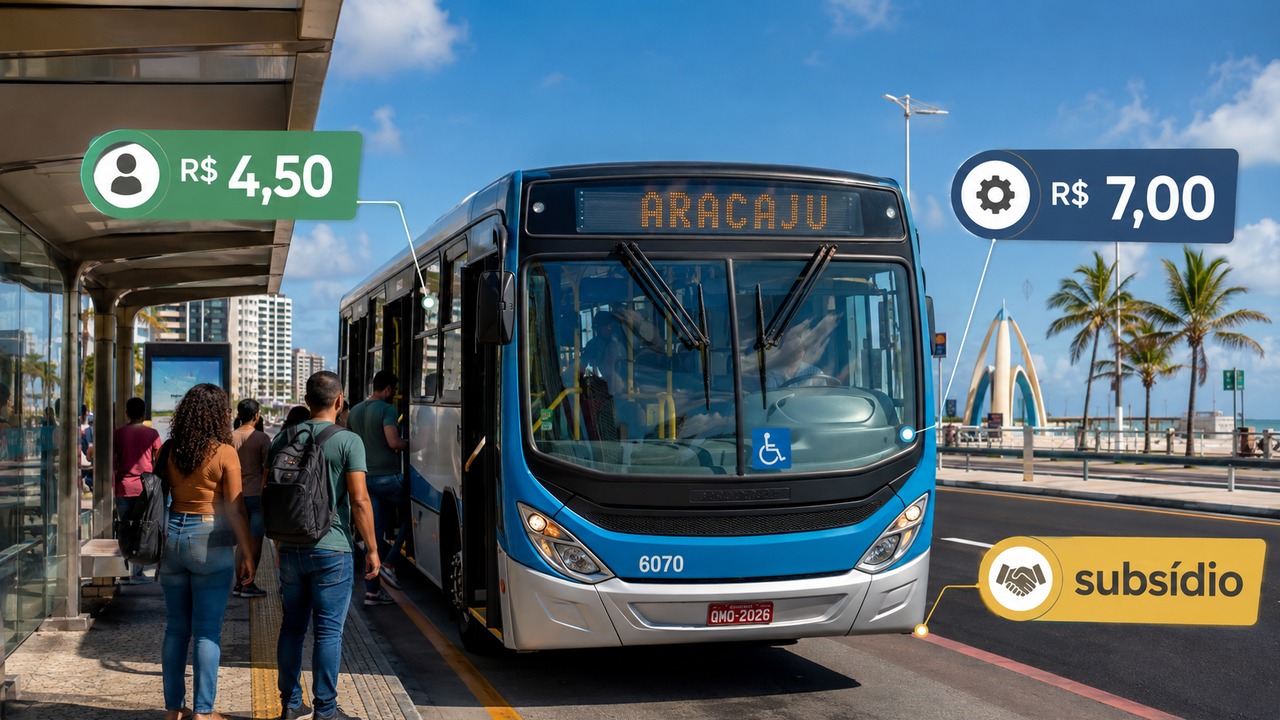
In 2026, the bus fare in Aracaju is R$ 4.50 for passengers. This is the public fare, meaning the amount actually charged to the user. The R$ 7.00 figure that also appears in news reports and documents is not a new passenger fare: it corresponds to the technical fare adopted by the City Hall as a reference for operating the system. The difference between the two amounts is supported by a public subsidy.
Resolution No. 01/2026 of the Municipal Superintendence of Transport and Traffic of Aracaju, known as SMTT, updated the fare subsidy per equivalent passenger for the period from February 1 to December 31, 2026. When announcing the measure, the City Hall stated that it kept the passenger fare at R$ 4.50 and set the technical fare at R$ 7.00.
How much passengers pay in Aracaju in 2026
For anyone who simply needs to know how much to load onto a transit card or include in the budget for a regular trip, the answer is R$ 4.50. This is the amount published by the City Hall for public transport fares in 2026.
Keeping the price unchanged had already been announced at the beginning of the year and was reaffirmed when SMTT updated the subsidy in March. In an institutional communication published in July 2026, the City Hall continued to cite the frozen fare of R$ 4.50. Therefore, as of this reporting in August 2026, there is no official indication that a regular passenger should pay R$ 7.00.
The point that causes confusion is that the system works with more than one amount at the same time. One is the amount paid out of the user’s pocket. Another represents the economic reference used to remunerate and sustain the operation.
Why R$ 4.50 and R$ 7.00 appear at the same time
The National Urban Mobility Policy, established by Law No. 12,587/2012, distinguishes the public fare from the service remuneration fare. The public fare is the price charged to the user. Remuneration, in turn, may be made up of that price plus revenue from other sources, precisely to cover the service provided and the operator’s remuneration.
In the material published by the City Hall of Aracaju, the R$ 7.00 amount is called the technical fare and is presented as the real operating cost per passenger. In practice, it works as an economic reference for the system and not as the price that should be charged directly to someone boarding a bus.
This allows the public administration to maintain a lower fare policy for users even when the recognized cost of the service is higher. That is why R$ 4.50 and R$ 7.00 can both be correct at the same time, as long as each amount is understood according to its role.
R$ 7.00 is not the new passenger fare
The most important point is not to turn the technical fare into the turnstile fare. The City Hall explicitly stated that it set the technical fare at R$ 7.00 while maintaining R$ 4.50 for users.
There was also a third amount in the discussion: R$ 8.49. According to the City Hall, this was the technical fare amount proposed by the Union of Passenger Transport Companies of the Municipality of Aracaju, Setransp. The municipal administration stated that, after analysis, it did not adopt that figure and set R$ 7.00 instead.
Thus, the three figures have different meanings. R$ 4.50 is the price paid by the passenger; R$ 7.00 is the technical fare set by the Municipality; and R$ 8.49 was the amount proposed by the companies, not the fare approved for users.
Where the fare subsidy comes in
When the public fare is below the remuneration fare or the technical reference used by the system, a gap appears that must be financed from another source. Law No. 12,587/2012 itself defines the fare deficit or subsidy as the shortfall between the remuneration fare and the public fare charged to the user.
In Aracaju, the nominal difference between R$ 7.00 and R$ 4.50 is R$ 2.50. This calculation helps illustrate why the subsidy needed to be expanded in 2026. It does not mean, however, that there is a hidden R$ 2.50 charge to passengers. Users continue to pay the public fare of R$ 4.50; the remainder is handled through the system’s funding model.
Resolution No. 01/2026 deals with updating the subsidy per equivalent passenger. This expression matters because the administrative calculation should not be confused with simply multiplying the R$ 2.50 difference by the gross number of boardings. Free rides, transfers, equivalent passengers and other calculation rules in the system can affect how transfers are accounted for.
For that reason, understanding the total cost of the subsidy in the municipal budget would require consulting data on equivalent passengers and the transfers actually made during the period. For the question of how much the fare costs the user, this step does not change the answer: R$ 4.50.
What changed compared with 2025
The comparison with 2025 helps explain why the word “subsidy” gained more prominence in 2026. SMTT Resolution No. 01/2025 kept the single user fare at R$ 4.50. For February through December 2025, the document set a fare subsidy of R$ 1.50 per equivalent passenger. The City Hall later reported that the technical fare then in force was R$ 6.00.
In 2026, the public fare remained at R$ 4.50, but the technical fare was raised to R$ 7.00. The nominal difference between the two amounts therefore rose from R$ 1.50 to R$ 2.50. Instead of passing that increase on to passengers, the Municipality announced an expansion of the subsidy.
That is the central point of the change: there was an adjustment in the recognized cost of the system and in the public financing required to keep the price paid by users unchanged, but there was no increase in the public fare to R$ 7.00.
Why the technical fare rose to R$ 7.00
When announcing the decision, the City Hall attributed the revision to a combination of costs. Factors cited included the 5.5% wage adjustment granted to public transport workers on the category’s annual adjustment date, as well as fuel, fleet maintenance, parts, onboard technology, free rides and administrative expenses.
The administration also stated that it hired the Economic Research Institute Foundation, Fipe, to guide the review of the calculations, with a focus on the sustainability of the system and affordable fares. This does not mean that each component increased by the same proportion; these are the factors presented by the Municipality to explain the update to the technical amount.
The companies’ proposal reached R$ 8.49, according to the City Hall, and did not consider the inclusion of electric buses in the system. After analysis, the Municipality set the amount at R$ 7.00. This difference between the requested amount and the amount adopted also helps explain why different news reports may show figures that seem contradictory.
How to read each amount without confusion
If you saw R$ 4.50
This is the relevant amount for a regular passenger. It is the public fare maintained in 2026 and the price that should be used as the reference when the question is how much the bus fare costs.
If you saw R$ 7.00
This is the technical fare set by the City Hall. It is used to express the economic reference for the operation and does not automatically replace the R$ 4.50 fare charged to users.
If you saw R$ 8.49
This figure appeared as the proposal submitted by Setransp for the technical fare. The City Hall stated that it did not adopt it and set the technical amount at R$ 7.00.
If you saw the word subsidy
It indicates that part of public transport funding does not come directly from the fare paid at the turnstile. The public authority uses other revenue to cover the difference and keep the price paid by users below the technical amount recognized for the system.
Until when does the R$ 4.50 fare apply?
Resolution No. 01/2026 updates the fare subsidy for the period from February 1 to December 31, 2026. The City Hall presented this measure as a mechanism for keeping the public fare at R$ 4.50 during the period, and later institutional communications continued to record that amount.
If the information is checked after December 31, 2026, or if a new SMTT act is issued before that date, the most recent rule should be verified. Fares and subsidies are volatile information and may be changed by a new administrative decision.
The short answer for anyone taking the bus
In Aracaju in 2026, passengers pay R$ 4.50. The R$ 7.00 amount corresponds to the technical fare, not a new passenger fare. The nominal R$ 2.50 difference helps show the size of the portion that was not passed directly on to users and instead became supported by the system’s subsidy mechanism.
When different amounts appear in a news report, the most useful question is: is this figure the public fare charged to the passenger, the system’s technical fare, or a proposal that has not been adopted? In the case of Aracaju in 2026, making that distinction resolves the apparent contradiction.