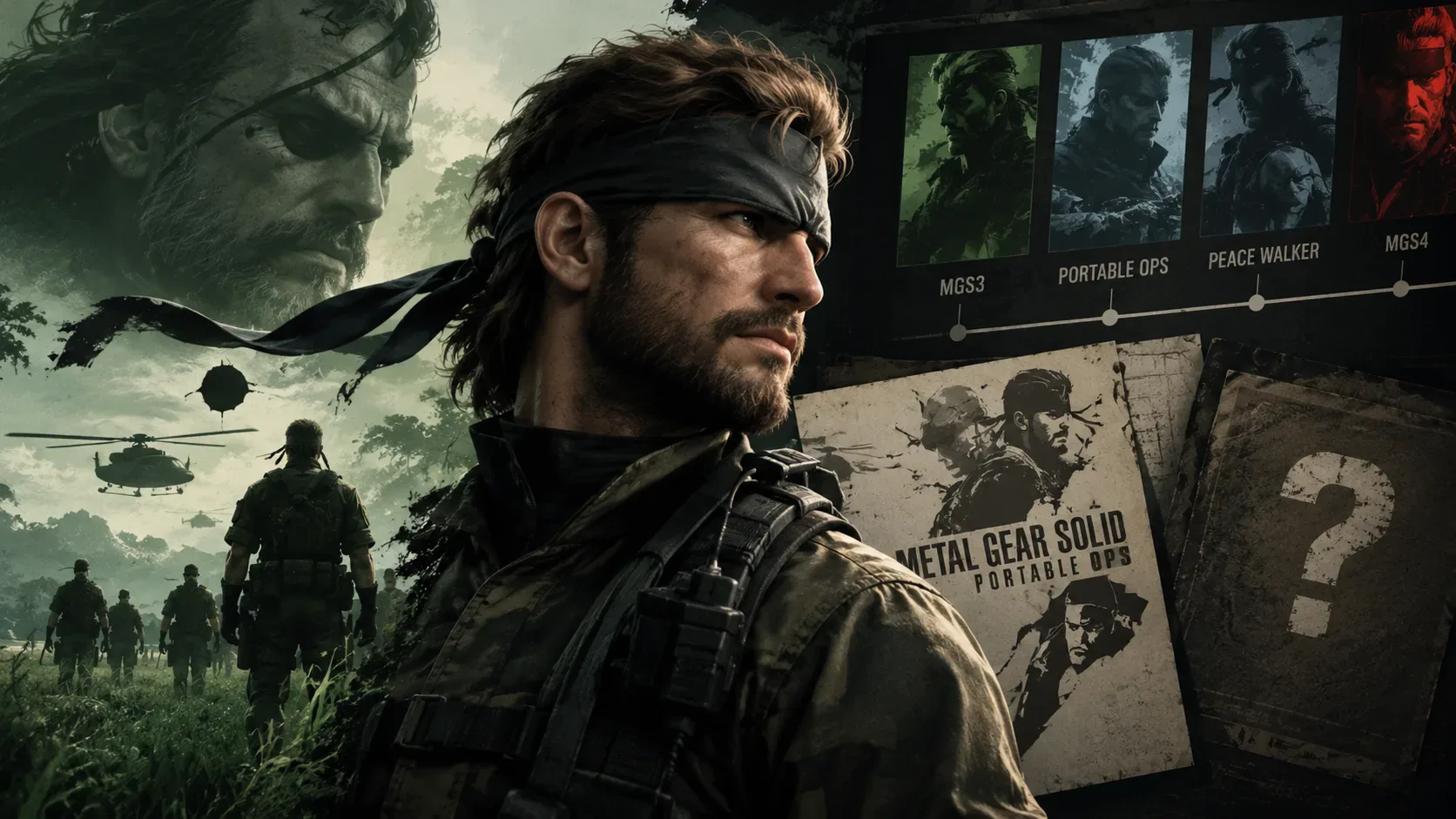
Short answer: calling Metal Gear Solid: Portable Ops “completely non-canon” is more categorical than the official sources allow. Konami still maintains official support pages in which the 1970 San Hieronymo incident explicitly appears as Metal Gear Solid: Portable Ops. At the same time, current Metal Gear Solid: Master Collection Vol. 2 material places Metal Gear Solid 4 and Peace Walker at the center of the saga and leaves Portable Ops out of the collection. The safest reading is to separate three questions: whether the events are acknowledged, whether the game is essential to follow the story, and whether every detail in the game carries the same canonical weight.
What Konami directly confirms
The clearest official evidence in favor of Portable Ops comes from Konami itself. The support page “Backstory: What is the timeline of the events that precede Metal Gear Solid V” includes 1970, identifies the game by name and summarizes the San Hieronymo incident. In that chronology, Big Boss meets Roy Campbell, faces the FOX Unit rebellion, defeats Gene, and the episode connects to the Philosophers’ Legacy and the future formation of FOXHOUND.
Konami also maintains a dedicated page, “What is the story of Metal Gear Solid: Portable Ops?”, which treats those events as part of the franchise’s backstory. An official Peace Walker page likewise repeats the 1970 Portable Ops events before moving to 1974. That makes it difficult to argue that Konami has simply erased the incident from continuity.
There is an important caveat: these are support materials currently published by Konami, but they should not be treated as a legal declaration or a “constitution of canon.” They show that the company continues to acknowledge the story and its events; they do not say that every detail in Portable Ops takes precedence over any later work.
Why Master Collection Vol. 2 seems to say something else
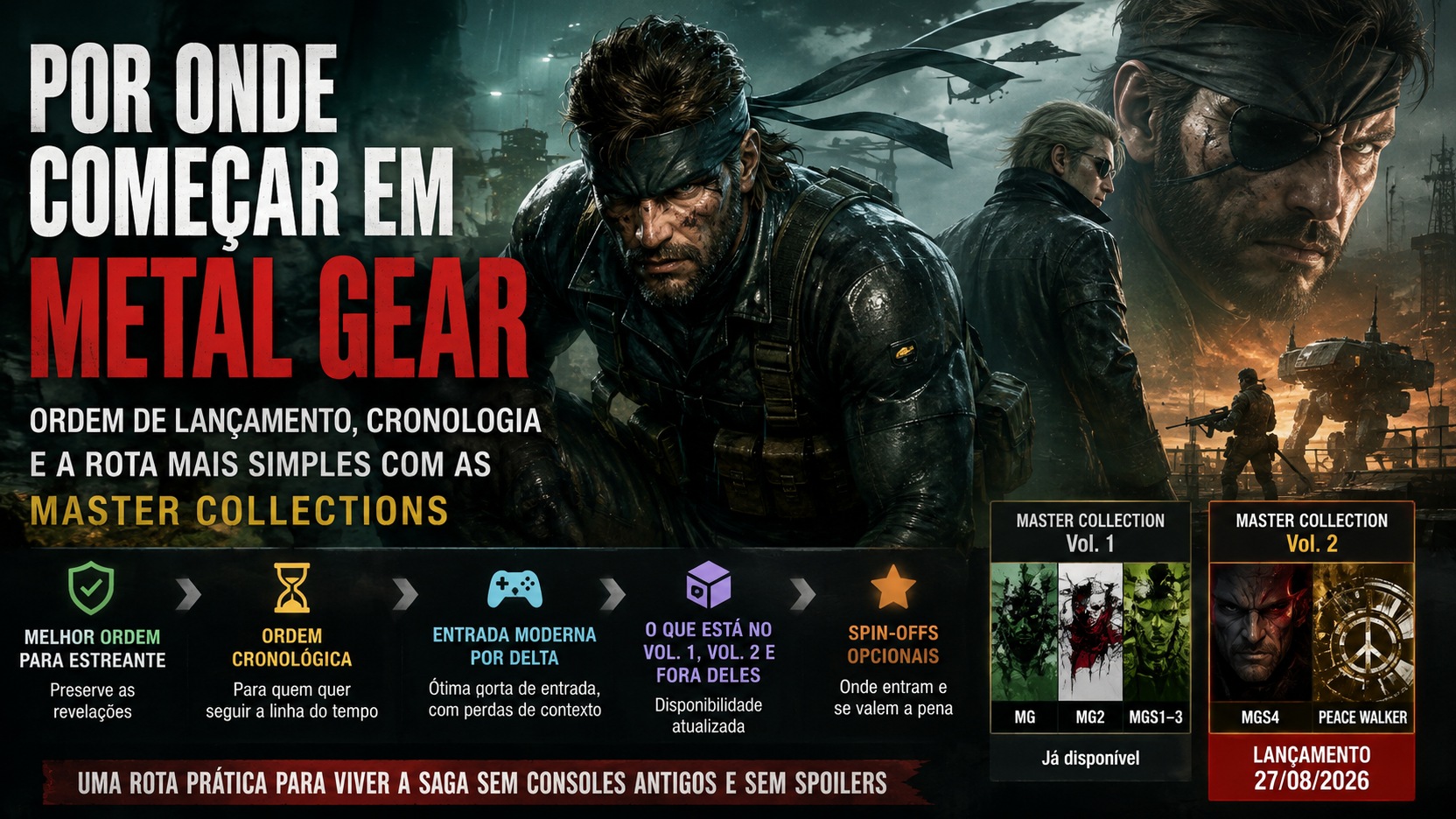
The contrast became more visible in 2026. In the launch announcement for Master Collection Vol. 2, Konami presents Metal Gear Solid 4: Guns of the Patriots and Metal Gear Solid: Peace Walker as the collection’s two central titles. Ghost Babel appears as bonus content and is described as a spin-off. Portable Ops is not on the list.
That omission has editorial weight: it shows which games Konami chose to treat as the main route through this collection. But absence from a collection is not, by itself, an announcement that something has been removed from canon. Vol. 1 already mixed central games and extras, and Vol. 2 includes a non-mainline spin-off as bonus content. Therefore, “it was not included” and “it does not belong to the continuity” are different claims.
After the August 27, 2026 release, players also compared the collection launcher’s timeline with other sources and noted that Portable Ops was absent. That is useful context for understanding the controversy, but it remains an interpretation of an interface: Konami did not publish a note alongside that timeline saying that the San Hieronymo incident had been de-canonized.
The MGS4 Database complicates the answer — but does not settle it by itself
The Metal Gear Solid 4 Database, originally released in 2008, is another reason why the answer “it is not canon” sounds incomplete. The database was built as an encyclopedia of the series and contains references to Portable Ops characters, terms and events, including San Hieronymo. In 2026, Konami again distributed the METAL GEAR SOLID 4 Database as part of Vol. 2.
That confirms that the historical material connecting Portable Ops to MGS4 remains relevant to the series’ official preservation. Even so, a database is a reference work created to organize the lore that existed at a particular point in time. It is strong evidence of acknowledgment, but not necessarily a rule that every detail of every cited game can never later be adjusted, omitted or reinterpreted.
Three different questions that are often mixed together
| Question | What the sources support | Safest reading |
|---|---|---|
| Are the events of Portable Ops acknowledged? | Yes. Official Konami pages still place the game and San Hieronymo in the backstory timeline. | The core incident has not simply been erased. |
| Is Portable Ops essential to follow the saga? | It does not appear to be treated that way today. Vol. 2 prioritizes MGS4 and Peace Walker and works without including Portable Ops. | It is a complementary chapter, not required to understand the main throughline. |
| Is the entire game “fully canon,” detail by detail? | The official sources reviewed do not make that broad claim. | Do not turn acknowledgment of the incident into a guarantee of absolute authority for every detail. |
Where the idea of “semi-canon” or “soft canon” comes from
“Semi-canon” and “soft canon” are fan labels, not official Konami categories. They emerged because Portable Ops sits in an intermediate position: it was presented as a chapter of the saga, elements of it were incorporated into MGS4 material, it appears in backstory timelines, but it is also omitted from some selections and retrospectives that highlight the main games.
Hideo Kojima’s historical comments reinforced that ambiguity. In a 2014 interview, he distinguished the overall plot of Portable Ops from some details that, in his explanation, did not fit the main line perfectly, while also stressing the difference between games he wrote and directed and games on which he served as producer. That comment helps explain the origin of the dispute, but today questions about the franchise’s catalog and continuity should be answered primarily by looking at what Konami actually publishes and preserves.
Does the 2026 launcher omission de-canonize Portable Ops?
There is not enough evidence to say that. A launcher timeline can function as a guide to the titles a company wants to foreground rather than as an exhaustive inventory of every acknowledged event. The inference is even weaker because Konami itself still hosts a backstory chronology that names Portable Ops in 1970.
For an unequivocal de-canonization, stronger evidence would be expected: an official statement saying the incident no longer belongs to continuity, a new explicitly superseding narrative chronology that contradicts it, or a clear rewrite of the same events. The material reviewed through September 1, 2026 does not provide that kind of statement.
What is safe to treat as part of the story
If the goal is to summarize the chronology without overstating certainty, the safest elements are those Konami itself still repeats on official pages: there was a 1970 episode tied to Portable Ops; Big Boss and Roy Campbell become connected; the renegade FOX Unit and Gene belong to that episode; and the story is used as a bridge between the post-Snake Eater period and the phase leading toward Peace Walker.
Very specific details — especially those that come into tension with later biographies, dates or characterizations — deserve more cautious language. At that level, “the core is acknowledged, but not every detail necessarily carries the same weight” is more useful than a simple yes or no.
So, do you need to play Portable Ops?
To understand the backbone of Big Boss’s story, no. You can move from Metal Gear Solid 3 to Peace Walker and then to Metal Gear Solid V without losing the indispensable narrative structure; in practice, that is the route Konami’s modern selection favors.
But Portable Ops adds context for San Hieronymo, Roy Campbell, Gene, the evolution of Big Boss’s army and political ideas that resonate with MGS4. For anyone interested in how the series’ mythology was built — including its revisions and contradictions — it remains a relevant chapter.
The most precise wording in 2026
Instead of saying “Portable Ops is canon” or “Portable Ops is not canon” without qualifications, the most defensible formulation is: Konami continues to acknowledge the main events of Portable Ops within Metal Gear’s backstory, but it does not currently treat the game as an essential chapter of the main route or provide confirmation that every detail has full canonical authority.
That is why the sources seem contradictory. They are answering different questions: the Database and backstory pages preserve events; the Master Collection selects which games to place at the center; and the launcher timeline simplifies the path presented to the player. Once those functions are separated, much of the contradiction disappears.