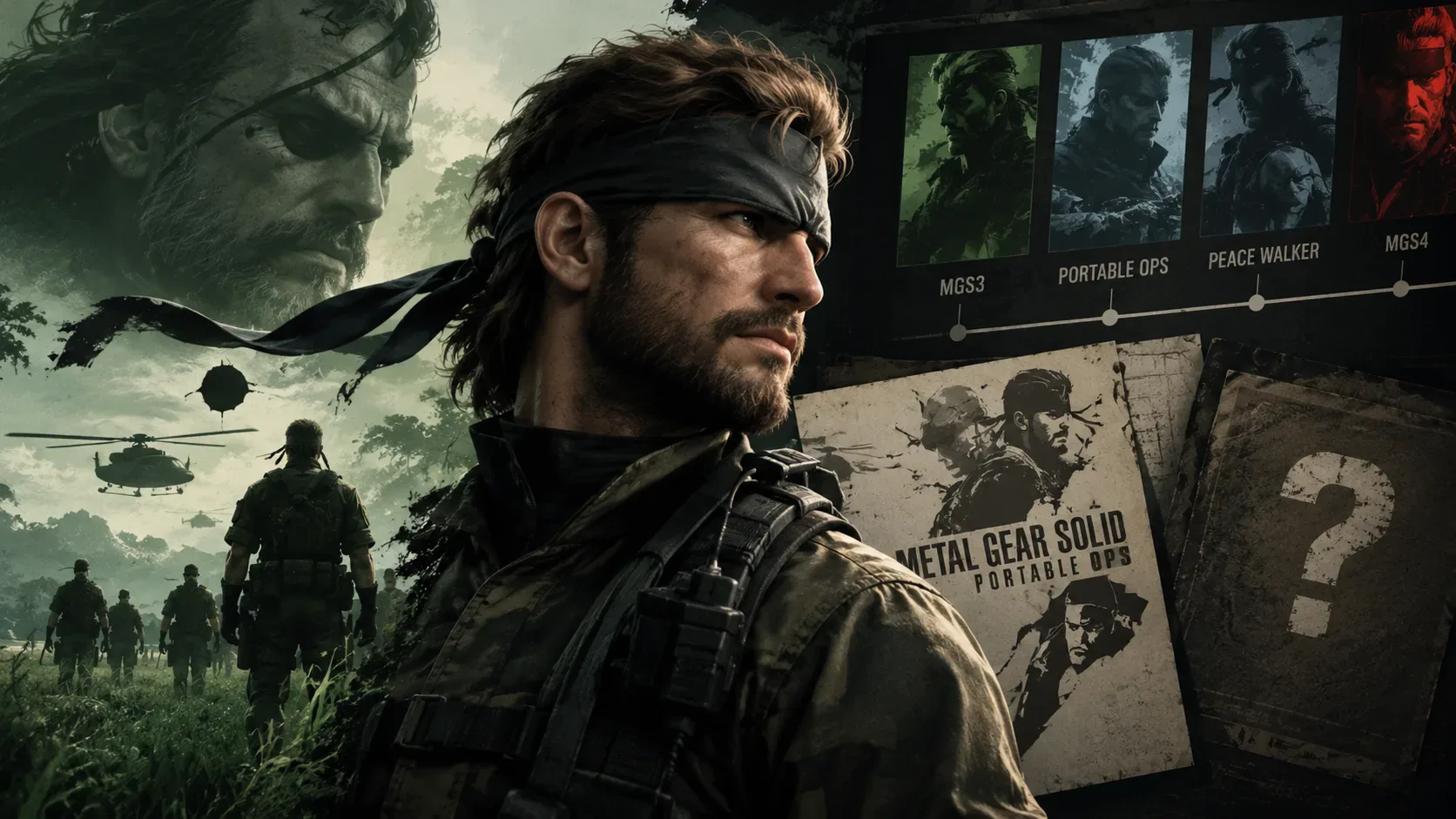
If you've never played Metal Gear and want to follow the story without dismantling the effect of the revelations, the best reference is the release order, not the internal chronology. For most newcomers, the most balanced entry point is Metal Gear Solid, from 1998. Those who tolerate 8-bit games can start earlier, with Metal Gear and Metal Gear 2: Solid Snake, both now included in the Master Collection Vol. 1.
The practical route looks like this: Metal Gear and Metal Gear 2 are recommended, but they can become context reading if the age of the games is a barrier; then come Metal Gear Solid, Metal Gear Solid 2, Metal Gear Solid 3, Metal Gear Solid 4, Peace Walker, Ground Zeroes and The Phantom Pain. This sequence follows the narrative construction of the main line and leaves for later the side titles that are not necessary to understand the central arc.
The best order for those who have never played Metal Gear
There are two correct answers, depending on your tolerance for old games. The most complete answer is to start with 1987's Metal Gear, move on to 1990's Metal Gear 2: Solid Snake, and then enter the Solid phase with Metal Gear Solid. The first two establish events and relationships that MGS1 treats as the known past.
The most practical answer is to start directly with Metal Gear Solid. It already works as a strong gateway to the universe, introducing Solid Snake, the espionage structure and the conflicts that will sustain the sequels. If you skip Metal Gear and Metal Gear 2, it's worth knowing a basic summary of previous events, but there's no need to buy old hardware: both games are in Master Collection Vol. 1.
After MGS1, head to Metal Gear Solid 2: Sons of Liberty. Then play Metal Gear Solid 3: Snake Eater. Although MGS3 takes place before the previous ones within the chronology, it was released later and was built to reinterpret information that the player already knew. This is the main reason not to use the chronology as a first trip through the series.
Following are Metal Gear Solid 4: Guns of the Patriots, Metal Gear Solid: Peace Walker, Metal Gear Solid V: Ground Zeroes and Metal Gear Solid V: The Phantom Pain. MGS4 closes
issues accumulated in the Solid Snake era; Peace Walker returns to Big Boss' past; Ground Zeroes is the direct prologue to The Phantom Pain. Konami itself describes Ground Zeroes as a direct sequel to Peace Walker and sells the two chapters of MGSV together in The Definitive Experience.
Why chronological order is better for replay
The internal chronology looks simpler on paper because it starts in the past and moves into the future. The problem is that Metal Gear uses prequels to change the meaning of previously presented characters, organizations and events. Throwing everything through the timeline the first time rearranges when you receive certain information.
For this reason, the chronological order works better after you already know the saga. In this case, the main sequence can be read like this: Metal Gear Solid 3 or its remake Delta; PeaceWalker; Ground Zeroes; The Phantom Pain; Metal Gear; Metal Gear 2; Metal Gear Solid; Metal Gear Solid 2; Metal Gear Solid 4. Portable Ops can be placed between MGS3 and Peace Walker if you want to expand the Big Boss phase, but it is not essential for the modern route.
Metal Gear Rising: Revengeance comes after MGS4 if the intention is to extend the Raiden line. Konami places its events four years after Guns of the Patriots. It need not be in the path of a beginner who first wants to understand the Snake saga.
What the Master Collection Vol. 1 solves
The Master Collection Vol. 1, released in 2023, covers practically all the bases needed to get started. The main selection features Metal Gear, Metal Gear 2: Solid Snake, Metal Gear Solid with VR Missions or Special Missions, Metal Gear Solid 2: Sons of Liberty in the HD Collection version and Metal Gear Solid 3: Snake Eater also in the HD Collection version.
The package also includes extras such as the version of Metal Gear for NES/Famicom and Snake's Revenge, as well as digital books and graphic novels. For the main route, however, these extras do not change the recommended order. Snake's Revenge can be treated as a historical curiosity, not as an obligatory step before MGS1.
In terms of platform, Vol. 1 is available on Nintendo Switch, PlayStation 4, PlayStation 5, Xbox Series X|S and Steam. This already eliminates the need to search for MSX, PlayStation, PlayStation 2 or older versions of the HD Collection just to start the series.
What the Master Collection Vol. 2 adds in 2026
The big hole in the modern route was Metal Gear Solid 4. For many years, it remained associated with the PlayStation 3. Konami announced Master Collection Vol. 2 for August 27, 2026 and claims that this will be the first port of MGS4 since the original 2008 release.
Vol. 2 brings together Metal Gear Solid 4: Guns of the Patriots and Metal Gear Solid: Peace Walker in the HD Collection version. Metal Gear: Ghost Babel appears as bonus content and is officially presented by Konami as a spin-off. The collection also includes digital materials, soundtrack and the database linked to MGS4.
The platforms announced for Vol. 2 are Nintendo Switch 2, Nintendo Switch, PlayStation 5, Xbox Series X|S and Steam. The official list does not include PlayStation 4. Konami also announced MGS4 and Peace Walker as separate digital purchases, which allows you to complete just the remaining chapters without necessarily purchasing the entire package.
The practical consequence is important: after August 27, 2026, Vol. 1 and Vol. 2 cover Metal Gear, Metal Gear 2, MGS1, MGS2, MGS3, MGS4 and Peace Walker on current platforms. To complete the main route it will still be necessary to search for MGSV outside of the two collections.
What continues outside the two volumes
Metal Gear Solid V: Ground Zeroes and Metal Gear Solid V: The Phantom Pain are not part of the two announced Master Collections. The consolidated alternative continues to be Metal Gear Solid V: The Definitive Experience, a package that brings together Ground Zeroes, The Phantom Pain and their additional content. Konami's official page has versions for PlayStation 4, Xbox One and PC.
For those who want the simplest solution on a single platform, PC via Steam is the most straightforward combination: there's Master Collection Vol. 1, Vol. 2 has been announced for Steam, and MGSV: The Definitive Experience is also available on the service. Delta is sold separately and can be included as an option, but is not necessary to complete the MGS3 story because Vol. 1 already contains the HD version of Snake Eater.
Is it worth starting with Metal Gear Solid Delta: Snake Eater?
It's worth it, but for a different reason. Metal Gear Solid Delta: Snake Eater is a faithful remake of Metal Gear Solid 3, released for PlayStation 5, Xbox Series X|S and Steam in August 2025. Konami has preserved the story, characters, voices, gameplay, and music of the original, while adding modern presentation and an updated control option.
This makes Delta the most comfortable entry point for those who cannot adapt to a 1998 game. But it is not the most neutral entry point into the narrative. As MGS3 was conceived after MGS1 and MGS2, starting with Big Boss's past changes the order in which the player discovers certain relationships and ideas in the series.
If your number one criteria is to preserve the developing experience, start with MGS1 and leave MGS3 or Delta for the third step. If your number one criteria is having modern controls, camera, and presentation to decide if you like the universe, starting with Delta is defensible. In that case, treat it as a replacement for MGS3 and then go back to MGS1 and MGS2 before moving on to MGS4.
Which route to choose without buying old consoles
For a first time, the simplest route is to use the Master Collection Vol. 1 for Metal Gear, Metal Gear 2, MGS1, MGS2 and MGS3; use Master Collection Vol. 2 for MGS4 and Peace Walker; and finish with MGSV: The Definitive Experience for Ground Zeroes and The Phantom Pain. If Metal Gear and Metal Gear 2 are too old for your taste, you can start in MGS1 without dismantling the Solid phase release sequence.
This combination is precisely what changes with Vol. 2. Before it, a legal and current route came up against MGS4, historically tied to the PS3. With the new volume, the biggest gap in the main series now has a version for current platforms, and the purchase of an old console is no longer a requirement for anyone willing to use the official re-releases.
Where spin-offs and optional games come in
Metal Gear: Ghost Babel is a spin-off and comes as a bonus to Vol. 2. It can be played after MGS1 as a side experience, without being necessary to continue the main story.
Metal Gear Solid: Portable Ops takes place after MGS3 and before Peace Walker. Konami's own supporting documentation places it in 1970, six years after the events of Snake Eater. For a first route, however, it may be left for later, especially since it was not announced in either of the two Master Collections.
Metal Gear Rising: Revengeance works better after MGS4. It's a Raiden tie-in sequel set four years after Guns of the Patriots, but its focus and style are different enough to be treated as a complement, not an obligatory step between MGS4 and Peace Walker.
Metal Gear Survive could also be left out of the first trip. Konami describes it as an alternative timeline that starts at the end of Ground Zeroes. It explores a branch of its own and is not necessary to get to The Phantom Pain or understand the main arc.
The ultimate recommendation for a beginner
If you want a single decision and don't intend to study an entire tree before playing, start with Metal Gear Solid in Master Collection Vol. 1. Try Metal Gear and Metal Gear 2 before that if the old graphics and controls are not a problem; otherwise, treat them both as context and come back to them later.
From there, follow MGS2, MGS3, MGS4, Peace Walker, Ground Zeroes and The Phantom Pain. Use Delta over MGS3 if you prefer the modern remake, knowing that it is a presentational replacement, not a new chapter. Leave the pure chronology, Ghost Babel, Portable Ops, Rising and Survive for a second pass or for when any of these branches spark interest.
With Vol. 2 scheduled for August 27, 2026, the hardware barrier decreases significantly: the two Master Collections begin to concentrate the classic part of the main saga, and MGSV completes the path outside of them. For a newcomer, this is today the most direct combination between preservation of revelations, current availability and fewer unnecessary purchases.