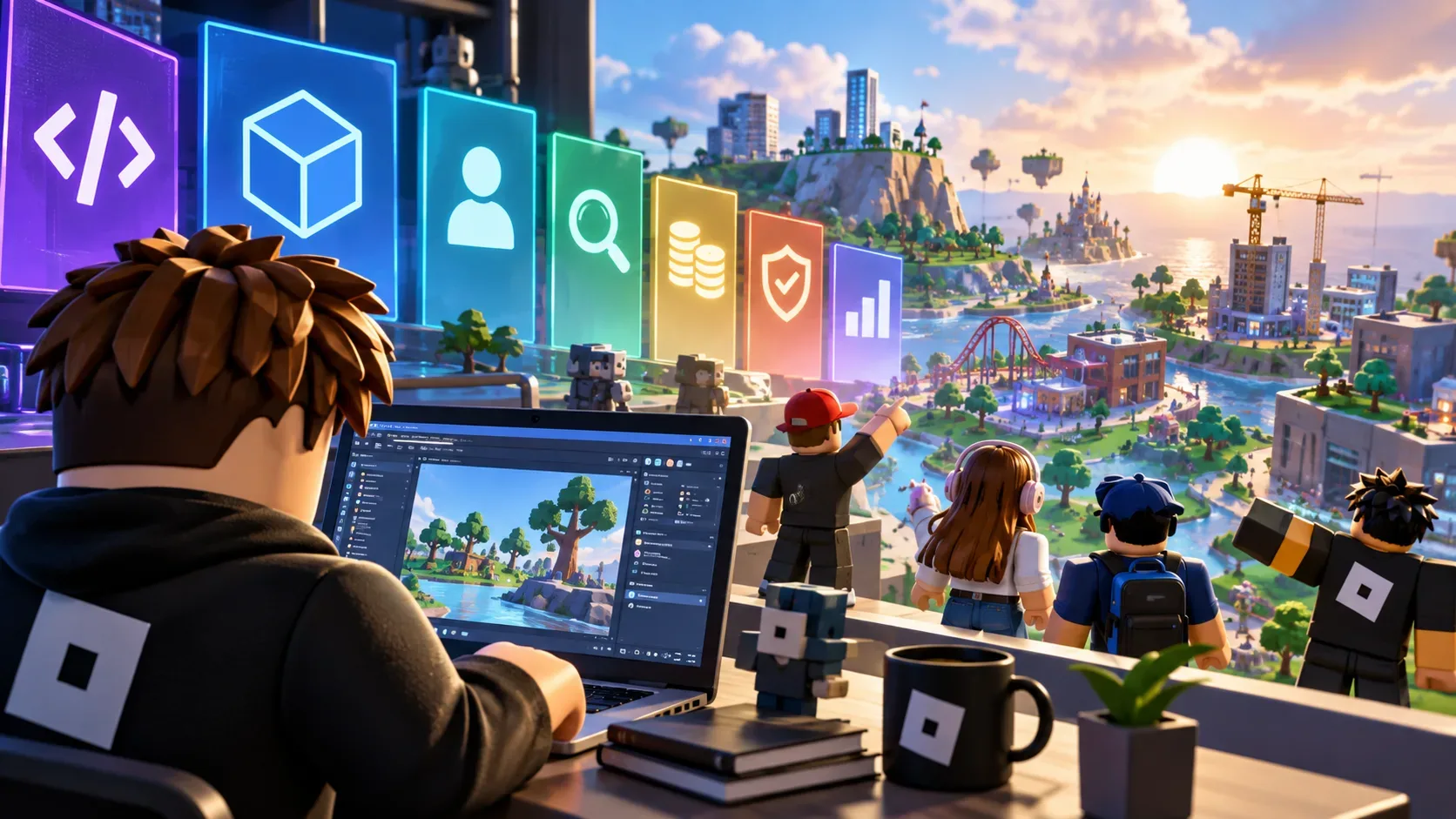
Roblox updated the Creator Roadmap on September 18, 2026 after RDC26 and added 72 items announced during the event. The list spans Studio workflows, engine and rendering, avatars, discovery, monetization, safety, and Creator Hub analytics. The key point for creators is to separate announcements, target windows, and actual availability: many of the additions are planned for late 2026 or for 2027, so they should not be treated as already released features.
In the same update, the company said 47 roadmap items had shipped since the previous update and 32 had their target dates adjusted. On a broader measure, Roblox says it shipped 130 roadmap features since the previous RDC, with 79% delivered on time, and closed 4,401 bugs. The figures and change list are in the official Creator Roadmap 2026: Fall Update post.
What changed in the 2026 roadmap
The update is more than a list of new features. It reorganizes what creators can expect from the platform development cycle across four fronts: new additions, items already shipped, schedule changes, and the incorporation of RDC26 announcements into the public plan.
| Area | New items worth watching | Target window | Practical impact |
|---|---|---|---|
| Studio and workflows | multiple client views, Project Window, Studio teleports, Place branching and merging, early testing, compute functions, and player data improvements | late 2026 to early 2027 | More testing, collaboration, and debugging inside the official creation workflow. |
| Engine and rendering | adaptive streaming, path prefetching, 500-stud minimum draw distance, a new physics solver, new primitives, material upgrades, and terrain improvements | late 2026 to late 2027 | Higher fidelity and scale, with a focus on performance across devices. |
| 2D, UI, and interaction | orthographic camera, 2D particles, animated image containers, UI blur, upgraded gradients, Input Action Manager, and QueueService | late 2026 to 2027 | Broader support for 2D games, richer interfaces, and multiplayer systems. |
| Generative AI | new texture generation, scene generation, and unified permissions for Assistant, MCP, plugins, and OCALE | late 2026 | More prototype automation with more centralized access controls. |
| Avatars | emissive UGC items, in-game makeup creation, procedural bones, motion matching, silhouette-preserving fit, FACS upgrades, and root motion | late 2026 to mid 2027 | More expressive avatars and NPCs with more advanced animation and clothing fit. |
| Discovery and communication | name protection, promotional update text, automatic text-to-speech translation, Dutch support, and customizable quick words | late 2026 | New ways to present experiences and reduce language and communication barriers. |
| Safety and publishing | pre-publish moderation signals, deceptive copy takedowns, Android anti-cheat, Safety Callback API, and streamlined publishing | late 2026 | More feedback before publishing and more tools to address abuse and imitation. |
| Monetization | free trials for passes, game items on surfaces outside the experience, and the start of the Roblox Wallet rollout | late 2026 | New conversion points and changes in how creators access earnings. |
| Creator Hub and analytics | observability platform, analytics agent, and journey analytics with non-linear funnels | late 2026 | Technical diagnosis and player behavior analysis move closer to the same operating dashboard. |
Studio: collaboration and testing get a bigger role
Among the most relevant changes for teams are Multiple client views, which is intended to let creators observe several clients alongside the server in one playtest, and Branch and merge place files, planned to support simultaneous work in isolated Place branches followed by conflict resolution at the property and script level. The Project Window also points toward project organization that more closely resembles traditional software workflows, with navigable folders, readable references, and automatic versioning.
Other items aim to reduce steps currently spread across different tools or custom solutions. Teleports in Studio is intended to support testing teleports between Places without leaving the development environment. On-device testing targets testing on real devices with debugging from Studio. Player data management improvements promise built-in transactions, session locking, schemas, validation, and error handling. Compute functions are described as a way to run event-driven or scheduled serverless Luau without repurposing a game server as the host.
Engine and rendering target scale, 2D, and more flexible terrain
On performance, the roadmap includes adaptive Instance Streaming radius, content prefetching along likely player paths, and a higher minimum draw distance on low-end devices. For 2027, it lists a more stable physics solver, SLIM support for NPCs and rigid items, material response improvements, material layering, terrain signed distance fields, and virtual texturing.
There is also a clear push to widen the range of experiences that can be built natively. Orthographic camera, 2D particles, animated images, and more advanced gradients benefit 2D and isometric projects. New primitives such as Capsule, Cone, and Disc reduce the need for meshes for basic shapes. QueueService, navigation upgrades, and offline play show that the roadmap is also targeting gameplay infrastructure, not only visual quality.
Avatars: more expression and more control over animation and clothing
For avatar creators, the list goes beyond cosmetics. Texture-controlled emissives and in-game makeup creation are targeted for late 2026. For 2027, Roblox plans procedural bones in Avatar Schema, motion matching, silhouette-preserving clothing and accessory fitting, Animation Graph improvements, higher mesh resolution, additional FACS controls, and root motion.
At RDC26, the company also framed the new avatar direction around more dynamic NPCs and more natural movement. The official RDC26 announcement recap places these deliveries within the larger strategy for creation, business, engine, and avatars.
Discovery, communication, and retention enter the same cycle
On discovery, the most direct addition is the combination of name checks and promotional text for updates. The goal is to better protect an experience name from copycats and allow creators to communicate updates on platform surfaces. The roadmap also adds automatic text-to-speech translation, Dutch support, and creator customization for quick words.
These changes should be read alongside how discovery currently works. Official documentation says the recommendation system uses signals such as engagement, retention, and monetization when retrieving and ranking experiences, while Creator Analytics helps track impressions, plays, and behavior by acquisition source. Presentation, communication, and measurement features can therefore complement one another, although the roadmap does not promise that any single item will increase distribution. See the Discovery documentation.
Monetization and Creator Hub become more integrated with the product
Three additions directly affect revenue. Free trials for passes is intended to let a player try a pass for one full session before purchasing. Game items outside of your game would surface passes and developer products on Home and other discovery surfaces before the user enters an experience. The start of the Roblox Wallet rollout appears as part of the payments infrastructure shift announced at RDC.
In Creator Hub, the direction is to turn data into an operating tool. The Observability platform is intended to unify session search, client and server logs, memory, dumps, and performance data on one timeline. The Analytics agent is designed to answer plain-language questions about metrics and recommend next steps. Journey analytics is planned to instrument branching journeys and visualize paths with Sankey diagrams. Current documentation already positions analytics as a foundation for understanding retention, engagement, and monetization. See the Analytics documentation.
Safety: more signals before publishing and new real-time responses
The safety block includes pre-publish asset moderation signals, action against experiences that imitate another game's name or thumbnail, Android anti-cheat using Hardware Attestation and trust levels, changes intended to reduce punishment for minor violations, and a streamlined publishing flow.
Another notable item is the Safety Callback API, planned to notify servers when real-time moderation detects violating content so scripts can remove it before shutdown. The stated goal is to give creators more response capability without replacing platform moderation.
What has already shipped since the previous update
The post marks 47 items as shipped since the previous roadmap update. They include Better Assistant Scripting, Studio Luau file sync, Android native code generation, the revamped Asset Manager, Server Authority, game server logs, and structured logging. On discovery and communication, the list includes better recommendations, Global Chat, Quick Words for all ages, and Hindi support.
Across the ecosystem and Creator Hub, shipped items include Creator Store seller analytics, updated publishing requirements, updated Data Stores limits, custom alerts, OrderedDataStore BatchGet, game server management, custom analytics dashboards, segmentation and targeting, analytics alerts, server lifecycle events, MessagingService insights, and server history.
32 items had their schedules revised
The roadmap also records 32 delays. Examples include CSG on meshes, DataModel and script API updates, glTF export, Asset versioning, Text generation API, Open Cloud APIs for AI tools, Search landing page, Dynamic filters, Content moderation API, Suspicious activity alerts, Video preview analytics, and Analytics for game chat and voice.
This reinforces an important reading rule: windows such as "late 2026", "early 2027", or "mid 2027" are planning targets, not guaranteed release dates. The roadmap FAQ itself notes that software priorities and estimates can change and that the roadmap does not cover everything the company is working on.
What creators should watch next
- Larger teams: branch and merge, Project Window, multiple clients, and observability could reduce collaboration and debugging friction.
- Games with complex backends: compute functions, QueueService, and player data improvements could replace parts of custom infrastructure if they ship as described.
- 2D or cross-platform projects: orthographic camera, sprite sheets, Input Action Manager, and richer UI expand native support.
- Avatar-heavy experiences: emissives, motion matching, root motion, and clothing-fit changes could affect art and animation pipelines.
- Live operations and growth: observability, analytics agent, journey analytics, discovery features, and new monetization surfaces bring product, acquisition, and revenue closer together.
For status and schedule changes, the primary reference remains the Creator Roadmap 2026: Fall Update and the official roadmap linked from it. The September update matters because it turns RDC26 announcements into trackable items, separating what is planned, what has already shipped, and what has moved on the calendar.