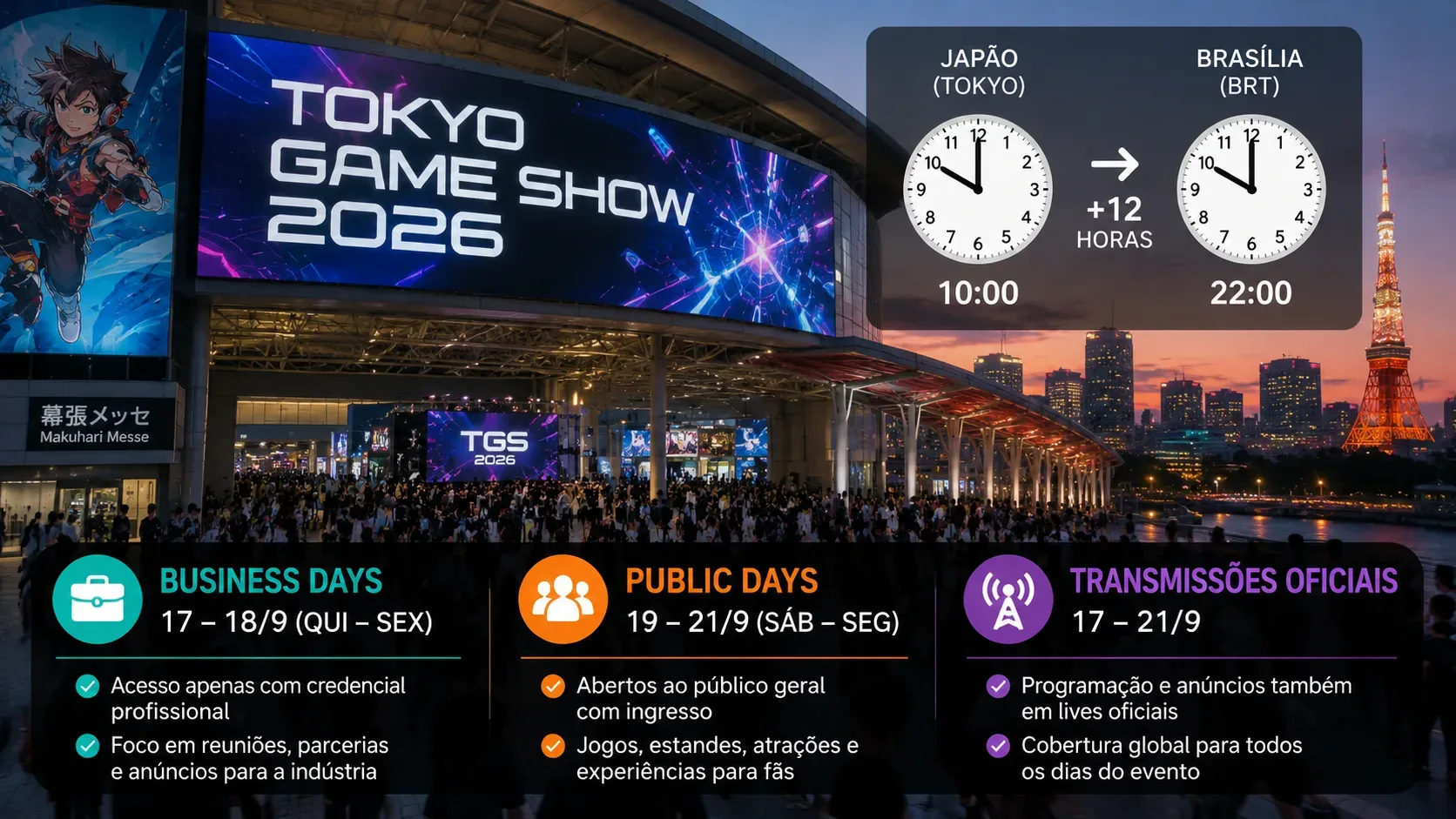
Tokyo Game Show 2026 will take place from September 17 to 21 at Makuhari Messe in Japan, with two days aimed at industry professionals and three days open to the general public. For anyone following from Brazil, one detail changes how the entire schedule should be read: in September, Tokyo is 12 hours ahead of Brasília. That means each event day in Japan begins on the previous evening in Brasília time.
Tokyo Game Show 2026: dates and times in Brazil
The official calendar designates September 17 and 18 as Business Days and September 19, 20 and 21 as Public Days. The table below converts the opening and closing hours of the in-person event in Japan to Brasília time (BRT) by subtracting 12 hours.
| TGS date in Japan | Day type | Time in Japan (JST) | Brasília time (BRT) |
|---|---|---|---|
| Sep. 17, Thursday | Business Day | 10:00–17:00 | Sep. 16, 22:00 – Sep. 17, 05:00 |
| Sep. 18, Friday | Business Day | 10:00–17:00 | Sep. 17, 22:00 – Sep. 18, 05:00 |
| Sep. 19, Saturday | Public Day | 09:30–17:00 | Sep. 18, 21:30 – Sep. 19, 05:00 |
| Sep. 20, Sunday | Public Day | 09:30–17:00 | Sep. 19, 21:30 – Sep. 20, 05:00 |
| Sep. 21, Monday, public holiday in Japan | Public Day | 09:30–16:00 | Sep. 20, 21:30 – Sep. 21, 04:00 |
The organizers also state that on Public Days the opening time may be moved up by as much as 30 minutes depending on circumstances. Visitors in Japan should therefore use these as the official reference hours while still checking same-day notices. The TGS 2026 overview page is the main official source for dates and venue hours.
Why TGS starts “the day before” for viewers in Brazil
Japan uses Japan Standard Time (JST), UTC+9, while Brasília uses UTC−3. The difference is 12 hours: to convert a time announced in JST to Brasília during TGS 2026, simply subtract 12 hours. If the result crosses midnight, the Brazilian calendar date moves back one day.
For example, an activity scheduled for 10:00 on September 19 in Tokyo corresponds to 22:00 on September 18 in Brasília. This is especially important for announcements, press events and livestreams: searching only by the Japanese date can make a Brazilian viewer arrive 12 hours late.
What changes on the September 17–18 Business Days
A Business Day is not simply “a quieter day.” These days are designed for industry professionals. The organizers explicitly state that general public admission is not permitted and operate a separate pass system for business visitors.
Industry-oriented activities include the TGS Forum, professional sessions and opportunities for meetings and business matching. Access to specific services varies by pass type. In the official eligibility table, Business Day passes provide admission to the professional days, while Public Day admission is not included as a benefit of those passes. Requirements and details should be checked on the official business visitor page.
In practical terms, business travelers should separate three questions: which credential is required for entry, which services their pass tier includes, and which seminars or activities require a separate reservation. It is not safe to assume that any TGS ticket grants access to the professional days.
What changes on the September 19–21 Public Days
The final three days are the general public attendance days. On September 19 and 20, the in-person event is scheduled for 09:30–17:00 in Japan; on September 21 it closes one hour earlier, at 16:00.
Public admission follows its own ticket rules. The official site states that there will be no same-day ticket sales for either people living in Japan or overseas visitors; tickets must be purchased in advance through the indicated channels. Because ticket types, prices, availability and conditions can change, the best place to verify them is the official Public Day ticket page.
This also prevents a common misunderstanding: “Public Day” describes the access category for that day, not a specific broadcast or automatic access to every activity. Individual areas, experiences and queues may have their own rules.
Official broadcasts: do not treat venue hours as the livestream schedule
TGS says its official programming will run across all five days, from the Business Days through the Public Days, on platforms including YouTube, X, Niconico, Twitch, TikTok, DouYu, bilibili and Douyin. The broadcast timetable should be checked separately because an official program may start at a different time from the opening or closing of the exhibition halls.
To convert any slot published by the organizers, use the same calculation: JST − 12 hours = Brasília time. If a program is scheduled for 18:00 on September 18 in Japan, for example, it falls at 06:00 on September 18 in Brasília. A 09:30 Japanese slot, by contrast, falls at 21:30 on the previous day in Brazil.
The reference for program names, platforms and times is the TGS 2026 official program page. Because the timetable may be adjusted before or during the event, it is better to confirm a slot close to airtime rather than relying only on a conversion saved weeks earlier.
How to organize the TGS 2026 schedule from Brazil
- For announcements: use the official program timetable, not just the venue opening hours.
- For reminders: convert each Japanese time by subtracting 12 hours and check whether the date moves to the previous day.
- For public travel: plan for September 19, 20 or 21 and verify your ticket in advance.
- For business travel: confirm eligibility and the Business Day pass type before counting on meetings, forums or professional areas.
- For the final day: remember that September 21 ends at 16:00 in Japan, one hour earlier than the two preceding Public Days.
Quick summary
Tokyo Game Show 2026 has Business Days on September 17 and 18 and Public Days from September 19 to 21. In Brasília, most of the schedule starts on the previous evening: 10:00 in Japan is 22:00 on the previous day in Brazil, and 09:30 in Japan is 21:30 on the previous day. Business Days require appropriate professional credentials; Public Days use separate tickets that the organizers instruct visitors to buy in advance. For livestreams, follow the official timetable and convert each slot individually because broadcast times do not have to match the exhibition hall hours.