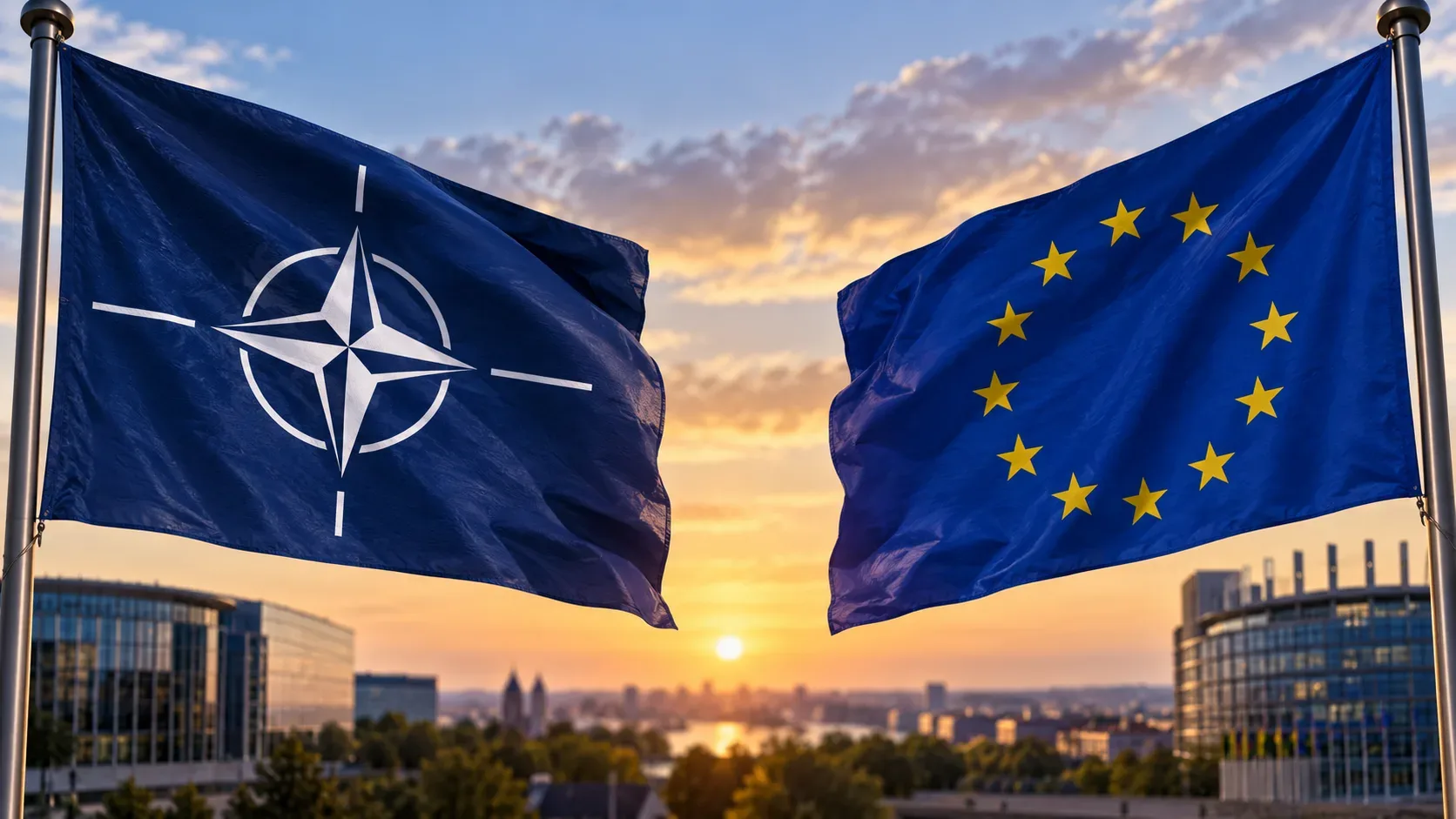
NATO Article 5 and Article 42(7) of the Treaty on European Union (TEU) belong to the same family of commitments — assistance to a state under attack — but they are not equivalent clauses. The difference lies both in the wording of the treaties and in the political and military architecture surrounding each provision.
In practical terms, Article 5 requires every NATO Ally to assist the Ally under attack, while allowing each state to choose the action it deems necessary, including — without making it compulsory in every case — the use of armed force. Article 42(7) TEU, in turn, places the other EU Member States under an obligation to provide aid and assistance by all the means in their power, preserves the specific character of the security and defence policy of certain countries, and expressly states that for NATO members the Alliance remains the foundation of collective defence and the forum for its implementation.
Article 5 vs Article 42(7): a direct comparison
| Aspect | NATO Article 5 | EU Article 42(7) |
|---|---|---|
| Legal trigger | An armed attack against one or more Allies within the scope defined by the North Atlantic Treaty and Article 6. | Armed aggression on the territory of an EU Member State. |
| Basic obligation | Each Ally must assist and take forthwith, individually and in concert with the others, such action as it deems necessary. | The other Member States have an obligation of aid and assistance by all the means in their power. |
| Is military force automatic? | No. NATO itself explains that assistance may or may not involve the use of armed force. | There is no automatic military package. Assistance can be civilian, diplomatic, technical, medical or military, depending on the case. |
| How it is implemented | NATO provides a standing framework for consultation, coordination and planning through the North Atlantic Council and an integrated military structure. | The treaty does not set out a detailed procedure. The 2015 practice and EU guidance stress requests from the attacked state and case-by-case assistance, including bilateral arrangements. |
| Neutrality or specific defence policy | There is no equivalent caveat: all members joined a collective-defence alliance. | The text preserves the “specific character” of the security and defence policy of certain Member States. |
| Relationship with NATO | It is the Alliance’s central collective-defence clause. | The text states that for EU states that are also NATO members, NATO remains the foundation of collective defence and the forum for its implementation. |
| Use through 2026 | Invoked once, after the 11 September 2001 attacks on the United States. | Invoked once, by France after the November 2015 Paris attacks. |
What NATO Article 5 actually requires
The key point is to separate the obligation to assist from the concrete form of assistance. The North Atlantic Treaty provides that an armed attack against one or more Allies is to be considered an attack against them all. Each party then undertakes to assist the attacked party through such action as it deems necessary, including the possible use of armed force.
This means Article 5 is not an automatic order for every Ally to enter the same war with the same type of force at the same time. NATO’s official explanation of collective defence is explicit: assistance may or may not involve armed force, and each Ally determines how it will fulfil its obligation. Domestic constitutional procedures can also shape implementation, including requirements for parliamentary consultation or approval.
National discretion does not, however, make the commitment optional. The duty to assist exists; discretion mainly concerns the form of that assistance. In practice, the North Atlantic Council, defence plans, commands and integrated forces place Article 5 inside a collective infrastructure that goes far beyond a single treaty sentence.
What triggers Article 5
The treaty refers to an “armed attack” and must be read together with Article 6, which sets geographic parameters relevant to the clause. NATO also says the assessment is case-specific and that sufficiently serious cyber or hybrid attacks may, depending on the circumstances, be considered armed attacks.
NATO further explains that the treaty does not prescribe one fixed activation ritual. Under the Alliance’s current institutional interpretation, the assistance obligation presupposes that an Ally has suffered an armed attack and that the attacked state requests or consents to collective action. The North Atlantic Council provides the political forum in which Allies assess the situation and coordinate their response.
What EU Article 42(7) actually requires
Article 42(7) of the Treaty on European Union uses different wording. If a Member State is the victim of armed aggression on its territory, the other Member States have an obligation to provide aid and assistance by all the means in their power, in accordance with Article 51 of the UN Charter.
The European External Action Service describes that obligation as legally binding once activated. At the same time, it explains that the nature of assistance is determined case by case according to the attacked state’s needs: it may range from diplomatic support and technical or medical assistance to civilian or military aid.
Article 42(7) does not in itself create an operational mechanism equivalent to NATO’s command structure. The treaty does not lay down a detailed implementation procedure or automatically place the response inside an EU military operation. The attacked state can ask for institutional coordination support, but the logic remains strongly intergovernmental.
The neutrality caveat is not an automatic opt-out
A major difference is the sentence preserving the “specific character” of the security and defence policy of certain Member States. It accommodates different national traditions and constraints, including those of countries that do not belong to NATO.
This should not be read as a general escape clause. The assistance obligation remains; what may vary is the nature of the contribution. EU documentation itself lists diplomatic, technical, medical, civilian and military assistance as possible forms. A state with a specific defence policy therefore does not simply sit outside the commitment: it can meet the obligation through means compatible with its position and with the request of the attacked state.
Why overlapping membership changes the comparison
In 2026, NATO has 32 Allies and the European Union has 27 Member States. Twenty-three countries belong to both organisations; Austria, Cyprus, Ireland and Malta are in the EU but not in NATO. This overlap helps explain why Article 42(7) contains an explicit bridge to the Atlantic Alliance.
For a state that belongs to both the EU and NATO, both legal commitments may be relevant in the same crisis, but the TEU itself says that commitments in this field must be consistent with NATO and that, for NATO members, the Alliance remains the foundation of collective defence and the forum for implementing it. Article 42(7) was therefore not designed as an institutional copy of Article 5.
For the four EU members outside NATO, the EU clause has an even clearer independent function: it creates a mutual assistance obligation among Union members that do not all share the same military alliance.
The precedents show the gap between obligation and response
Article 5 was applied for the first and, through 2026, only time after the 11 September 2001 attacks. The Allied response did not consist of identical military action by every member. NATO agreed measures such as greater intelligence-sharing, security support, overflight clearances, access to ports and airfields, airborne early-warning deployments and a naval presence. The precedent illustrates the flexibility built into the treaty wording.
Article 42(7), in turn, was activated by France after the Paris attacks of 13 November 2015. At the November 2015 Foreign Affairs Council, ministers backed the French request, and assistance developed through Member State contributions, to a large extent bilaterally. The episode showed that activating the clause does not automatically create a single EU military operation.
What the 2026 Ankara Summit changed — and what it did not
In the Ankara Summit Declaration of 8 July 2026, Allied leaders reaffirmed their commitment to collective defence under Article 5. Politically, that reaffirmation matters because it renews the Alliance’s signal of cohesion and deterrence in a more demanding security environment.
Legally, however, Ankara did not rewrite Article 5. The declaration did not remove each Ally’s latitude to choose the action it deems necessary or turn the clause into an obligation to deliver an identical military response. The 2026 significance is mainly political and strategic: it confirms that the pledge remains the core of the Alliance.
Treaty text vs interpretation: where errors arise
Three common shortcuts should be avoided. The first is saying that “Article 5 means automatic war”. The treaty text does not say that. The second is claiming that Article 42(7) is automatically “stronger” simply because it uses the phrase “all the means in their power”. That ignores the caveat for national policies, the absence of an identical operational mechanism and the treaty’s own recognition of NATO’s primacy for states that belong to the Alliance. The third is treating both clauses as if they had the same territorial and institutional scope.
The safest comparison separates four layers: the legal trigger, the duty to assist, national latitude over the type of contribution, and the institutional mechanism used to coordinate the response. It is in this fourth layer that the distance between NATO and the EU becomes especially visible.
How to analyse a concrete scenario
- Who was attacked? Check whether the state belongs to NATO, the EU or both.
- Does the event meet the legal threshold? Not every threat, provocation or incident automatically qualifies as an “armed attack” or “armed aggression”.
- Where did it occur? Article 5 must be read with Article 6; Article 42(7) refers to aggression on a Member State’s territory.
- Did the attacked state request or accept collective assistance? Institutional practice depends on the sovereign position of the state affected.
- What type of assistance was requested? Air defence, intelligence, logistics, armed forces, diplomatic support, cyber defence and other measures can carry different weight.
- What national procedures apply? Constitutions, statutes and parliamentary controls can affect how each government implements its obligation.
In summary
NATO Article 5 and EU Article 42(7) share the idea of defensive solidarity, but they operate in different structures. Article 5 combines a binding duty to assist with flexibility over the means used and NATO’s integrated political and military architecture. Article 42(7) creates a separate obligation among EU states, allows varied forms of assistance, preserves specific national defence policies and expressly recognises NATO’s central role for countries that belong to both organisations. Comparing only the strongest phrases in each treaty therefore creates an equivalence that the texts themselves do not support.