Since 1 January 2026, the European Union's Carbon Border Adjustment Mechanism (CBAM) has been operating under its definitive regime. The key change is that CBAM is no longer only a reporting system: for covered imports, compliance now combines authorisation, declaration of embedded emissions and surrender of certificates linked to the carbon price in the EU ETS. The main legal responsibility sits with the EU importer or, in specific situations, its indirect customs representative — not with the foreign exporter simply because it sells into the EU.
What changed with the definitive regime in 2026
CBAM was designed to bring the carbon cost applied to certain imported goods closer to the cost faced by European producers under the EU Emissions Trading System (EU ETS). The European Commission states that the definitive regime began on 1 January 2026. From that point, operators subject to the rules need to be properly set up as authorised CBAM declarants and track embedded emissions, certificates and any deduction for a carbon price already paid in the country of origin.
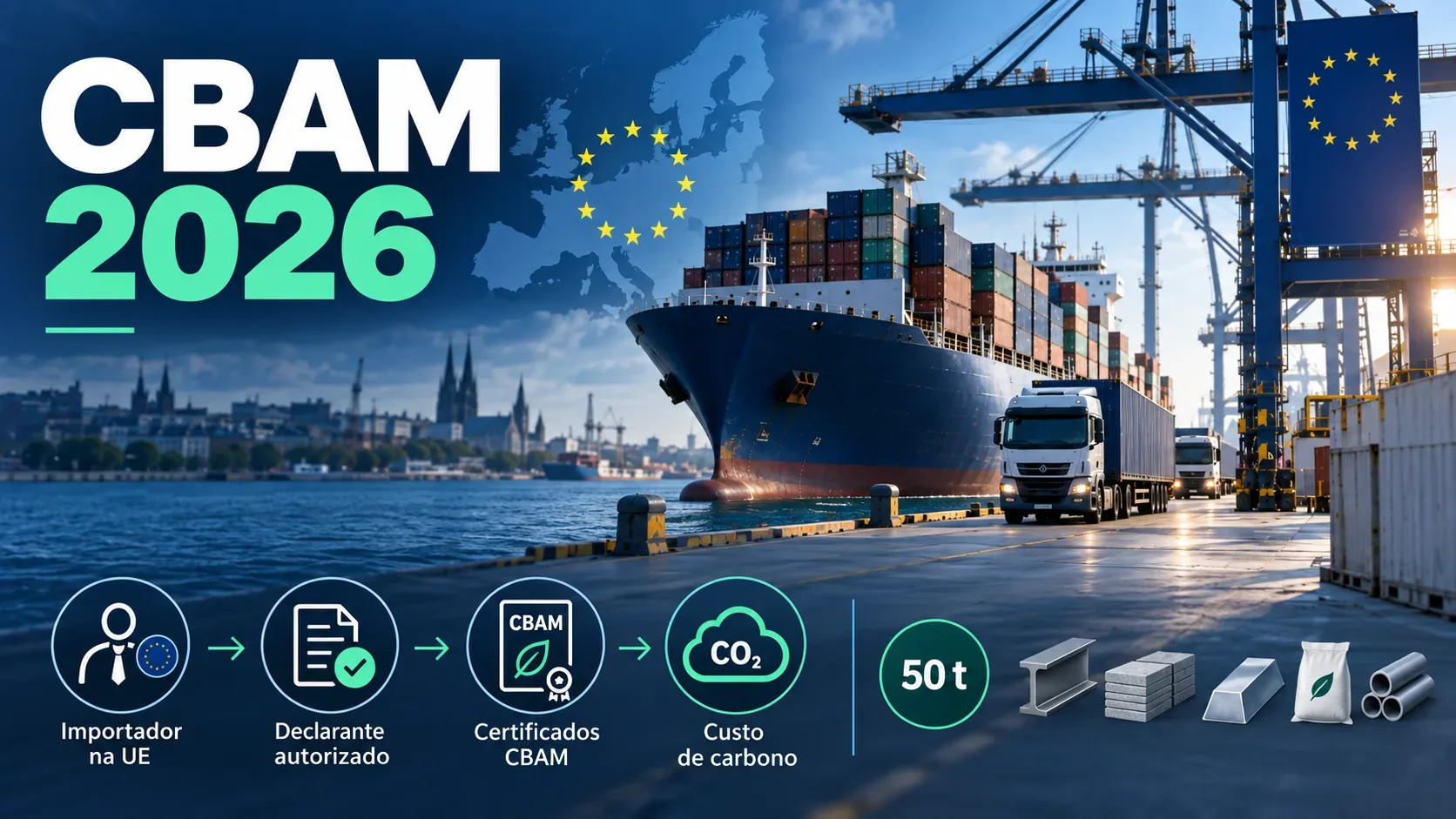
For companies trading with Europe, the most useful way to understand the system is to separate three questions: who is accountable to the EU, when the 50-tonne threshold removes or triggers obligations, and how the carbon price becomes a financial cost.
Who needs authorisation in the European Union
The consolidated CBAM Regulation provides that an importer established in a Member State must apply for authorised CBAM declarant status before importing covered goods when it expects to exceed the applicable threshold. An indirect customs representative may also take on that role under the conditions set by customs law.
| Situation | Who takes the CBAM role |
|---|---|
| Importer established in the EU | As a rule, the importer itself applies for authorisation when it expects to be subject to CBAM obligations. |
| EU-established importer using an indirect customs representative | The representative may act as the authorised CBAM declarant if appointed and if it accepts that role. |
| Importer not established in a Member State | The indirect customs representative must obtain authorised CBAM declarant status. |
Authorisation is handled through the CBAM Registry and is connected to customs clearance. This is different from a commercial clause between buyer and seller: the authorised declarant remains responsible for compliance before the EU even when it relies on information supplied by third parties.
How the 50-tonne threshold works
The 2025 reform introduced a mass-based de minimis exemption. The initial threshold is 50 tonnes of net mass per importer per calendar year. The rule cumulatively aggregates covered goods under the relevant CN codes in the cement, iron and steel, aluminium and fertiliser sectors.
- Up to 50 tonnes in the year: if cumulative net mass does not exceed the threshold, the importer may be exempt from CBAM obligations for that year, while declaring the exemption in the customs declaration.
- Above 50 tonnes: once the threshold is exceeded, the obligations apply to all embedded emissions in all covered goods imported during that calendar year, including volumes imported before the threshold was crossed.
- Aggregation: this is not 50 tonnes per shipment, CN code or supplier; it is cumulative per importer and calendar year.
- Electricity and hydrogen: the mass-based exemption itself does not apply to those imports.
This prevents a common but incorrect reading: importing 49 tonnes in one transaction and another 2 tonnes later does not keep the first 49 tonnes outside the regime. If the annual total exceeds 50 tonnes, the year's imports are assessed as a whole.
Which goods are covered by CBAM
The European Commission groups CBAM into six broad sectors: cement, iron and steel, aluminium, fertilisers, electricity and hydrogen. That does not mean every product commercially associated with those sectors is automatically covered. Scope depends on the Combined Nomenclature (CN) codes listed in Annex I to the regulation and may include selected precursors and specific products.
For a real transaction, the first test is therefore not the generic product name but the CN code used for import. The Commission's official CBAM sectors page provides sector-specific resources.
Where the carbon cost enters
The financial cost is not a fixed customs duty per tonne of goods. It arises from the relationship between the embedded emissions attributed to the product and the number of CBAM certificates that the declarant must surrender after the applicable regulatory adjustments. Each certificate corresponds to one tonne of CO2 equivalent.
In simplified form, the flow is: import of a covered good → determination of embedded emissions → application of the relevant regulatory adjustments → calculation of the number of certificates to surrender → valuation of those certificates using the price linked to the EU ETS.
The regulation also provides an adjustment reflecting the share of free allowances still allocated to EU installations under the EU ETS. This matters because CBAM is phased in while that free allocation is phased out. Therefore, embedded emissions do not automatically translate one-for-one into the final gross financial cost without adjustments.
Certificate prices for 2026
For emissions associated with 2026 imports, the Commission calculates quarterly prices based on the weighted average of EU ETS auction clearing prices. The official CBAM certificate price page published €75.36 for the first quarter of 2026 and €75.28 for the second quarter. As of 12 September 2026, the third-quarter price had not yet been published; the Commission lists 5 October 2026 as the publication date.
Although the 2026 reference prices are calculated during 2026, purchases of certificates covering 2026 imports begin in February 2027 under the definitive-regime timetable.
A carbon price paid outside the EU may reduce the obligation
If the declarant can prove that a carbon price was effectively paid in the country of origin during production of the imported goods, the corresponding amount may be deducted under the regulation. The purpose is to avoid charging again for a portion of carbon that has already been priced through an eligible mechanism in the third country.
This does not mean that any environmental tax, climate target or producer cost is automatically accepted. The deduction depends on documentation and on the criteria laid down by the CBAM rules.
Practical timeline: 2026 imports and the 2027 settlement
- 1 January 2026: the definitive regime starts.
- During 2026: the importer tracks product scope, the 50-tonne threshold where relevant and embedded-emissions data. Authorisation must be addressed when the operator expects to exceed the threshold or where a specific rule requires it.
- Throughout 2026: the Commission publishes quarterly certificate prices corresponding to emissions in imports from each quarter.
- From February 2027: certificates intended to cover 2026 imports can be purchased.
- By 30 September 2027: the authorised declarant submits the first annual CBAM declaration, covering 2026, and surrenders the corresponding number of certificates.
What this means for exporters to the EU — and what it does not mean
A third-country exporter is not normally the party that applies for CBAM authorisation or surrenders certificates in the EU Registry merely because it sells into Europe. The regulatory obligation lies with the EU importer or with the indirect customs representative that takes the authorised-declarant role.
That does not make the exporter irrelevant. In practice, European buyers are likely to require information on the installation, production process and embedded emissions. When actual values are used, verification requirements apply; the Commission has published dedicated material on CBAM emissions verification.
| For a non-EU exporter | Correct interpretation |
|---|---|
| CBAM authorisation | As a rule, it is not an export licence obtained by the foreign manufacturer; authorisation belongs to the responsible declarant in the EU. |
| Emissions data | It may become an important commercial requirement from the European customer because it feeds the importer's declaration. |
| Certificate cost | The legal duty to acquire and surrender certificates lies with the declarant, but contracts, pricing and bargaining power may redistribute the economic burden along the supply chain. |
| 50 tonnes | The threshold is measured per EU importer and per calendar year, not by adding all sales made by one exporter to all of its customers. |
Checklist for a 2026 transaction
- Confirm whether the product's CN code is within the scope of Annex I.
- Identify the importer and, where relevant, the indirect customs representative.
- Check whether the 50-tonne exemption applies to the sector and track cumulative net mass per importer during the year.
- If the threshold is expected to be exceeded, address authorisation before it creates a customs-clearance problem.
- Agree with the supplier on how embedded-emissions data will be obtained and, where required, verified.
- Map any carbon price already paid in the country of origin and the documentation needed to claim a deduction.
- Use official certificate prices, rather than unofficial estimates, in financial projections.
In summary
In 2026, CBAM is already in its definitive regime, but the financial settlement for that year's imports is carried out through certificates purchased from 2027. The 50-tonne threshold simplifies compliance for smaller importers of cement, iron and steel, aluminium and fertilisers, but it is cumulative and stops protecting the importer once the annual total is exceeded. It does not apply to electricity or hydrogen. For companies outside the EU, the key distinction is that formal responsibility sits on the European side, while the quality of emissions data and negotiations over cost can directly affect the commercial relationship.
Main sources: European Commission — CBAM definitive regime; Regulation (EU) 2023/956, consolidated version; Regulation (EU) 2025/2083 simplifying CBAM; official certificate prices.