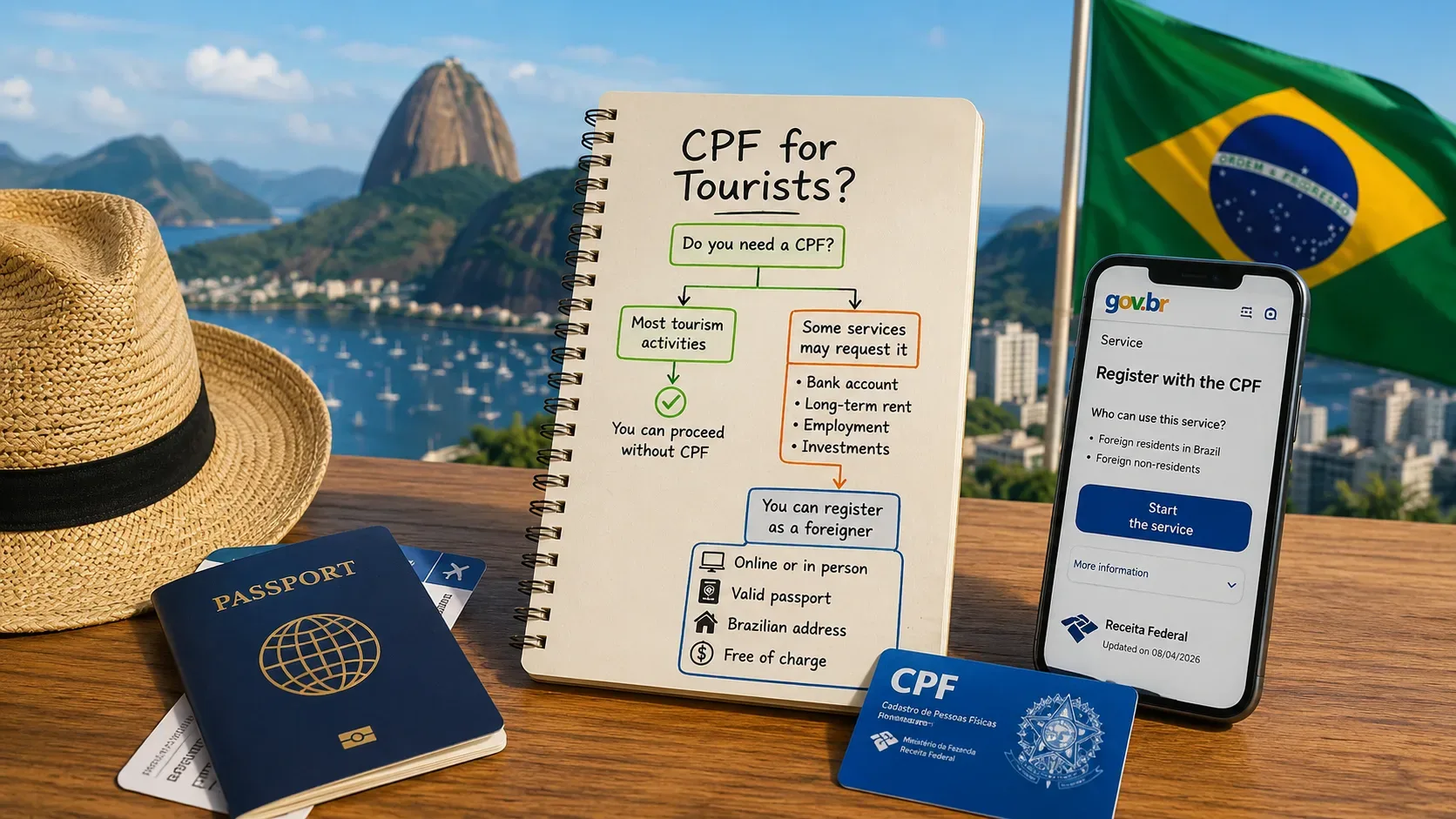

Yes. For an interstate bus trip that starts and ends within Brazil, an adult foreign traveler may board using a valid foreign passport as identification. The National Land Transport Agency (ANTT) also lists, for foreign passengers, the Foreigner Identity Card (CIE), diplomatic or consular identification, and another legal travel document allowed under international agreements signed by Brazil.
The key is to separate a domestic trip from an international trip. A bus can cross state lines without crossing a national border; in that case, a valid foreign passport is expressly included in ANTT's list. If the route enters another country, immigration rules, the destination country's accepted travel documents, and possible visa requirements also apply.
Quick answer: traveler situation x accepted document
| Situation | What ANTT indicates | Practical caution |
|---|---|---|
| Adult foreign traveler on an interstate bus within Brazil | Foreign passport with current validity | According to ANTT's list, it is sufficient as identification for boarding. |
| Foreign resident holding a CIE | Valid CIE | Brazil's Federal Police states that CRNM is the current name of the document formerly called CIE. |
| Foreign traveler waiting for a CIE | ANTT's boarding-document page states that the CIE application protocol issued by the Federal Police may be used on a domestic trip for up to 180 days from issuance | The rule is published by ANTT using the older term “CIE”; check that your protocol corresponds to the current migration document. |
| Foreign traveler with diplomatic or consular ID | Accepted, provided it is valid | Carry the document that actually identifies the passenger. |
| Foreign traveler with a national ID from the home country | It may be accepted only when it qualifies as a legal travel document under an applicable international agreement | Do not assume every foreign national ID card is valid for boarding or travel in Brazil. |
| Bus trip that crosses Brazil's international border | A valid travel document, subject to international travel rules and applicable agreements | A document that is enough for a domestic Brazilian trip may not be enough to enter the destination country. |
So is a passport by itself enough?
For identification when boarding a domestic road trip, yes. ANTT expressly includes a valid foreign passport among the documents accepted from foreign passengers. A traveler therefore does not need to hold a CIE solely to prove identity when boarding an interstate bus within Brazil.
This answer is limited to the identification required for transport. It does not turn the passport into proof of immigration status for every purpose, nor does it replace specific requirements that may apply to minors, international border crossings, or entry into another country.
CIE and CRNM: why do the names differ?
ANTT still uses the acronym CIE in its guidance pages. Brazil's Federal Police explains that CRNM stands for Carteira de Registro Nacional Migratório and is the current name of the document formerly called CIE, Cédula de Identidade de Estrangeiro.
Foreign residents in Brazil may therefore encounter official guidance using both names. For boarding purposes, the safest approach is to follow ANTT's current list and present a valid document that fits one of its accepted categories.
What about the CIE application protocol?
On its boarding-document page, ANTT states that, for travel within Brazil, the CIE application protocol issued by the Federal Police may replace the original card for up to 180 days from issuance. This matters for a traveler who has already begun the documentation process but has not yet received the physical card.
Because the Federal Police now uses the term CRNM for the migration card, note that ANTT's published wording still refers to a “CIE protocol.” If you hold a current migration-registration protocol and cannot clearly match it to that rule, it is safer to confirm with ANTT or the bus company before travel rather than assume equivalence.
Can an expired CIE be used?
ANTT publishes a narrow exception: an expired CIE may be accepted for foreign passengers with a physical disability or those aged 60 or older, provided they hold permanent status and took part in the prior re-registration referred to by the agency. Because this is a specific exception, it should not be generalized to every foreign passenger with an expired document.
What changes if the bus goes to another country?
On an international trip, the question is no longer only “which document identifies the passenger on the bus.” The documentation must also allow the traveler to cross the border and satisfy the destination's immigration rules. ANTT advises international road passengers to carry valid documents and, when applicable, comply with visa and other entry requirements.
For foreign passengers, ANTT lists a foreign passport, CIE, diplomatic or consular ID, and another legal travel document under international agreements. The existence of an agreement is precisely what may allow certain national identity documents on specific routes, so a foreign ID card should not be treated as universally valid for border crossing.
What you should not assume
- Foreign driver's license: it does not appear in ANTT's list for foreign-passenger identification, so it should not be treated as a guaranteed substitute for a passport or the other documents expressly listed.
- Expired document: ANTT's general page requires current validity for documents presented by foreign travelers, apart from the specific expired-CIE exception published by the agency.
- Any foreign national ID: use it as a travel document only when an applicable international agreement supports it.
- Domestic rule applied internationally: a protocol accepted for travel within Brazil should not be assumed to be valid for crossing an international border.
Checklist before going to the terminal
- Confirm whether the trip stays entirely within Brazil or crosses an international border.
- For a domestic trip as an adult foreign traveler, carry a valid foreign passport or another ANTT-listed document that applies to your situation.
- If you plan to use a CIE/CRNM or protocol, check its validity and the specific rule that applies.
- For international travel, also verify the immigration and entry requirements of the destination country.
- For an unusual document or borderline case, confirm directly with ANTT or the carrier before boarding.