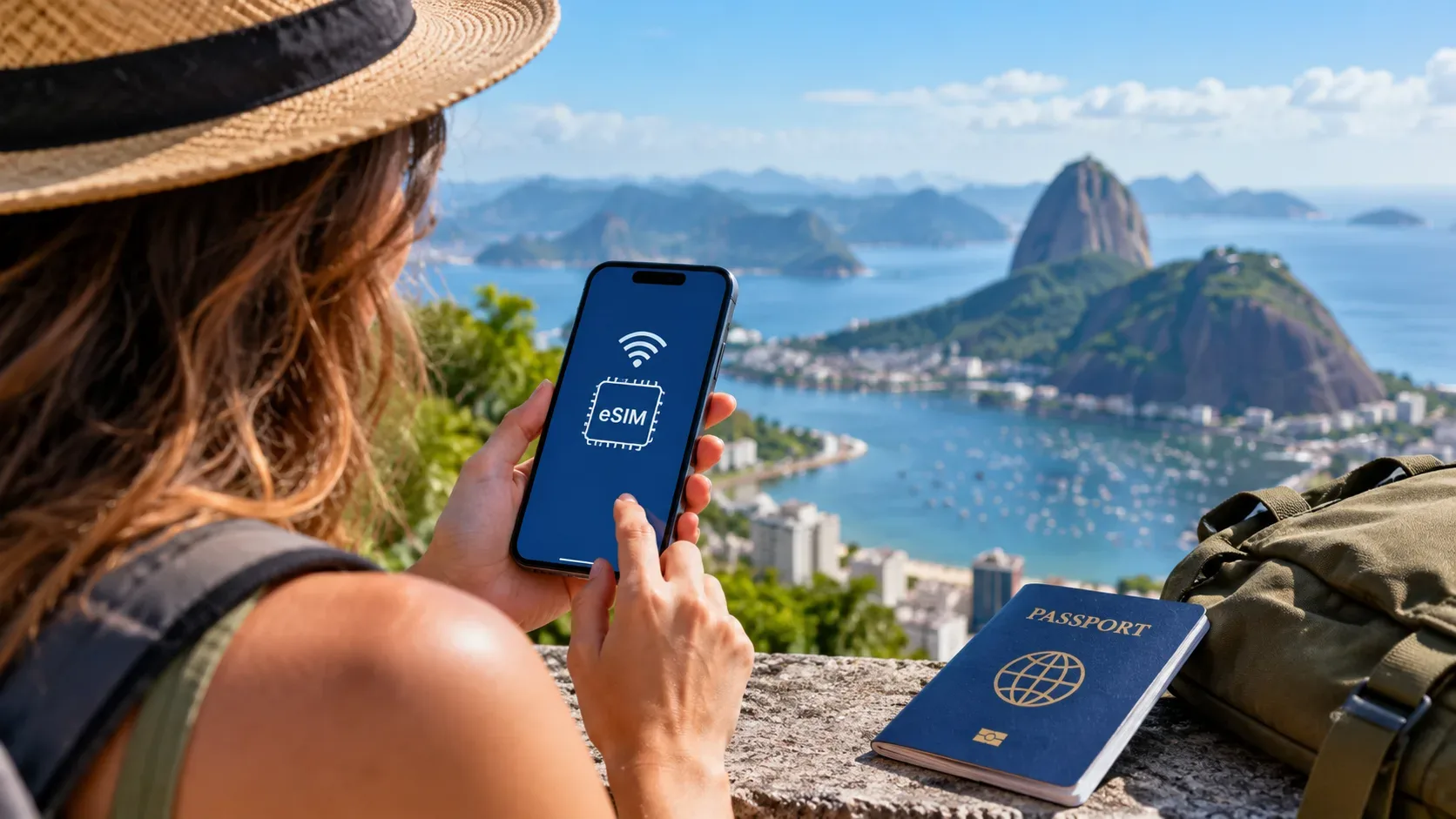
Yes. A foreign tourist can get a local eSIM in Brazil without assuming they already have a Brazilian CPF tax number. The clearest option today is the Vivo Tourist Plan, which was created for international visitors. Vivo says plan activation is tied to the traveler’s passport number, while the current offer page allows online purchase and delivery of the eSIM by email.
That does not mean every Brazilian SIM can be activated without a CPF. Brazil’s standard prepaid-registration process still uses CPF as a key identifier. The Tourist Plan is a specific foreign-visitor journey, so travelers should use that product’s dedicated flow and check the fields shown at the time of purchase.
Quick answer: what a tourist needs to know
- CPF: Vivo launched the Tourist Plan for foreign visitors and says activation is conditioned on the passport number.
- Format: it is an eSIM plan, so the phone must support eSIM.
- Offer checked on September 8, 2026: 25 GB of data, 300 minutes and 100 SMS for R$55, valid for 30 days from activation.
- Purchase: it can be bought online, paid by credit card, and the eSIM is sent by email.
- Activation deadline: Vivo’s current page says you have 15 days after purchase to activate it.
- Best time to activate: Vivo recommends activating only after you arrive in Brazil so the 30-day validity starts then.
How the passport route works instead of a CPF
The confusing part is that Brazil’s general prepaid mobile registration process normally asks for a CPF, date of birth and other registration data. Brazil’s telecom regulator, Anatel, describes that standard prepaid-registration flow.
The Vivo Tourist Plan follows a different path because it is specifically designed for foreign visitors. In Vivo’s official launch announcement for the Tourist Plan, the carrier said travelers need an eSIM-compatible device and that activation is conditioned on the passport number. So a visitor without a Brazilian CPF should not assume a local line is unavailable; they should use the dedicated foreigner flow.
Because the registration process is digital and can change, check the live checkout for the exact data and documents requested. If an older instruction conflicts with the current purchase screen, follow the carrier’s current flow.
What the Vivo Tourist Plan currently includes
On the official page checked on September 8, 2026, the package is listed at R$55 and includes 25 GB of data, 300 minutes and 100 SMS, valid for 30 days. Vivo also says the plan works in Brazil and allows hotspot/tethering.
The included calls and texts are for Brazilian numbers. For international calls or messages, Vivo offers extra credit. Additional data can also be purchased through “My Tourist Plan.” Since prices, allowances and commercial rules can change, review the official offer immediately before paying.
Pre-purchase checklist
1. Confirm that your phone supports eSIM
A recent phone is not automatically eSIM-compatible. Check the phone settings and the manufacturer’s documentation for your exact model and regional variant. Vivo’s eSIM support page also provides compatibility guidance.
2. Make sure the phone is carrier-unlocked
A phone bought abroad can support eSIM and still be locked to the original carrier. Vivo says phones purchased outside Brazil can activate its eSIM if they comply with the relevant international standards and are not tied to a foreign carrier commitment. Anatel also warns that imported phones can face technical incompatibilities or a lock imposed by the original carrier.
3. Do not buy too early
Vivo says the Tourist Plan must be activated within 15 days of purchase. At the same time, it recommends activating only after arrival in Brazil. In practical terms, if you buy before your trip, make sure the purchase date is close enough to your arrival date that the activation window will not expire.
4. Have Wi-Fi available for installation
Vivo recommends a Wi-Fi connection while setting up the eSIM. A sensible approach is to install the eSIM profile before you need it for internet access, but activate the line only when you are in Brazil, following the carrier’s current guidance.
5. Recheck payment and validity
The current payment method is credit card. Vivo says Hipercard and Diners are not accepted, and a digital credit card can be used as long as it is not temporary. The main plan lasts 30 days from activation; add-on packages have their own conditions.
6. Decide whether 25 GB and the voice allowance fit your trip
For maps, messaging, browsing and moderate video use, 25 GB may be enough for many itineraries, but there is no universal “right” amount. If you expect to work with video, tether frequently or spend long periods away from Wi-Fi, monitor your balance and factor in the possibility of buying extra data.
Purchase, installation and activation: the safest order
- Before paying, confirm that the phone supports eSIM and is carrier-unlocked.
- Open the official Vivo Tourist Plan page and recheck the price, data allowance, validity and payment terms.
- Complete the tourist/foreigner purchase flow and enter the requested data, including the passport number when required.
- Receive the eSIM by email and install the profile while you have Wi-Fi.
- After arriving in Brazil, activate the line according to Vivo’s instructions and set the Tourist Plan as the primary line for mobile data.
- Test the connection before leaving the airport, hotel or another place where backup Wi-Fi is available.
What if your phone has no eSIM or is locked?
Then the Vivo Tourist Plan may not be a good fit. A phone without eSIM support cannot install this product, and a device locked by the original carrier may prevent a Brazilian line from working. Alternatives include checking your home carrier’s roaming, using another compatible device, or looking for a local option that supports your hardware and documents. Registration rules can differ by product and carrier.
Bottom line
For a tourist without a CPF, the answer is yes: there is an official route to get a local eSIM in Brazil through the Vivo Tourist Plan using the passport-based foreigner flow. The key is the pre-purchase check—eSIM support, carrier unlock status, the 15-day activation window, the documents requested in the live checkout and the current commercial offer. On September 8, 2026, Vivo’s official page listed 25 GB, 300 minutes and 100 SMS for R$55 over 30 days; recheck those details when you buy.