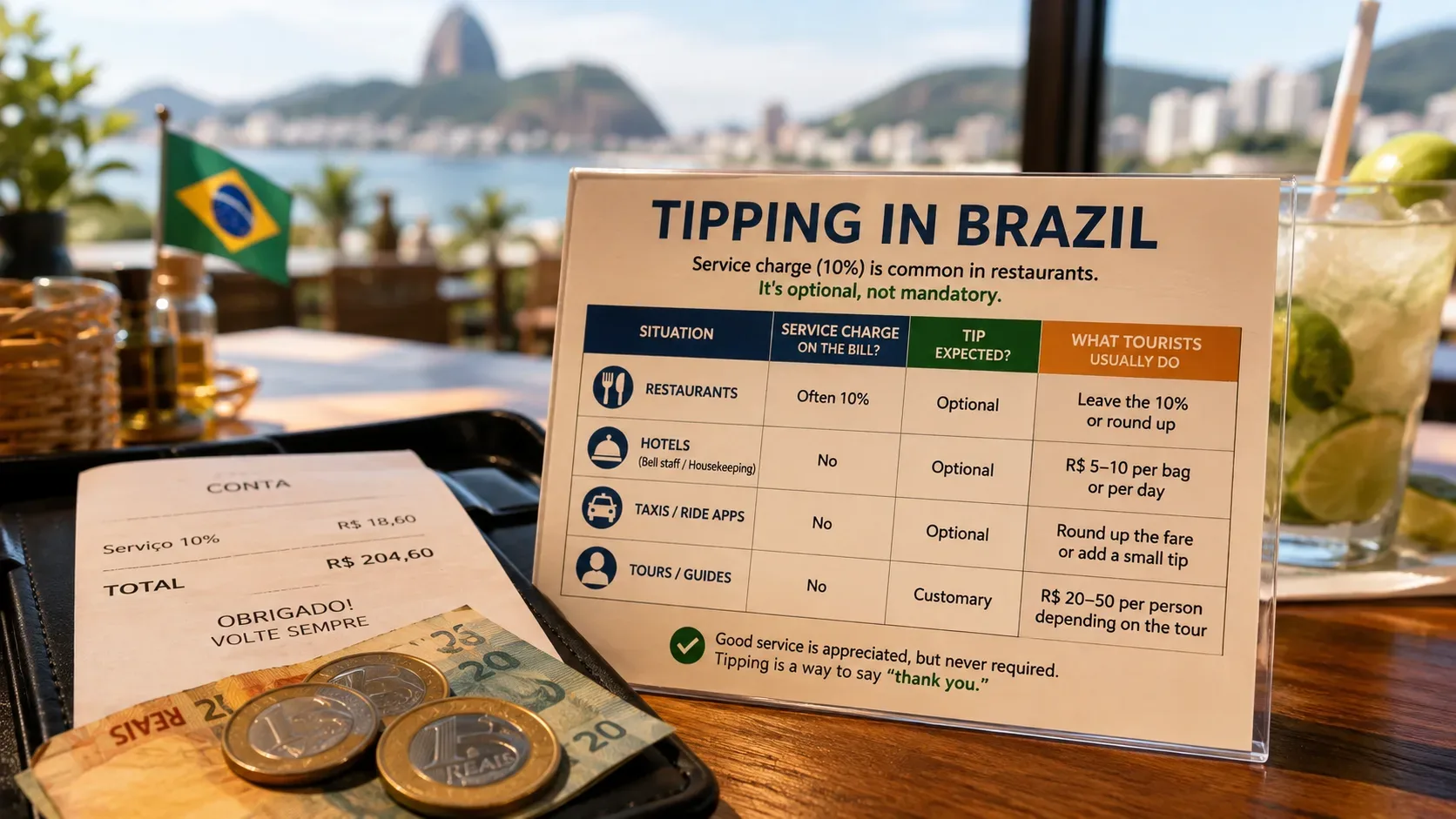
For visitors to Brazil, the most useful rule is simple: tipping is appreciated, but it is not mandatory. In restaurants and bars, the bill often shows a suggested service charge of around 10%. Even when that amount is already calculated, the customer can choose not to pay it or ask for a different amount.
Visit Brasil, Brazil’s official tourism portal, says tips are not mandatory and that around 10% is common in restaurants, bars and similar services. Brazilian consumer-protection agencies also state that the service charge is optional.
What to do in each situation
| Situation | What you may see | Mandatory? | Practical approach for visitors |
|---|---|---|---|
| Restaurant or bar | The bill may show around 10% as “serviço”, “taxa de serviço” or “gorjeta”. | No. | If service was good, many customers leave the 10% in place. If you do not want to pay it, ask for it to be removed; you may also choose a different amount. |
| Hotel | Small tips may be given to staff who provide additional services. | No. | Use your judgment. A small amount for extra help is a common way to say thanks, but there is no fixed nationwide percentage. |
| Taxi or ride-hailing app | There is no mandatory tipping charge. In taxis, rounding up the fare may be appreciated. | No. | Round up if you want to thank the driver; in an app, use the tipping feature only if you wish. |
| Tour or guide | Tips may be appreciated, especially when the guide provided service above expectations. | No. | Consider a discretionary tip based on the length, quality and format of the tour. There is no mandatory nationwide percentage. |
Why does a 10% charge appear on the bill if it is optional?
In Brazil, a tip can be given directly by a customer or collected by an establishment as an additional service amount intended for workers. Law No. 13,419/2017 regulates how these tips are treated and distributed to employees. It does not, however, turn a suggested 10% service charge into a mandatory payment for the customer.
Recent consumer-protection guidance is explicit on this point. Procon Santa Catarina says the 10% service charge is optional, while Procon-SP explains that the percentage is usually a suggestion and that customers may refuse it, lower it or increase it based on their assessment of the service.
If the 10% is already included, should I tip again?
Usually, there is no need to add a second tip. Check the bill first. If an approximately 10% service charge is already listed and you choose to pay it, that normally serves as the tip for the meal.
Anything beyond that is a personal choice, not a universal expectation. The easiest way for a visitor to avoid double-tipping is to look for words such as serviço, taxa de serviço or gorjeta on the bill before adding anything extra.
Can I ask to remove the service charge?
Yes. Because the charge is optional, you can ask for it to be removed before you pay. A useful phrase is: “Sem os 10%, por favor.” (“Without the 10%, please.”) If you would rather leave a different amount, you can also ask the establishment how to adjust the tip.
You do not need to start a legal argument to decline it. A polite, direct request is usually enough. If you are pressured to pay a charge presented as an optional tip, ask for clarification and keep the bill.
Restaurants: what do tourists usually do?
For most visitors, leaving the suggested 10% in place when service was satisfactory is the simplest choice and matches the practice described by Visit Brasil. If no service charge appears, leaving something around 10% is also a common reference point — but it remains your choice.
This differs from countries where tipping functions almost like an expected part of the final price. In Brazil, the suggested amount may be printed on the bill, but the customer still decides whether to pay it.
Hotels, taxis, ride-hailing and tours
Hotels
Visit Brasil says it is customary to leave a small tip for hotel staff who provide additional services. That can include special help with luggage or another extra service. There is no mandatory nationwide table, so the amount is up to the guest.
Taxis and ride-hailing apps
For taxis, travel guides such as Rough Guides note that tipping is not required and that rounding up can be a way to show appreciation. For ride-hailing apps, the same general logic applies: any gratuity is optional and can be added in the app when that feature is available.
Tours and guides
There is no mandatory Brazilian percentage for tours. Travel guides note that small tips may be appreciated when a guide has been especially helpful or attentive. “Free walking tours” can work differently because participant contributions are often part of the service model; in that case, check how the operator describes payment.
A service charge is not the same as a tax
Another point that can confuse visitors is how the bill is structured. Visit Brasil says taxes are normally already included in displayed prices. A tip or service charge is different: it is a gratuity for service, not a mandatory tax added to the price.
Quick rule of thumb
- Restaurant/bar: check whether roughly 10% service has been added; pay it if you choose.
- If you already paid the 10%: there is no obligation to tip again.
- Hotel: a small amount for extra service is appreciated, but optional.
- Taxi/app: rounding up or tipping is optional.
- Tour/guide: gratuity is discretionary and varies with the service.
- If unsure: ask whether the service amount on the bill is optional or already included in the total.
For a tourist, the best way to think about tipping in Brazil is to treat the 10% as a common suggestion, not an unavoidable charge. Check the bill, avoid paying twice and use tipping as a thank-you when it feels appropriate.