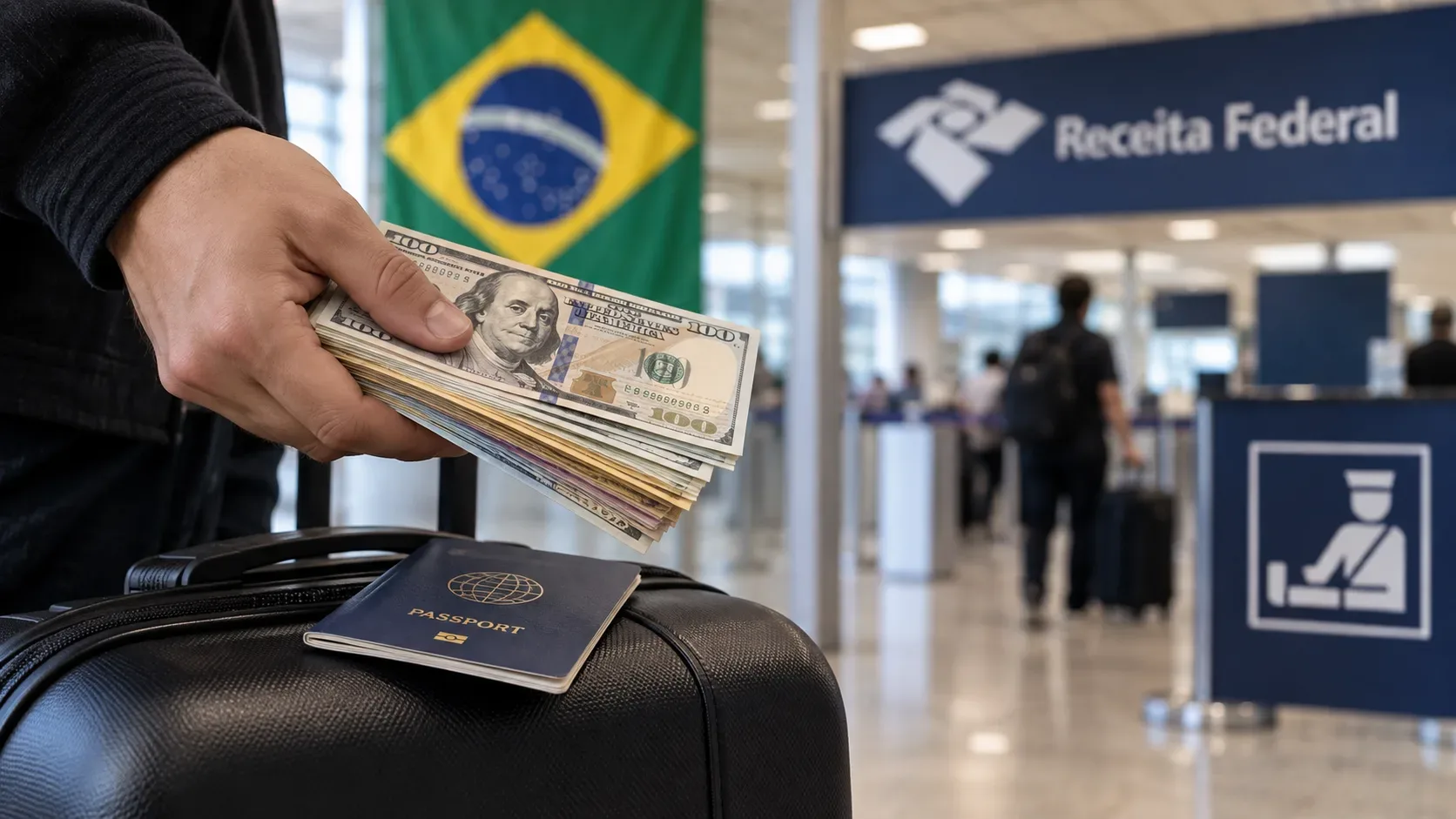
If you enter Brazil carrying up to US$10,000 in cash, including exactly US$10,000, the cash rule alone does not require an e-DBV. The obligation starts when the amount is greater than US$10,000 or the equivalent in another currency. That does not mean bringing more cash is prohibited: Brazil's Central Bank states that there is no fixed maximum amount of cash a traveler may carry; above the threshold, however, the traveler must declare it to customs.
Official pages from the Brazilian Federal Revenue Service and the gov.br service confirm this rule and make clear that it applies per traveler when entering or leaving the country. For someone arriving in Brazil, the declaration is made through the Electronic Traveler's Declaration of Goods (e-DBV) and, when required, must be presented to customs authorities.
The US$10,000 threshold: what “greater than” means in practice
| Situation | Declare the cash through e-DBV? | Practical reading |
|---|---|---|
| US$9,999 in cash | No, based on the cash rule | The amount does not exceed the threshold. |
| Exactly US$10,000 in cash | No, based on the cash rule | The official rule refers to an amount greater than US$10,000. |
| US$10,001 in cash | Yes | The amount exceeds the threshold and must be declared. |
| Amount in reais, euros or another currency | It depends on the US-dollar equivalent | If the total equivalent exceeds US$10,000, the declaration is required. |
| Cash below the threshold, but goods that must be declared | Not for the cash; the goods may still require e-DBV | Cash and baggage rules are separate. |
The key point is that this threshold is a declaration trigger, not a shopping duty-free allowance and not a cap on how much cash may enter Brazil. The Central Bank's official foreign-exchange FAQ also states that there is no fixed maximum for carrying cash; the customs declaration obligation begins once the amount is above the equivalent of US$10,000.
What counts as “cash”
For this rule, the Brazilian Federal Revenue Service describes the declarable item as national or foreign paper currency carried in cash. Its official guidance explicitly excludes credit instruments, checks and traveler's checks from that definition. In other words, the US$10,000 threshold discussed here is the declaration threshold for physical banknotes carried by the traveler.
- Counts: banknotes in Brazilian reais, U.S. dollars, euros, pounds, pesos or other currencies physically carried by the traveler.
- Not included in this paper-currency definition: checks, traveler's checks and credit instruments.
- Also not physical cash being carried: a bank-account balance, a card limit, a credit or debit card, or an electronic transfer. Those instruments may be subject to other financial or tax rules, but they are not added to the banknotes for this specific customs cash threshold.
What if I am carrying several currencies?
The rule is stated as US$10,000 or the equivalent in another currency. So do not compare only the face-value numbers printed on the notes: what matters is the equivalent value of the cash being carried. If you carry more than one currency, consider the cash as a whole.
Example: if a traveler carries US$6,000 plus euros, the relevant question is whether the euro portion, once converted for declaration purposes, makes the total equivalent exceed US$10,000. If it does, the traveler must declare it. Because exchange rates change, it is not sensible to turn the rule into one permanent amount in reais or euros for every trip.
When the declaration is completed, the system asks for the amounts carried in each currency. For a trip involving several currencies, organize the amount of each one in advance and report the actual amounts carried rather than trying to declare only the portion above the threshold.
How to complete and present the e-DBV when entering Brazil
- Open the official service. Use the Declare goods for international travel (e-DBV) page or the system linked by the Brazilian Federal Revenue Service.
- Select entry into Brazil. Fill in the traveler and trip information and answer the questions about goods and cash.
- Report the cash. Enter the currencies and amounts you are carrying when the total is above the declaration threshold.
- Submit the declaration. Save the receipt generated at the end. The Federal Revenue Service states that the form can be completed online before travel; its e-DBV page allows submission up to 30 days in advance.
- Present yourself to customs on arrival. After collecting your baggage, use the red channel or the goods to declare area. Have the e-DBV receipt, your travel document and the declared cash available for inspection if requested.
At land-border points that do not have the usual “Goods to Declare” and “Nothing to Declare” channels, the official guidance is to approach customs before any inspection procedure begins, with the e-DBV receipt available on paper or on a mobile device.
Cash, goods and shopping allowances are different issues
A common mistake is to treat US$10,000 as if it were the traveler's shopping allowance. It is not. The e-DBV covers different declaration situations, each with its own legal trigger.
| Item | Relevant rule | What to watch |
|---|---|---|
| Cash | More than US$10,000 or equivalent | This is a reporting obligation for physically carried value. |
| Goods purchased abroad | Separate value allowances and quantitative limits | Exceeding them may trigger a declaration and import tax. |
| Goods under temporary admission | Specific rules for nonresidents and certain goods | Registration may be required regardless of the cash amount. |
| Checks and traveler's checks | Not paper currency for this cash rule | Do not treat them as banknotes when applying the US$10,000 threshold. |
| Cards, accounts and transfers | Not physical cash carried in baggage | They are not part of the banknote calculation, although other financial rules may apply. |
Does declaring more than US$10,000 mean paying tax?
Not automatically. Declaring the cash is a customs-control requirement for the physical movement of money. The e-DBV service treats cash separately from goods that may generate import tax. If the same declaration includes taxable merchandise, the system may generate a Darf payment for those goods; that is distinct from reporting the cash.
So a person can be required to declare because they are carrying US$15,000 in cash even if they have no purchases above the baggage allowances. Conversely, someone with only US$500 in their pocket may still need an e-DBV because of goods that must be declared.
What happens if required cash is not declared?
The official gov.br service lists consequences for failing to declare when declaration is mandatory. For cash, the guidance states that the traveler may face loss of the amount exceeding US$10,000, or the equivalent in another currency, when the required declaration was not made. Other customs violations may carry their own consequences.
In practical terms, if you are over the threshold, the correct procedure is to submit the e-DBV and voluntarily report to the goods-to-declare channel before leaving the customs area.
Quick checklist before you leave arrivals
- Add up the physical cash you are carrying and separate the amounts by currency.
- If the total is up to the equivalent of US$10,000, including exactly US$10,000, the cash alone does not trigger the e-DBV requirement.
- If the total is greater than the equivalent of US$10,000, complete and submit the e-DBV.
- Keep the receipt in digital or printed form.
- After collecting baggage, go to the goods-to-declare channel and present yourself to the Brazilian Federal Revenue Service.
- Separately check whether purchases, temporary-admission goods or controlled items also require declaration.
Official sources
- Brazilian Federal Revenue Service — Cash on Entry into Brazil.
- Gov.br — Declare goods for international travel (e-DBV), service updated in 2026.
- Brazilian Federal Revenue Service — What is e-DBV?, including guidance on advance completion.
- Central Bank of Brazil — How much cash may I carry?.