Short answer: a tourist can pay by Pix in Brazil if they have access to an account that can originate Pix through a participating institution. Nationality by itself is not the key issue; what matters is the account and provider that give access to the network. If you arrive in Brazil with only a foreign bank account that does not offer this function, seeing a Pix QR code at checkout is not enough to complete the payment.
Quick decision tree: can you pay by Pix?
- Does your bank, wallet or account show a Pix function for payments in Brazil? If yes, move to the next question. If no, you do not have direct Pix access through that account.
- Can the app scan a Brazilian Pix QR code, use Pix Copy and Paste, or send to a Pix key? If yes, check the amount, recipient, exchange rate and any fees before confirming. If no, the fact that the merchant displays a QR code does not solve the problem.
- Does the service clearly say who executes the Brazilian leg of the payment? If it is an international bridge, treat it as a separate service: check the provider, costs, FX, limits and support. Do not assume that every foreign account connects directly to Pix.
What you actually need to make a Pix payment
According to Brazil's Central Bank, a person or company can use Pix if they have a checking account, savings account or prepaid payment account at a participating institution. Pix is not a standalone app: it is normally used through the app or internet banking of the institution where the person holds the account. The Central Bank also requires an electronic device to be registered before Pix transactions, according to the journey offered by the institution.
For a tourist, this means separating two things: having a phone that can read a QR code and having an account that can authorize reais to leave through Pix. The first without the second does not pay for the purchase.
Why the QR code is not a payment method by itself
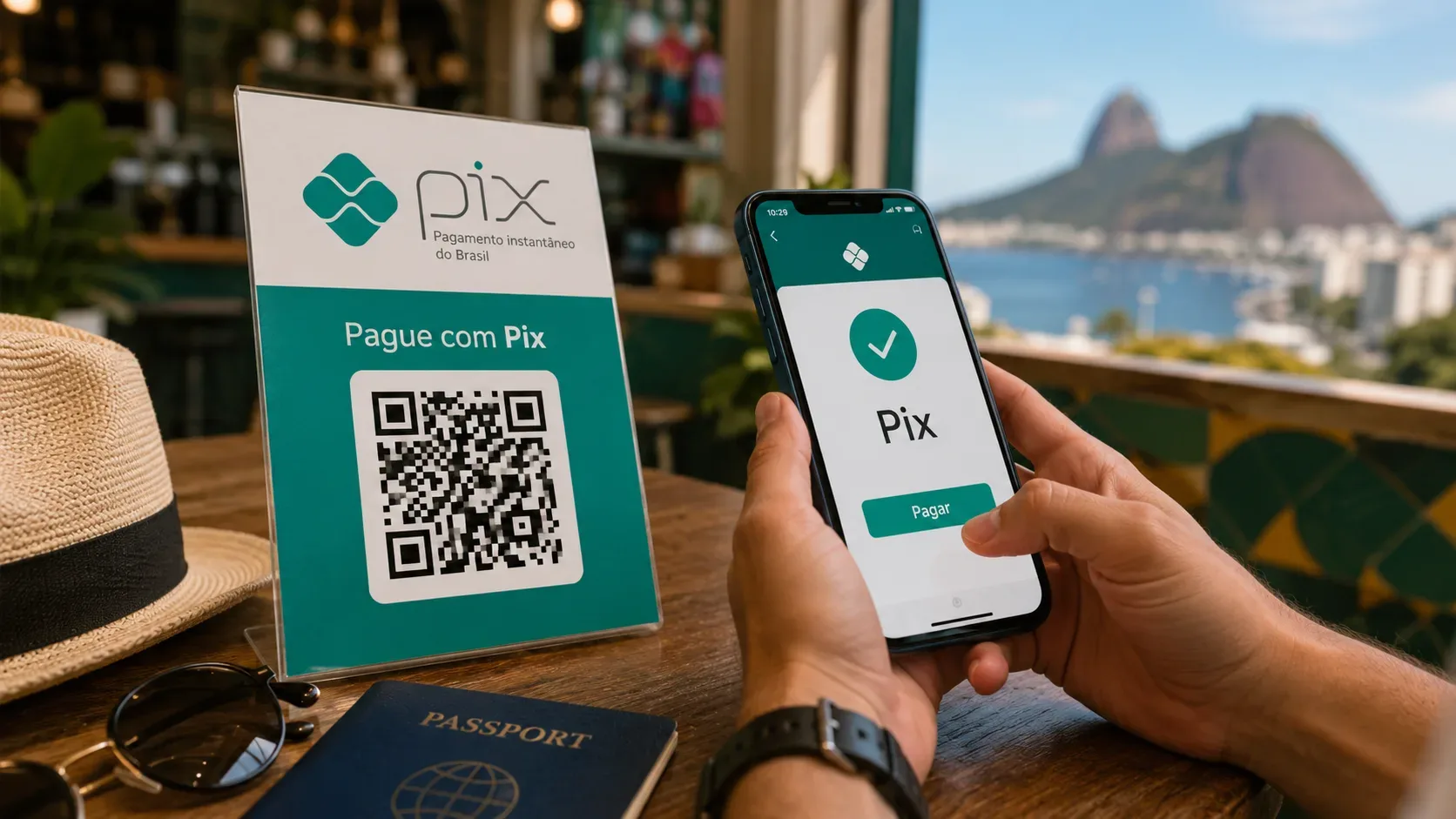
A Pix QR code carries the information needed to initiate a charge. It may include the recipient, amount and reconciliation data. But scanning the code has to end in an institution or service that can actually initiate and authenticate the transaction. The Central Bank lists Pix keys, account details, QR-code reading, Pix Copy and Paste and payment initiation as ways to make a Pix payment.
So a sign saying “Pix accepted” tells you what the merchant can receive; it does not guarantee that a visitor with any foreign bank can pay.
You do not need your own Pix key to pay
This is a common misconception. A Pix key is an account identifier that makes it easier to find the recipient, but the Central Bank says users are not required to register a key to use Pix. For the payer, the relevant requirement is access to an eligible account and the payment flow offered by their provider.
In other words, a tourist with an eligible account can pay a QR code without having a personal Pix key. The reverse is also true: knowing a merchant's key or scanning the code does not create Pix access when your account cannot originate the transaction.
Can foreigners open an account in Brazil?
There are paths for non-residents to open accounts in reais in Brazil, but this is not an automatic right or an instant travel step. The Central Bank says people who live abroad may open an account in Brazil at an institution authorized to operate in the foreign-exchange market; the institution is not required to open or maintain the account and sets its own documentation and fee policies.
Identification rules also allow identity documents recognized under Brazilian law for foreign account holders, but each institution is responsible for identifying and qualifying the customer and may request additional information. Do not therefore treat “getting a CPF” or “showing a passport” as a guarantee that any bank will open an account or enable Pix immediately.
What to do if you do not have a Pix-eligible account
- Use an international card where the merchant accepts it. For most travel spending, an international debit or credit card remains a straightforward alternative to Pix.
- Keep a small cash reserve. It helps when a seller accepts only Pix or cash, or when connectivity or the card terminal fails.
- Ask before you consume. At small businesses, markets, services and person-to-person payments, confirm that card or cash is available before committing to the purchase.
- Consider a local account only if it makes sense for the length of your stay. For longer stays, it may be worth contacting institutions that accept non-residents; onboarding, documentation, fees and Pix availability vary.
- If you use an international Pix bridge, understand that it is a separate service. Some companies may charge you abroad and settle locally through Pix. Compare total cost, FX, limits, refund policy and provider identity before using it.
How to evaluate a service that promises “Pix for tourists”
A private offer may be useful, but it does not change Pix's underlying rules. Ask where the money will come from, which currency you will be charged in, which institution will execute the transaction in Brazil and how many reais the recipient will get. Also check whether the service clearly shows its exchange rate, fees and support for a payment sent to the wrong person or a disputed charge.
When a Brazilian institution is involved, you can check the Pix participant list and the Central Bank's tool to find regulated or supervised institutions. This does not replace reading the service's terms, but it helps verify claims about the Brazilian leg of the operation.
Before you confirm: check the recipient and amount
For the QR-code journey, Pix rules require recipient information to be shown before confirmation. Use the same checks you would for any transfer: compare the displayed name with the business or person who should receive the money, confirm the amount in reais and only then authorize the payment. If an international service converts currencies, also check the final amount in your currency and any fees before tapping “confirm”.
A simple payment setup for your trip
For a short-term visitor, the most resilient setup is not to depend on a single payment method. Bring a working international card, a backup payment option and some cash. If your bank or wallet already shows explicit Pix support for Brazil, test the feature with a small amount and check the terms before relying on it as your main option.
If you plan to stay for months, work or spend long periods in the country, it makes more sense to investigate a real-denominated account that accepts non-residents and offers Pix. In that case, confirm required documents and available features directly with the institution instead of assuming every bank uses the same onboarding process.
Bottom line
Tourists can use Pix, but not because Pix is automatically open to every foreign account. Direct access depends on a checking, savings or prepaid payment account at a participating institution, or on a legitimate service that bridges into that infrastructure. You do not need your own Pix key to pay, and a QR code by itself does not create access. Without a compatible account or service, use a card, cash or another method the seller accepts.