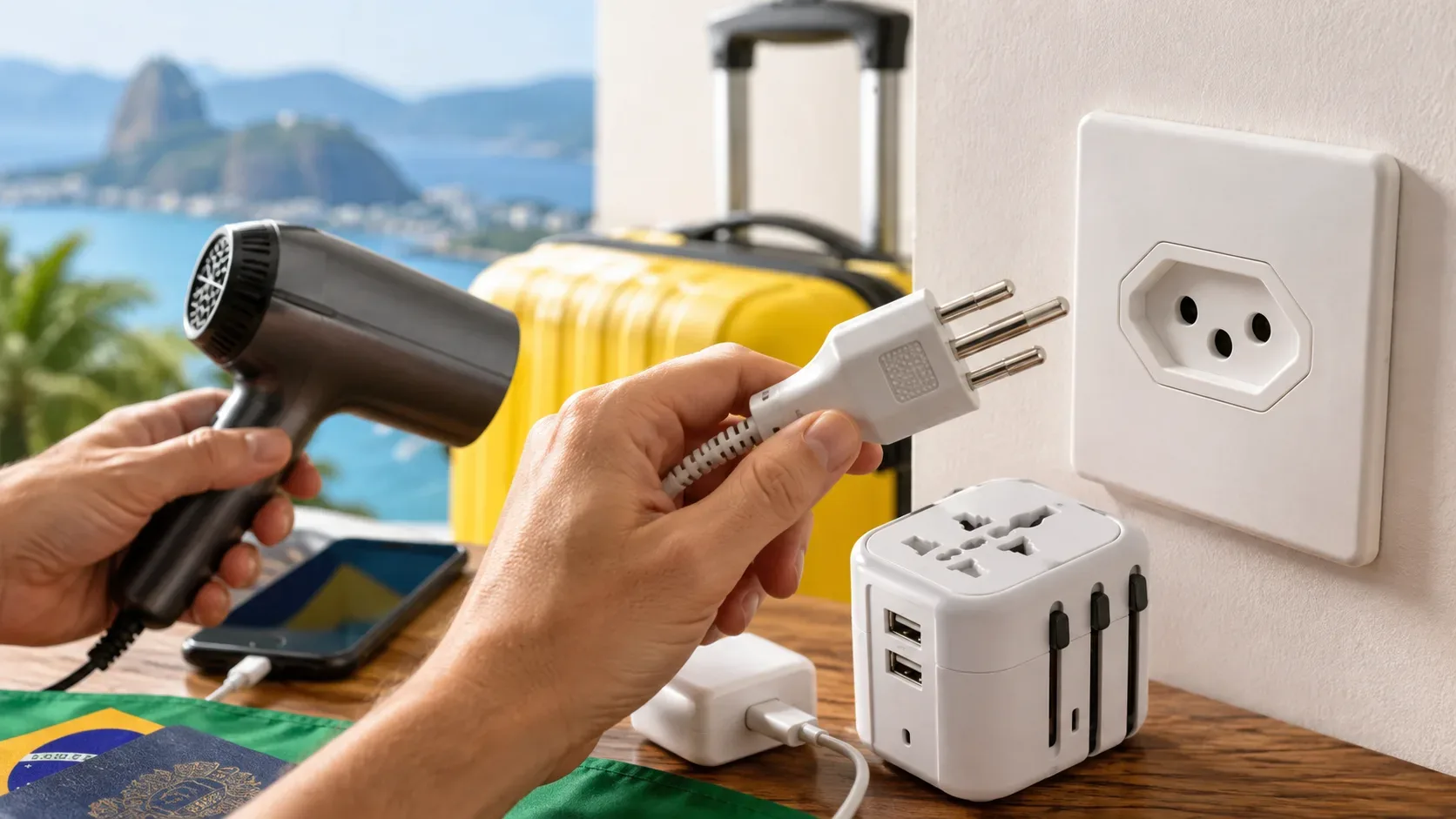
For a trip to Brazil with chargers and small appliances, there are two separate questions: does the plug physically fit the outlet? and is the outlet voltage compatible with the device? Brazil uses a round-pin standard, but the country does not have one single nationwide supply voltage. An adapter can solve the plug-shape problem and still leave the device unsafe for that outlet.
Quick answer: when you need an adapter, a voltage check, or a converter
| Situation | What to do |
|---|---|
| Your plug fits a Brazilian outlet and the device accepts the local voltage | Plug it in directly. |
| The device accepts the local voltage, but the plug shape does not fit | Use a travel plug adapter. |
| The plug fits, but the device does not accept the local voltage | Do not plug it in directly. You may need a voltage converter or transformer rated for the device. |
| You do not know whether the outlet is 127 V or 220 V | Ask the hotel/host, check for labeling near the outlet, or confirm with the local utility before using a single-voltage appliance. |
What Brazilian power outlets look like
Brazil standardized plugs and sockets under ABNT NBR 14136. According to Inmetro, the standardized socket has three holes, while Brazilian plugs can have two or three round pins. Inmetro also distinguishes 10 A and 20 A versions by pin diameter: 4.0 mm and 4.8 mm, respectively.
International travel guides usually call this Type N. A 10 A Type N socket is designed to accept the slim two-pin European Type C plug as well; plugs with other shapes — such as the flat blades used in the United States and Canada or the British plug — normally need an adapter. A practical compatibility reference is available from World Standards.
Even when two round-pin plugs look similar, do not force a plug into the socket. Pin shape and diameter, grounding, and current rating matter. If in doubt, use a suitable, undamaged adapter.
127 V vs 220 V: why voltage is the more important check
Do not assume all of Brazil uses the same voltage. Inmetro itself notes the coexistence of 110 V, 127 V, and 220 V distribution systems and the broad use of 220 V. For travel planning, 127 V and 220 V are the two values that most often require attention, and differences can exist between cities, neighborhoods, properties, or even circuits within one property.
That is why a state-by-state voltage list should be treated only as a starting point. For a hair dryer, styling tool, iron, shaver, travel kettle, or another higher-power single-voltage appliance, confirm the voltage of the actual outlet you intend to use.
How to read the label on your charger or appliance
- “INPUT 100–240 V, 50/60 Hz”: the device or power supply is designed to accept both a supply around 127 V and 220 V. You only need to solve the plug-shape issue if the plug does not fit.
- “127 V” or “110–120 V” only: do not use it directly on a 220 V outlet. A plug adapter does not step voltage down.
- “220–240 V” only: on a 127 V outlet, the device may not work correctly or may deliver inadequate performance. Do not improvise.
- Manual 110/220 or 127/220 selector: set the switch correctly before plugging in. The wrong setting can damage the equipment.
Modern phone, tablet, and laptop chargers are often wide-input devices, but you should confirm that on your own charger’s label. Heating appliances and motors deserve extra attention because they usually draw more power and can be more sensitive to voltage and frequency.
A plug adapter is not a voltage converter
A travel adapter changes only the mechanical connection between your plug and the wall socket. It does not convert voltage or frequency, as the UK safety organization Electrical Safety First explains. A converter or transformer, by contrast, is selected to change supply voltage and must be rated for the appliance’s power draw.
This matters especially for hair dryers and other heating appliances, which can draw substantial wattage. If a device is single-voltage and incompatible with the local supply, the simpler choice for a short trip is often to use a dual-voltage device or an appliance supplied by your accommodation rather than carry a heavy, high-wattage converter.
What to pack
- A travel adapter for Brazil’s Type N standard if your plugs are not compatible.
- 100–240 V chargers whenever possible.
- A clear photo of the electrical label on any important appliance.
- Advance confirmation of the property’s outlet voltage if you plan to use single-voltage equipment.
A 30-second check at a hotel or vacation rental
- Look at the outlet: the Brazilian standard uses round holes with a central grounding position.
- Confirm whether the outlet/circuit is 127 V or 220 V; do not infer it from the city alone.
- Read the “INPUT” line or rated voltage on your charger/appliance.
- If voltage is compatible and only the plug shape differs, use an adapter.
- If voltage is not compatible, do not plug in directly; use a properly rated conversion solution or a different device.
Bottom line
For travelers, the safest rule is to separate plug fit from voltage. Brazil uses the round-pin ABNT NBR 14136 standard, internationally known as Type N, but local supply can be 127 V or 220 V. Check both the device label and the local outlet voltage. If the only mismatch is plug shape, an adapter is enough; if the voltage does not match, you need a different electrical solution, not just an adapter.
Reference sources: Inmetro — Plugs and Sockets, Inmetro — voltage systems in Brazil, and Electrical Safety First — travel adapters.