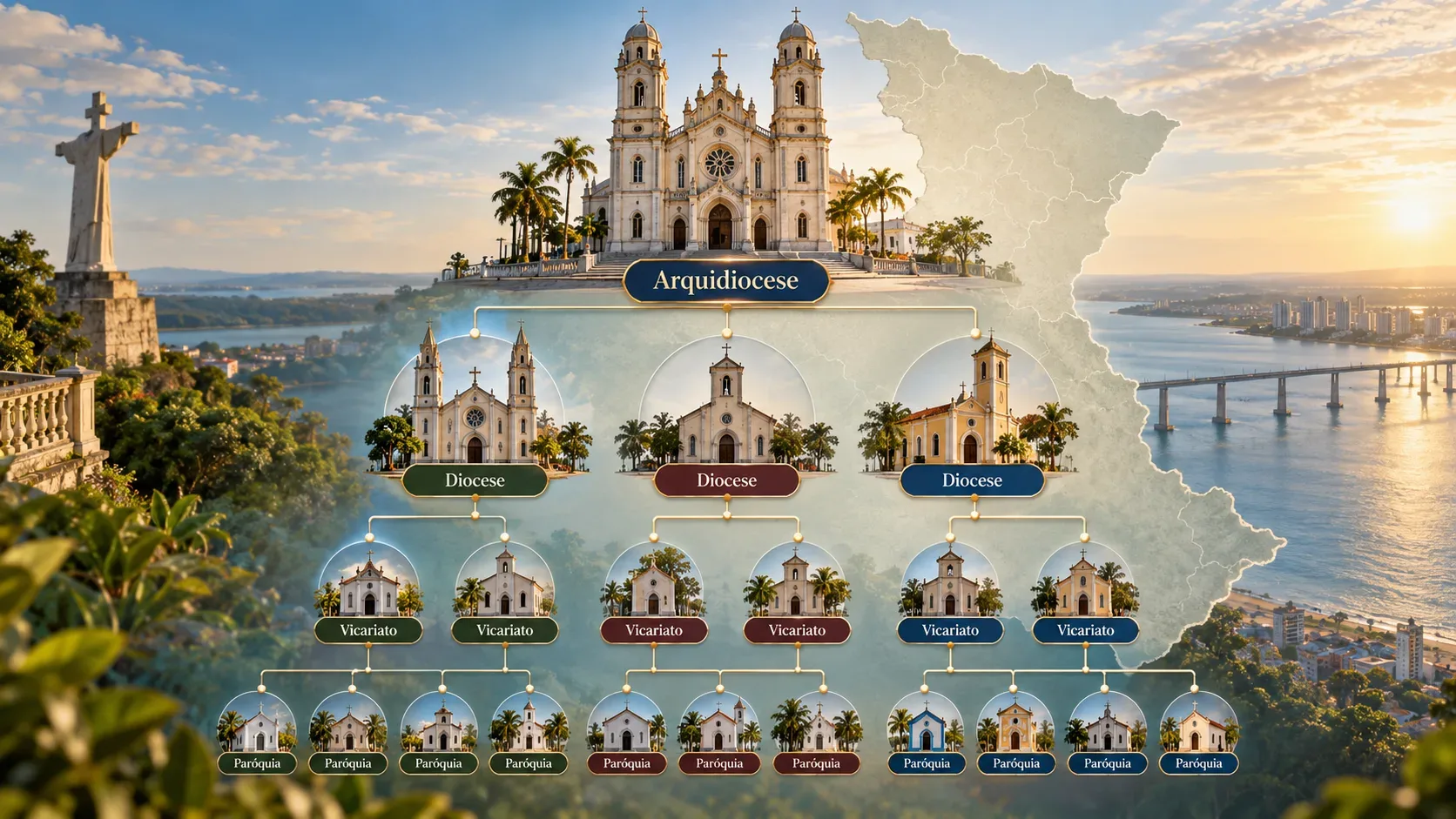
In Sergipe, the territorial organization of the Catholic Church becomes easier to understand when one separates an ecclesiastical jurisdiction from a pastoral grouping and from a religious building. The short version is this: the Ecclesiastical Province of Aracaju brings together the Archdiocese of Aracaju and the dioceses of Estância and Propriá; within each particular Church there are parishes; and neighboring parishes may be grouped into vicariates to coordinate pastoral work.
How the pieces fit together
| Term | What it is | Who has pastoral responsibility | Example in Sergipe |
|---|---|---|---|
| Ecclesiastical province | A group of nearby dioceses brought together to foster pastoral cooperation. | The metropolitan presides over the province within the competencies established by canon law. | Ecclesiastical Province of Aracaju. |
| Archdiocese | A diocese entrusted to an archbishop. When it is a metropolitan see, it gives its name to the province. | Diocesan archbishop; when metropolitan, he also exercises the specific functions established for the province. | Archdiocese of Aracaju. |
| Diocese | A particular Church, normally defined territorially, entrusted to a bishop. | Diocesan bishop. | Diocese of Estância and Diocese of Propriá. |
| Regional vicariate | A grouping of nearby parishes designed to facilitate coordination and common pastoral action. | Regional vicar, under the authority of the bishop or archbishop of that diocese. | Regional vicariates of the Archdiocese of Aracaju, such as São Lucas and São Tiago Apóstolo. |
| Parish | A stable community of the faithful within a diocese or archdiocese. | Pastor, under the authority of the diocesan bishop. | The parishes listed by the official websites of Sergipe's three jurisdictions. |
Archdiocese does not mean that the archbishop governs every diocese in Sergipe
The official history of the Archdiocese of Aracaju records that the Diocese of Aracaju, created in 1910, was elevated to a metropolitan see on April 30, 1960, when the dioceses of Estância and Propriá and the Ecclesiastical Province of Aracaju were also created. This explains why the three names appear together, but it does not turn Estância and Propriá into administrative departments of the Archdiocese.
The Code of Canon Law, canons 435 and 436, establishes that the metropolitan archbishop presides over the province and has specific competencies regarding suffragan dioceses. The same text makes clear that this title does not give him general governing authority over those dioceses. Estância and Propriá have their own diocesan government.
What a diocese is
Under canon 369, a diocese is a portion of the people of God entrusted to the pastoral care of a bishop, with the cooperation of the presbyterium. In practice, it brings together people, communities, parishes, clergy, pastoral bodies and, in most cases, a defined territory.
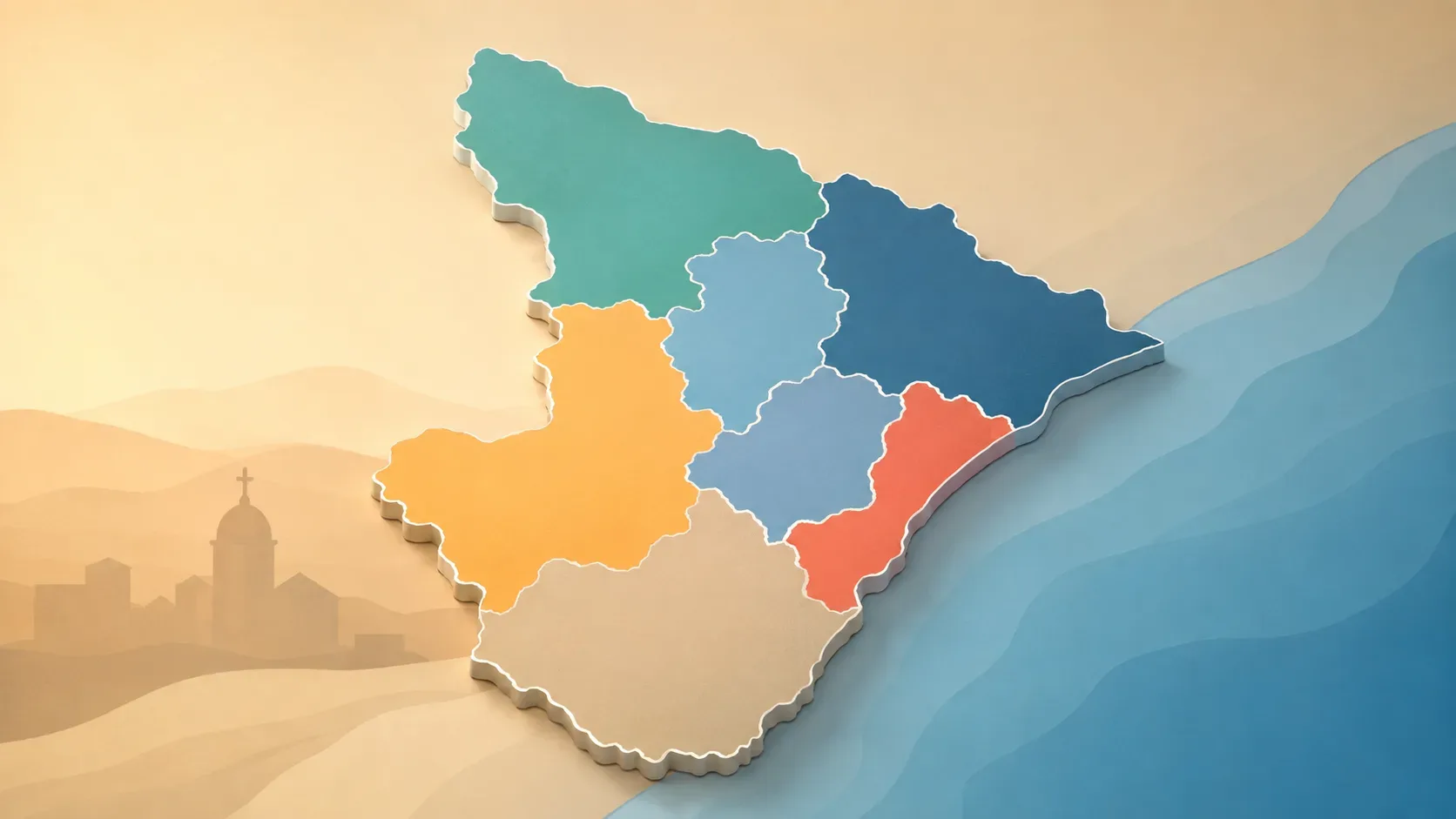
In Sergipe, the ecclesiastical province is made up of three particular Churches: the Archdiocese of Aracaju, the Diocese of Estância and the Diocese of Propriá. The Archdiocese itself records this composition, and the Diocese of Propriá also states that it belongs to the Ecclesiastical Province of Aracaju.
What a regional vicariate is
A regional vicariate is not a new diocese. It is a way of grouping parishes to bring pastoral coordination closer to local communities. Canon 374, paragraph 2, allows neighboring parishes to be joined into special groupings to foster common pastoral action.
In the Archdiocese of Aracaju, this structure was revised in January 2025. A decree publicized by the Archdiocese abolished the former episcopal vicariates and foranias and instituted regional vicariates, each accompanied by a regional vicar. The official parish page lists São João, São Lucas, São Marcos, São Mateus, São Paulo and São Pedro. In July 2026, the Archdiocese instituted the São Tiago Apóstolo Regional Vicariate, bringing together parishes in São Cristóvão and Itaporanga d'Ajuda.
Because vicariates are instruments of local pastoral organization, their composition can change by decision of the diocesan authority. To find a parish's current affiliation, the safest reference is the official directory of the relevant diocese or archdiocese.
What a parish is
A parish is not the same thing as a church building. According to canon 515, it is a stable community of the faithful within a particular Church, whose pastoral care is entrusted to a pastor under the authority of the diocesan bishop.
A parish may include a main church, chapels, communities, neighborhoods, rural settlements and different pastoral ministries. So when someone says they belong to a certain parish, they are referring to a pastoral and territorial community, not only to the building where they usually attend Mass.
Mother church, shrine and cathedral are not extra levels of the same hierarchy
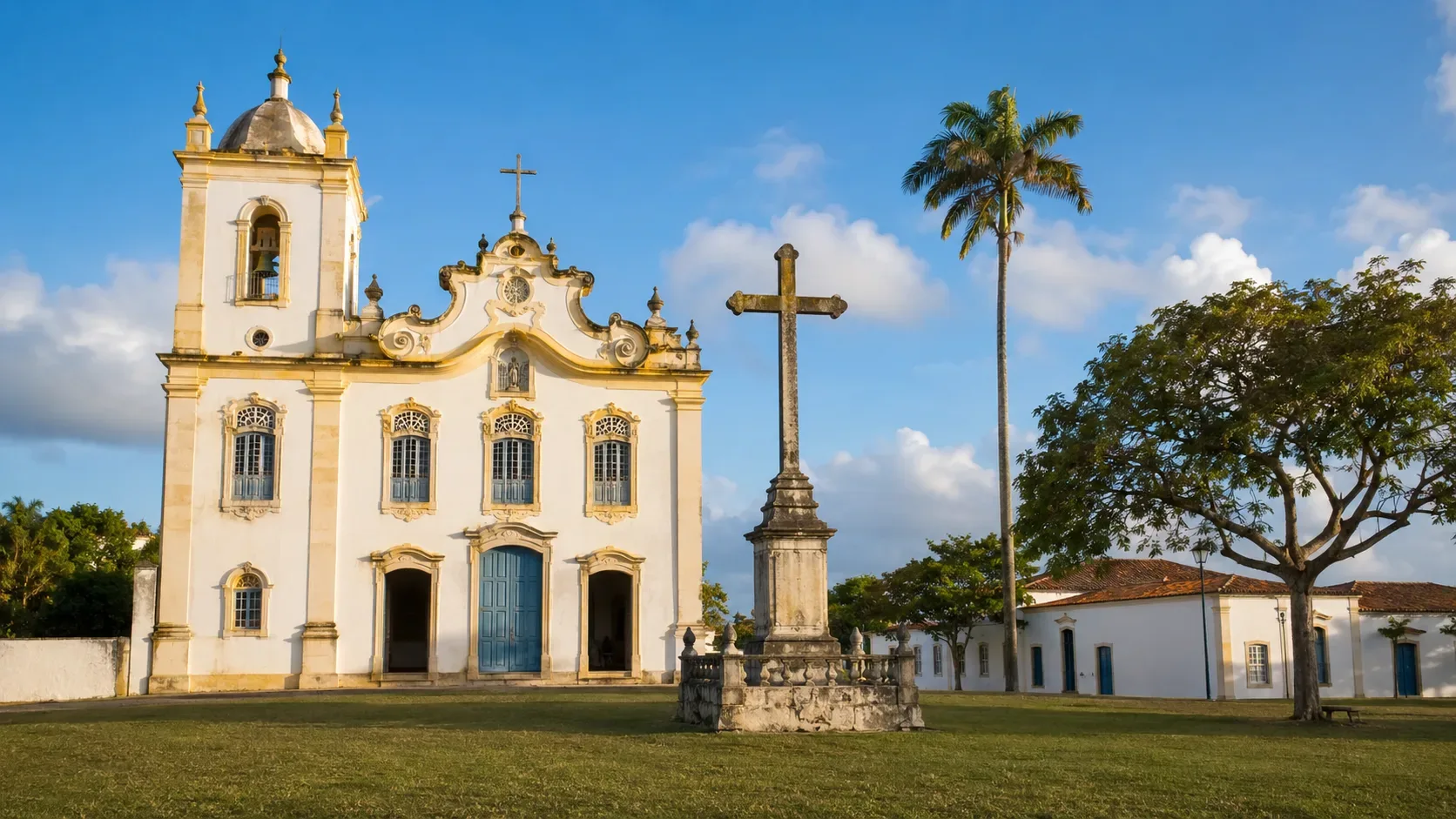
Mother church, or igreja matriz in Brazilian usage, is the principal church of a parish. It serves as the central reference point for that parish community, but the parish is larger than the building. Other chapels and communities may belong to the same parish.
Shrine is a different category. Canon 1230 defines a shrine as a church or other sacred place to which numerous members of the faithful make pilgrimage for a special reason of piety, with the approval of the competent authority. The same building can combine functions. In 2026, for example, the Archdiocese described the Church of Nossa Senhora da Vitória in São Cristóvão as both a Mother Church and Shrine during the celebration that instituted the São Tiago Apóstolo Vicariate.
Cathedral is the church that contains the bishop's cathedra, the liturgical seat symbolizing his teaching and governing ministry in the diocese. The Metropolitan Cathedral of Aracaju became a cathedral when Aracaju was erected as a diocese. Cathedral therefore describes a church's function within a diocese, not a territory above the parish.
An important caution about the word vicariate
In the Catholic Church, the word vicariate can appear in different contexts. A regional or forane vicariate is a grouping of parishes within a diocese. An apostolic vicariate, provided for in canon 371, is a different type of ecclesiastical jurisdiction, generally used in missionary contexts and treated as a particular Church in certain respects. Aracaju's regional vicariates are not apostolic vicariates.
How to identify the structure of a Catholic community in Sergipe
- First, identify the diocese or archdiocese to which the municipality belongs.
- Then identify the parish responsible for the community or area.
- Within the Archdiocese of Aracaju, also check the regional vicariate to which the parish belongs.
- Finally, check whether the local church is a mother church, chapel, shrine or cathedral. These names describe functions of a building and do not replace the parish or diocese.
This sequence avoids the most common confusion: treating archdiocese, diocese, vicariate, parish, mother church and shrine as if they were equivalent levels of a single ladder. In reality, some terms designate territories and communities, some organize pastoral work and others describe specific church buildings.
Where to check updated information
For the Archdiocese of Aracaju, the official parish directory is the practical source for checking names and affiliations. Vicariate boundaries, parishes and other governance arrangements can be changed by decree. For general concepts, the normative reference is the Code of Canon Law; for local composition, always consult the official website of the relevant ecclesiastical jurisdiction.