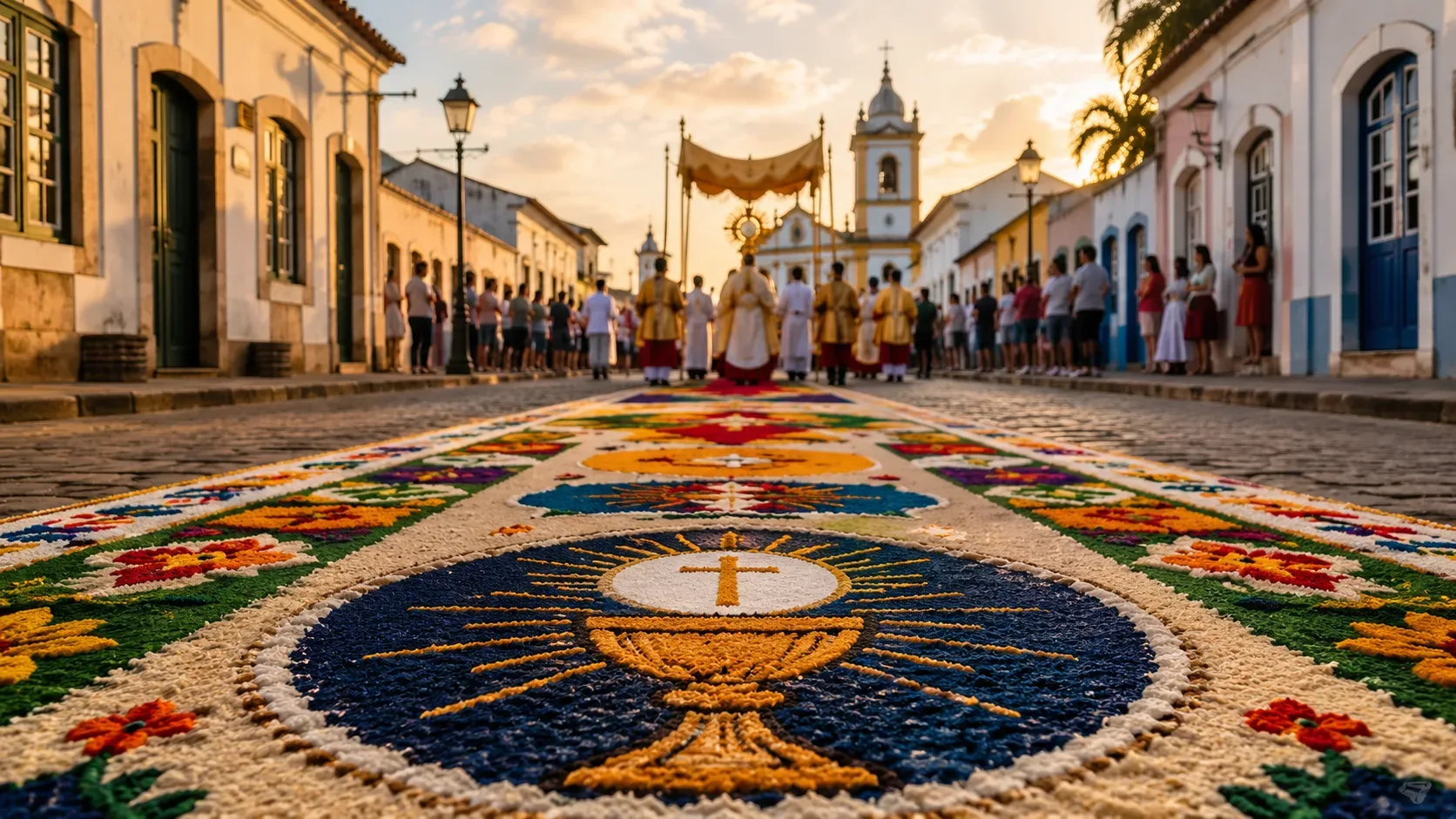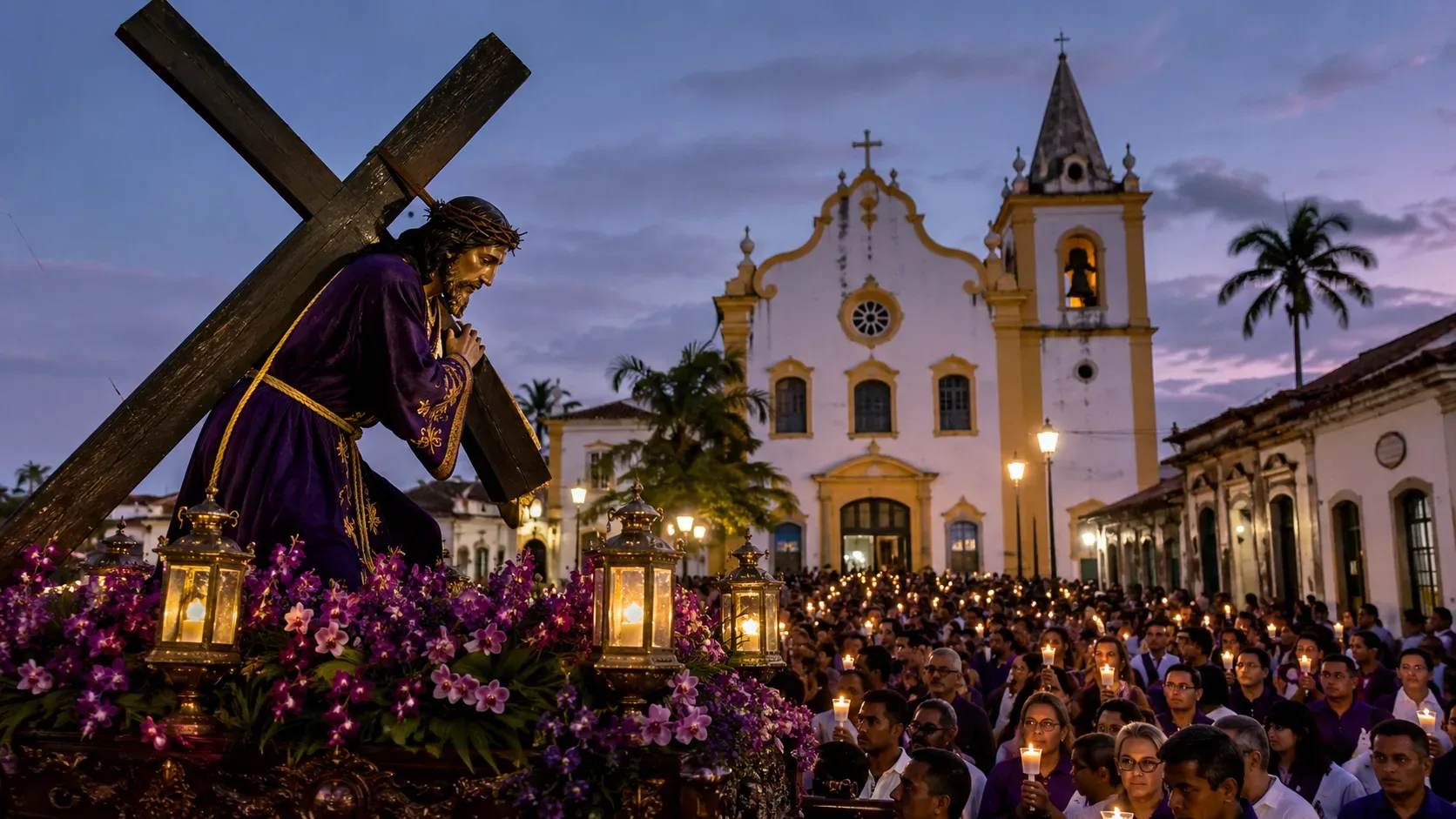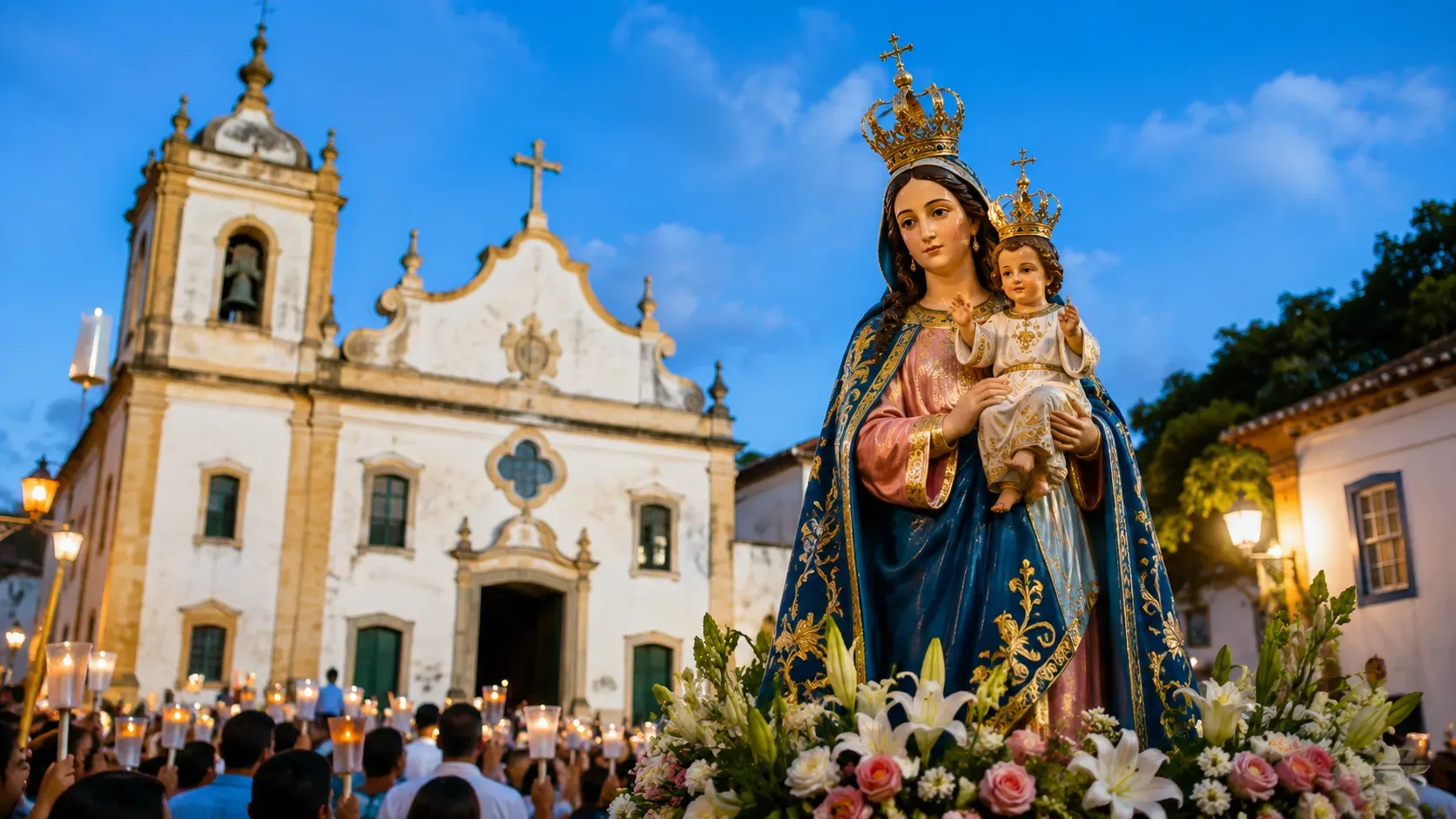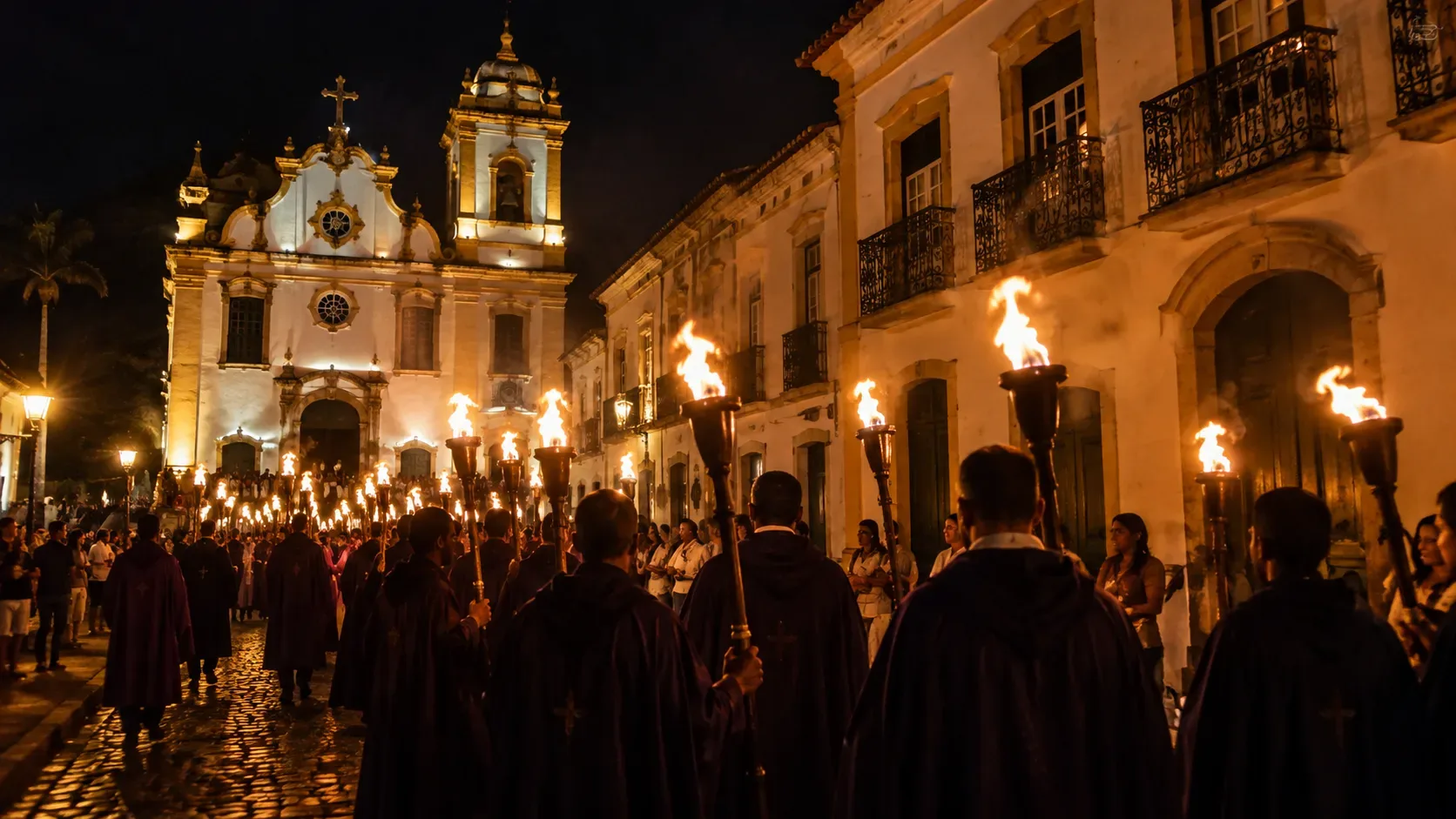
The Fogaréu Procession in São Cristóvão takes place on Holy Thursday in the Historic Center. The calendar date therefore changes every year according to Holy Week. Anyone planning to attend a future edition should distinguish between recurring traditions and details that must be confirmed each year: times, traffic closures, the number of participants and even parts of the route may be adjusted by the organizers.
In 2026, the official program began at 6 p.m. with the Mass of the Washing of the Feet at the Sanctuary and Parish of Nossa Senhora da Vitória, in Praça da Matriz. At 8 p.m., the Passion of Christ was staged in Praça São Francisco, followed by the procession through ten streets of the Historic Center. The City Hall reported about 100 actors and more than 200 men carrying torches. See the official 2026 program.
When the Fogaréu Procession takes place
The most stable rule is simple: the celebration is held on the night of Holy Thursday, as part of Holy Week. That is why the day of the month changes from year to year. In 2023, for example, it was held on April 6; in 2024, on March 28; in 2025, on April 17; and in 2026, on April 2.
For a future visit, use Holy Thursday as the calendar reference, but check the municipality's official program close to the date. The City Hall publishes notices about schedules, event infrastructure and traffic for each edition.
Mass, Passion play and procession are not the same thing
The evening usually brings together three related but distinct moments. Understanding the sequence helps visitors who want to see only one part or follow the whole celebration.
- Mass of the Washing of the Feet: held at the main church, the Sanctuary and Parish of Nossa Senhora da Vitória, in Praça da Matriz. In 2026 it began at 6 p.m.; in 2025, at 5 p.m.
- Passion of Christ staging: held in Praça São Francisco, with scenes related to the final moments of Jesus's life. Recent editions have included the entry into Jerusalem, the Last Supper, the pursuit and the condemnation of Christ.
- Fogaréu Procession: follows the staging or is integrated into the dramatic sequence. Men carrying torches move through the historic streets, accompanied by spectators and expressions of faith.
This distinction matters because annual news reports may emphasize specific times or scenes without making clear that the torch procession is only one part of a broader religious and theatrical program.
How the Fogaréu Procession works
The central visual element is the nighttime movement of men carrying lit torches through the Historic Center. The City Hall describes the procession as a moment symbolizing the arrest of Jesus and reports that public lighting may be switched off along parts of the circuit so that the torches dominate the streetscape.
The event is organized by the G12 commission or group, made up of São Cristóvão residents, with municipal support for infrastructure, logistics, traffic management and publicity. The City Hall links the local tradition's origins to the 18th century and Portuguese Franciscans, while also describing the contemporary group responsible for staging it as having worked for decades.
What route the Fogaréu Procession follows
The route should be treated as a reference circuit that must be confirmed each year. In 2026, the official notice said the procession would cover ten streets in the Historic Center, including the areas around Praça do Carmo and Praça São Francisco, but that announcement did not publish the full street-by-street list.
In 2025, a specific traffic notice detailed the route used for that edition. The sequence announced was:
- Rua Coronel Erundino Prado;
- Rua do Rosário;
- Praça João Francisco dos Reis;
- Travessa 31 de Março;
- Rua 31 de Março;
- Rua Engenheiro Botto de Barros;
- Rua Messias Prado;
- Praça do Carmo;
- Rua Tobias Barreto;
- Praça Getúlio Vargas;
- Rua Ivo do Prado.
See the 2025 traffic notice with the detailed circuit. This is the best recent reference for understanding the area occupied by the event, but it should not be treated as a permanent route: closures, staging points and traffic direction can change.
Where to arrive to follow the event
For first-time visitors, three landmarks are useful: Praça da Matriz, home to the Sanctuary of Nossa Senhora da Vitória and the usual location of the Mass of the Washing of the Feet; Praça São Francisco, where recent editions have concentrated the Passion staging; and Praça do Carmo, traditionally included in the circuit.
Because the procession occupies narrow historic streets and requires road closures, arriving before the program starts reduces the risk of finding access routes blocked. In 2025, for example, the City Hall announced partial closures from 5:30 p.m. and a full closure of the staging circuit from 6:30 p.m. Parking areas and alternative routes were also announced specifically for that edition.
What to confirm before leaving
| Information | What tends to remain | What to confirm for your year |
|---|---|---|
| Date | Holy Thursday | Exact calendar date |
| Location | Historic Center of São Cristóvão | Assembly points and access routes |
| Stages | Mass, Passion staging and torch procession | Times and program order |
| Route | Historic streets and squares, including the Carmo and São Francisco areas | Exact streets, direction and closures |
| Traffic | Road restrictions are used for event safety | Closure times, parking and alternative routes |
The best place to confirm details is the São Cristóvão City Hall website, especially Culture/Tourism, Mayor's Office and Traffic news. Notices from 2023, 2024, 2025 and 2026 show that the program is published repeatedly. Example of the official 2024 announcement and example of the official 2023 announcement.
How to take part respectfully and safely
- Arrive early and follow traffic guidance and instructions from event staff.
- Remember that cobblestones and historic streets may require comfortable shoes and extra care with mobility.
- Keep a safe distance from the torches and do not try to cross through the moving procession.
- Avoid blocking church doors, passageways and areas reserved for the staging.
- If you want to follow the whole evening, allow time for the Mass, the staging and walking through the streets.
What makes the Fogaréu night distinctive
The Fogaréu Procession is more than a walk lit by fire. In São Cristóvão, it combines liturgy, religious theater, use of the historic urban setting and a nighttime procession whose atmosphere depends on the relationship between torches, old streets and scenes from the Passion. The City Hall describes it as one of Sergipe's most striking cultural and religious manifestations.
For visitors, the most useful planning approach is to think in two layers: the permanent structure — Holy Thursday, the Historic Center, Mass, staging and procession — and the yearly details that must be checked when each edition is announced. This makes it possible to understand the tradition without depending on a single year's news report while still arriving with the correct practical information.