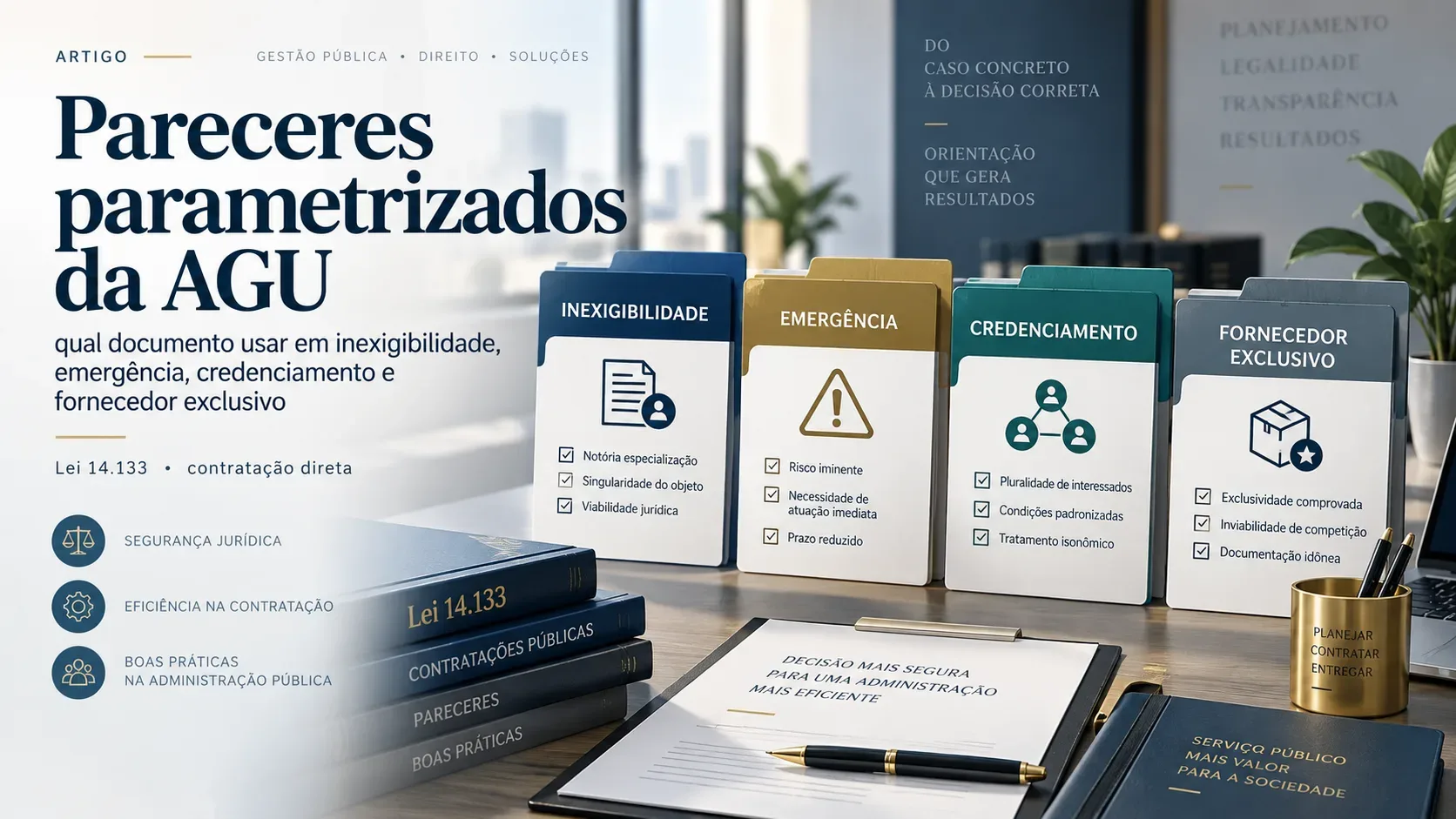
The official Brazilian Attorney General's Office (AGU) page for parameterized legal opinions on direct contracting was updated on September 8, 2026 and lists different documents according to the legal basis and the subject of the procurement. Under Law No. 14,133/2021, the correct choice starts with classifying the concrete case: accreditation (credenciamento) and an exclusive supplier are treated as grounds for non-competitive procurement due to impossibility of competition, while an emergency or public calamity is a waiver of the bidding procedure. The National ID is a precise locator for the opinion, but it does not replace checking the current version or proving the statutory requirements in the procurement file.
Quick map: scenario, legal basis and AGU opinion
| Scenario | Main legal basis | Parameterized opinion / ID | When it should not be the first reference |
|---|---|---|---|
| Training courses | Article 74, main clause, or Article 74(III)(f), depending on the legal classification | ID 647772 — Non-competitive procurement — Training Courses | When the subject is not staff training or professional development; for other specialized intellectual services, check ID 828035. |
| Accreditation (credenciamento) | Article 74(IV), together with the scenarios in Article 79 of Law No. 14,133/2021 | ID 729752 — Non-competitive procurement — Contracting through Accreditation | When the procurement does not fit the statutory accreditation scenarios or the choice of that model is not properly reasoned. |
| Emergency or public calamity | Article 75(VIII) | ID 814542 — Bidding waiver for Emergency or Public Calamity — with or without SRP | When there is no urgency as defined by law, or when the intended contract goes beyond what is necessary to address the emergency or calamity. |
| Exclusive supplier — general | Article 74(I) | ID 814600 — Non-competitive procurement — Exclusive Supplier — with or without SRP | When there is no reliable document proving exclusivity, or when the case is specifically an ICT procurement, for which AGU lists a dedicated opinion. |
| Exclusive supplier — ICT | Article 74(I), applied to an information and communications technology subject | ID 815710 — Non-competitive procurement — Exclusive Supplier — ICT | When the subject is not ICT; in that case, ID 814600 is the general exclusive-supplier reference. |
| ECT postal services | Article 74(I) and/or Article 75(IX), depending on the case | ID 814621 — Direct Contracting — Postal Services — ECT | For exclusive suppliers in general or for services that are not the postal services covered by the opinion. |
| Specialized intellectual technical services | Article 74(III) | ID 828035 — Non-competitive procurement — Specialized Intellectual Technical Services | When a more specific opinion exists for the subject, such as training courses, or when the requirements of Article 74(III) are not met. |
The table reflects the set published by ELIC/PGF on its direct contracting — non-competitive procurement and bidding waiver page. Because the list may be updated, it is prudent to verify both the ID and the document name before attaching an opinion to a procurement file.
Non-competitive procurement and a bidding waiver are different routes
For non-competitive procurement under Article 74, the starting point is the impossibility of competition. The statute lists examples such as an exclusive supplier, specialized technical services provided by professionals or firms of recognized expertise, and subjects that must or may be contracted through accreditation. Emergency or public calamity, by contrast, is addressed by Article 75(VIII) as a waiver of the bidding procedure. An emergency procurement therefore should not be treated as non-competitive procurement merely because time is short or because the Administration intends to contract directly.
This distinction prevents a common error: choosing an opinion based on the desired result — “direct contracting” — rather than on the legal basis that explains why a competitive bidding process will not be held. The first filter should always be the statutory ground and the facts supporting it.
Accreditation: use ID 729752 only when the design is genuinely an accreditation procedure
Opinion ID 729752 is the AGU document identified for non-competitive procurement through accreditation, referring to Article 74(IV). Law No. 14,133/2021 treats accreditation as an auxiliary procedure and, in Article 79, provides scenarios such as parallel and non-exclusive contracting, selection by third parties and fluid markets; legislation also now provides for electronic commerce through the Express Purchasing System (Sicx).
At the federal level, Decree No. 11,878/2024 requires the decision to use accreditation to be reasoned during the preparatory phase and to satisfy the conditions for direct contracting due to non-competitive procurement. In practical terms, the mere existence of several possible suppliers is not enough: the file should explain why accreditation fits the need and which statutory scenario supports it.
Before using this opinion, check Decree No. 11,878/2024 and the current wording of Articles 74 and 79 of Law No. 14,133/2021.
Emergency or public calamity: ID 814542 is a bidding waiver, not non-competitive procurement
For an emergency or public calamity, AGU lists ID 814542, titled “Bidding Waiver for Emergency or Public Calamity — with or without SRP.” The central legal basis is Article 75(VIII). The statute requires urgency capable of causing loss or jeopardizing continuity of public services or the safety of people, works, services, equipment and other public or private assets.
The law also limits the scope of the contract: it must be restricted to goods necessary to address the emergency or calamity and to portions of works and services that can be completed within a maximum of one year from the event. The provision bars extensions of contracts entered into on that basis and re-contracting the same company under the same statutory item.
The emergency opinion is therefore not a shortcut for any planning delay. If the statutory urgency is absent, another legal basis is required. If urgency exists, the file should show the connection between the concrete situation, the subject of the contract and the strictly necessary scope of the response.
Exclusive supplier: distinguish the general opinion from the ICT opinion
Article 74(I) permits non-competitive procurement for materials, equipment, goods or services that can only be supplied by an exclusive producer, company or commercial representative. The law requires the Administration to prove the impossibility of competition through an exclusivity certificate, exclusivity agreement, manufacturer statement or another reliable document, and it prohibits a preference for a specific brand as a stand-alone justification.
The updated AGU page lists two documents that should be kept separate:
- ID 814600 — Exclusive Supplier — with or without SRP: the general reference for Article 74(I);
- ID 815710 — Exclusive Supplier — ICT: the specific reference when the subject is information and communications technology.
For an ICT procurement, starting with the specific opinion reduces the risk of relying on a generic checklist that may not reflect the object's particularities. If the subject is not ICT, ID 814600 is the more closely matched reference of the two. In either case, the opinion does not replace the evidence of exclusivity required in the procurement file.
Training and other technical services: AGU lists different documents
The AGU list also avoids treating every intellectual service as the same situation. ID 647772 is specific to training courses and refers to Article 74, main clause, or Article 74(III)(f), which covers staff training and professional development. ID 828035, in turn, covers specialized intellectual technical services under Article 74(III) more broadly.
This distinction matters because the subject should drive the document choice. A training-course procurement need not begin with a generic technical-services opinion when a training-specific opinion exists; conversely, consultancy, expert appraisal, design work or another intellectual service should not automatically be treated as a training course.
Checklist before using a parameterized opinion
- Define the subject precisely: what will be contracted and which public need will it address?
- Identify the statutory ground: Article 74(I), (III) or (IV); Article 75(VIII); or another basis that actually applies.
- Look for specificity: check whether AGU has a dedicated document for ICT, ECT, training or another subset of the subject.
- Verify the ID and name on the current page: the AGU page was updated on September 8, 2026 and may be revised again.
- Document the facts and evidence: proof of exclusivity, characterization of the emergency, reasoning for accreditation and other requirements are not replaced by the opinion.
- Adapt the model to the concrete case: AGU's general guidance on procurement models recommends checking the characteristics of the procurement and any legislative, doctrinal or case-law changes not yet incorporated into the model.
Which document to use for the four most common questions
In short: accreditation → ID 729752; emergency or public calamity → ID 814542; exclusive supplier in general → ID 814600; exclusive ICT supplier → ID 815710. For non-competitive procurement of training courses, start with ID 647772; for other specialized intellectual technical services, check ID 828035.
The value of a parameterized opinion is that it provides a legal review framework that is better matched to the type of procurement. The decisive precaution is not to reverse the logic: first the procurement file proves the statutory ground and characterizes the subject; then the corresponding opinion is selected — always checking the current version and the guidance of the competent legal advisory body.