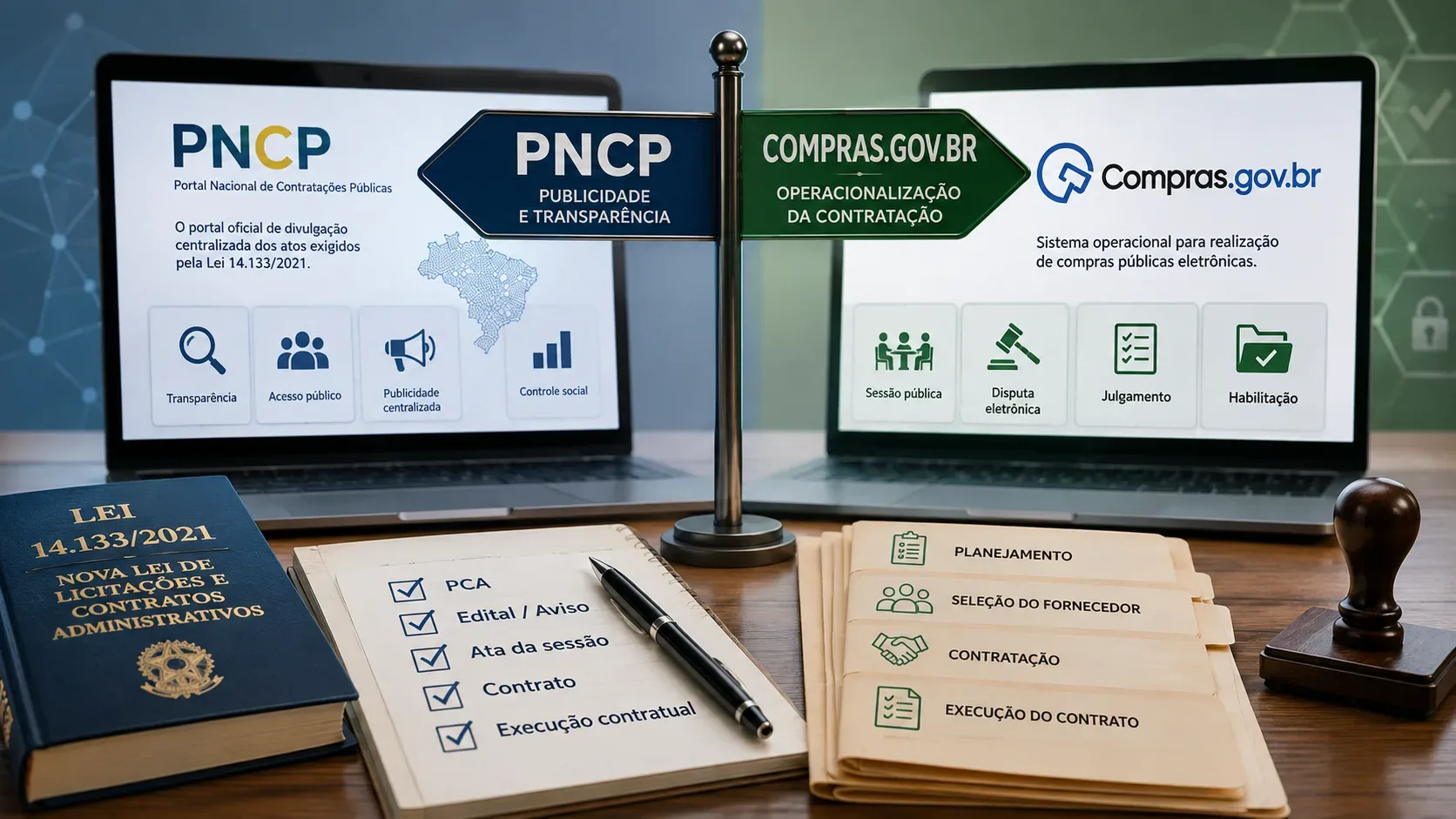
For a municipality, the safe answer is not simply “yes, because Decree 10,947 says so” nor “no, because Law 14,133 uses the word may”. Law No. 14,133/2021 provides a national basis, Decree No. 10,947/2022 directly regulates the federal Public Administration and the Law itself allows States, the Federal District and Municipalities to apply regulations issued by the Union. The conclusion about mandatory, flow, deadline, PGC and publication depends on identifying which of these standards was effectively incorporated or complemented in the entity and verifying the guidance of the competent external control.
The answer begins by separating three questions
The first question is what Law No. 14,133/2021 determines in itself. The second is which regulation governs the municipal entity: a specific decree, a normative instruction, an express reference to federal rules or another normative combination. The third is how the competent municipal audit court or audit court has interpreted the issue. Mixing these three layers produces categorical answers that may be correct for one entity and wrong for another.
What Law 14,133 really says about the PCA
Item VII of article 12 states that, based on the documents formalizing demands, the bodies responsible for planning for each federative entity will be able, in the form of regulations, to prepare an annual hiring plan. The device associates the PCA with the rationalization of hiring, alignment with strategic planning and support for the drafting of budgetary laws.
Writing matters. The Law uses “may” and conditions drafting to the form of regulation. Furthermore, article 18 determines that the preparatory phase must be compatible with the PCA “whenever prepared”. These two elements prevent the removal, just from the text of the national law, of a simple rule according to which every municipality would automatically be subject to the same federal PCA rite.
This does not mean that planning is optional. Planning is an express principle of Law No. 14,133/2021. And, when the PCA is prepared, the first paragraph of article 12 determines its publication and maintenance available to the public on the official website, in addition to requiring the entity to observe it when carrying out bids and executing contracts. In other words: discussing whether the PCA is mandatory does not authorize treating annual hiring planning as dispensable.
Decree 10,947 is not automatically a municipal regulation
Decree nº 10,947/2022 is often cited as if it alone established the routine of all entities. Article 1 itself, however, delimits its scope: Direct, autonomous and foundational federal Public Administration. Within the scope that it regulates, the PCA is prepared in the Contract Planning and Management System, the PGC, and follows a specific schedule.
Under the federal procedure, the information in the demand formalization documents is formalized in the PGC by April 1st; the hiring sector completes consolidation by April 30; and the competent authority approves the plan by the first half of May. The approved plan is automatically made available on the National Public Procurement Portal. These landmarks are important as a reference, but they should not be transplanted to a municipality without verifying the normative basis that makes them applicable in that entity.
The decree itself helps to understand this difference. Its article 4 provides that the use of the PGC can also be transferred to bodies and entities in the States, the Federal District and the Municipalities. The existence of this possibility of use does not, in itself, transform the entire remainder of the decree into a municipal obligation.
Federal rule is not automatically municipal rule
The central distinction is this: a national general standard and a federal executive regulation do not have the same scope. Law No. 14,133/2021 is a national law on general bidding and contracting rules. Decree No. 10,947/2022 regulates the PCA at the federal level indicated in its article 1. To know whether a municipality follows the decree model, it is necessary to find the normative bridge that connects it to the local entity.
This bridge may exist. Article 187 of Law No. 14,133/2021 establishes that States, the Federal District and Municipalities may apply the regulations issued by the Union to implement the Law. Therefore, a municipality may adopt the federal model to a greater or lesser extent. The decisive point is not to assume this adoption: it needs to be identified in the entity's regulatory and administrative chain.
How to find the regulations that actually govern the municipality
The search must begin on the municipality's official legislation portal and in the Official Gazette. Terms such as “Law 14,133”, “Annual Contracting Plan”, “PCA”, “PGC”, “Decree 10,947”, “article 12, VII” and “bidding regulations” usually reveal the general implementing decree and complementary rules. It is important to check the consolidated version, changes, revocations and effective date.
Then, check the subjective scope of the standard. A decree from the Executive Branch may cover Direct Administration, local authorities and foundations, but not necessarily the municipal Legislative Branch or entities with their own regime. Municipal councils, funds, authorities and state-owned companies may have specific acts. The question “does the municipality have a PCA?” can hide multiple answers within the same territory.
It is also common for the general decree not to include the operational calendar. Deadlines, responsible parties, format of DFDs, use of the PGC, review rules and approval steps may appear in regulatory instructions, annual ordinances or communications from the central purchasing body. Therefore, finding just the main decree does not end the search.
An example shows why local regulation changes the answer
In São Paulo City Hall, SEGES Normative Instruction No. 8/2023 regulates the PCA of the municipal Public Administration. The text establishes its own procedures, deadlines and use of the PGC. It also provides that bodies and entities that decide to prepare their PCAs follow its guidelines and that, when they choose not to prepare the plan in a given year, they formalize the decision by reasoned order.
The São Paulo calendar does not reproduce the federal calendar for April and May. The municipal rule establishes, as a general rule, preparation of DFDs by July 15th, consolidation by September 15th and approval by September 30th. Annual ordinances from the departments detail the following cycle. The example demonstrates that two administrations can use the same PGC and the same PNCP, but operate under different regulatory schedules.
The court of auditors enters before the final answer, not after
The interpretation of the competent external control body can significantly alter the
risk of a response based solely on the literality of article 12. In the State of São Paulo, the Court of Auditors has warned and recommended to municipalities the formulation of the PCA, relating it to the principle of planning and the efficiency of contracting. In concrete decisions, the Court has also noted that, in the absence of local regulation, it is possible to employ corresponding federal standards based on article 187.
This does not authorize the automatic transfer of TCESP's position to municipalities supervised by other courts. The correct thing to do is to research the competent TCE or TCM and distinguish the legal weight of the material found. Announcement, manual, course and booklet guide and reveal an inspection stance; consultation with normative force, prejudged, summary or reiterated decision can have a stronger legal impact. Font classification is part of the answer.
Normative decision tree to answer whether PCA is mandatory
First node: read Law 14,133 without completing the text with the decree
Record article 12, item VII, the first paragraph of the same article, article 18 and article 187. The Law provides the basis, the effects when the plan exists and the authorization to apply federal regulations, but it should not be read as if it already contained the schedule of Decree No. 10,947/2022.
Second node: check whether Decree 10,947 governs the entity by adoption
The decree directly governs the federal scope described in article 1. For the municipality, look for local regulations that adopt, incorporate, refer to or reproduce federal rules. If there is full remission, the federal calendar and procedures can become the entity's operational reference. If the adoption is partial, it is necessary to identify exactly which chapters or provisions were incorporated.
Third node: find the most specific and current local standard
Compare municipal decree, normative instructions, ordinances, resolutions and annual acts. Check who prepares the plan, which bodies are covered, whether the preparation is mandatory or depends on a formal decision, which contracts are included in the PCA, who approves it, when it is possible to review and which system should be used.
Fourth node: check guidance from competent external control
Research the accounting court responsible for the entity. Look not only for teaching material, but also for consultations, decisions and jurisprudence. If there is an explicit position on PCA, incorporate it into the analysis and identify whether it is a recommendation, guidance or understanding with normative force within that court.
Fifth node: only then close the obligation, deadline, PGC and publication
The final answer must mention the string found. If the municipality adopted Decree No. 10,947/2022, inform the local standard that made this adoption. If you edited your own schedule, use the municipal schedule. If you have made PCA mandatory, cite the local device. If you left the preparation conditioned on the decision of the body or entity, explain how this decision should be formalized. The same goes for PGC, PNCP, review and publication.
Three normative transplants that produce wrong answers
“Decree 10,947 obliges every municipality to deliver the PCA in May”
The statement confuses the federal scope of the decree with that of other entities. The schedule
April 1st, April 30th and the first half of May are federal. It should only be treated as municipal when there is a basis for its application in the entity, such as the adoption of Union regulations or equivalent local standards.
“Municipality with up to 20 thousand inhabitants only needs PCA in 2027”
Article 176 of Law No. 14,133/2021 grants a period of six years to municipalities with up to twenty thousand inhabitants for specific requirements: rules of articles 7 and 8 relating to agents, mandatory electronic bidding and disclosure rules on the official website. The provision does not list the preparation of the PCA as an independent item of this postponement. Making 2027 the general date of birth of the obligation to prepare PCA mixes different regimes.
“If the municipality uses Compras.gov.br, then it automatically follows all of Decree 10,947”
Use of system and regulatory regime are not the same thing. Decree No. 10,947/2022 allows the assignment of the PGC to other entities. A municipal regulation can choose the PGC and, at the same time, establish deadlines, responsible parties and procedures that are different from the federal ones. São Paulo is a practical example of this separation.
Deadlines, PGC and publication can only be closed with the correct source
When the applicable standard is the federal model, the calendar of Decree No. 10,947/2022 is the reference. When there is a specific municipal rule, the local deadline must guide the operation, as long as it is compatible with the Law. In some entities, annual acts may adjust dates within the permanent normative structure.
As for the PGC, check whether the local standard requires it, merely authorizes its use or adopts another system integrated with the PNCP. Regarding advertising, the Law determines that the PCA, when prepared, is published and kept available to the public on the official website. The PNCP, in turn, was created to centralize hiring information and includes annual hiring plans among its contents. The operational form of sending and integration must be confirmed in the regulations and in the system used by the entity.
For municipalities with up to twenty thousand inhabitants, article 176 still requires care with the transitional regime for the dissemination and adoption of the PNCP. This transitional regime should not be confused with a general planning exemption nor with an automatic postponement of the PCA.
What to record before issuing a note or internal opinion
An auditable response must identify the current wording of Law No. 14,133/2021, the basis for applying or not applying Decree No. 10,947/2022, the consolidated municipal regulation, any additional ordinances or instructions, the guidance of the competent audit court and, finally, the concrete effects: mandatory or not, responsible parties, calendar, PGC, review, publication and consequences of non-compliance. If any link is missing or contradictory, the uncertainty should appear in the conclusion rather than be filled in by silent analogy.
In municipal matters, it is also prudent to check the competence of whoever edited each act. An ordinance can organize the internal procedures of a secretariat, but does not necessarily create an obligation for the entire municipal administration. Likewise, an operational manual can explain a decree without replacing it.
Conclusion: respond by the normative chain, not by the rule's fame
The question “Is PCA mandatory for municipalities?” there is no single national answer that can be deduced only from Decree No. 10,947/2022. Law No. 14,133/2021 uses wording that requires reading alongside the regulations, authorizes municipalities to apply Union regulations and imposes transparency and compliance effects when the PCA is prepared. The federal decree offers a complete model, but its direct scope is federal.
To respond correctly in a specific case, first identify the local standard and the possible adoption of federal rules; then, check the position of the competent audit court; Only then inform if there is an obligation, what is the deadline, if the PGC is required and how publication occurs. In case of doubt or conflict between standards and guidelines, the conclusion must undergo a human legal review by the entity itself or qualified assistance before guiding administrative conduct.