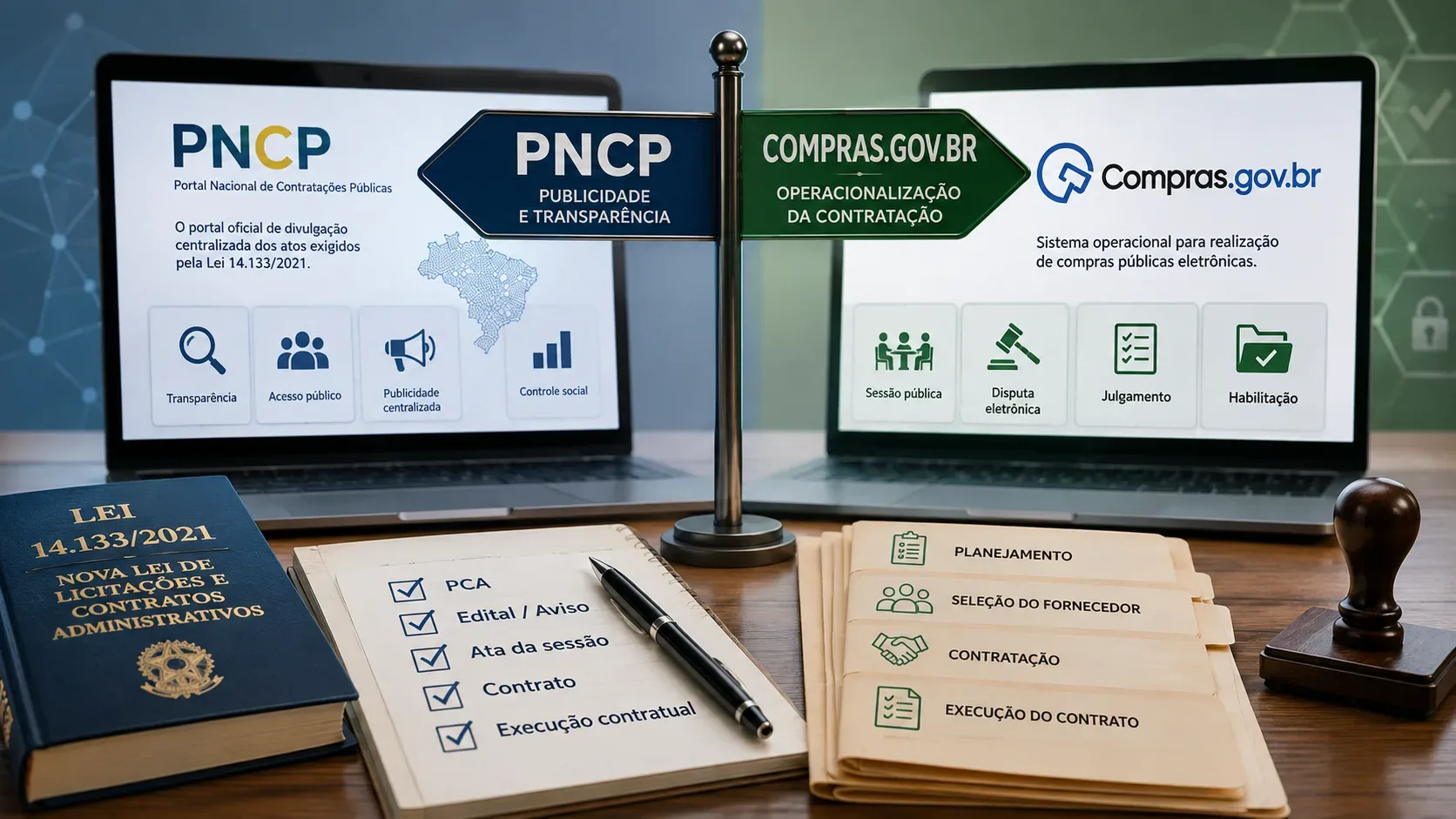
The practical rule is to separate legal disclosure from operational processing. Brazil's National Public Procurement Portal (PNCP) is the official website created by Law No. 14,133/2021 for the centralized and mandatory disclosure of acts that the law requires to be made public. Compras.gov.br, in turn, is the Federal Government's procurement system used to plan and run electronic procedures within its regulatory scope. That is why the same procurement can pass through Compras.gov.br and also appear on the PNCP: one system operates the procedure; the other provides the national disclosure layer.
PNCP vs. Compras.gov.br in one sentence
If the question is “where should the public find an act that Law No. 14,133 requires to be disclosed?”, the reference point is the PNCP. If the question is “where do the procurement team and bidders submit proposals, place bids, exchange messages, evaluate offers, qualify bidders and file appeals in a federal electronic tender?”, the answer will generally be Compras.gov.br, depending on the procurement method, award criterion and applicable regulation.
This distinction is reflected in Article 174 of Law No. 14,133/2021: the PNCP was created for centralized and mandatory disclosure of the acts required by the law. The same article provides for procurement functionality, and the current wording also states that these functionalities are to be the systems adopted and offered by the Federal Executive Branch. Article 175, meanwhile, allows procurement to be conducted through other electronic systems, public or private, as long as integration with the PNCP is maintained under the applicable regulation.
Quick chart: where each act belongs
| Act or stage | PNCP | Compras.gov.br | Practical reading |
|---|---|---|---|
| Annual Procurement Plan (PCA) | It is the national disclosure destination for PCAs. | At federal level, planning is prepared in the PGC, integrated into the procurement ecosystem. | Planning takes place in the competent system; the PCA must be publicly available and, for the Federal Executive, Decree No. 10,947/2022 provides for automatic availability on the PNCP. |
| Notice/tender document and annexes | Mandatory: full text and annexes on the PNCP. | It is the operating environment for federal electronic procurement when the applicable rule so requires. | The external phase begins with publication on the PNCP; the public session may run on Compras.gov.br. |
| Direct-award notice | It is part of the information made available through the PNCP. | In the federal electronic waiver procedure, the process is disclosed in the system and on the PNCP. | Do not choose one portal “instead of” the other when the rule requires both or when integration publishes automatically. |
| Price registration record | Expressly listed in Article 174, paragraph 2, as PNCP information. | It may be formalized or processed in the system adopted by the contracting body, subject to regulation. | A “price registration record” is not the same as the minutes/record of a public session. |
| Session record, evaluation, qualification and appeals | The law does not use “minutes” generically as a synonym for every session record. | In federal electronic procedures, session acts and bidder interactions are recorded in the system. | Look for the operational history in the system where the procedure was conducted; also check what was transmitted to the PNCP. |
| Contract and amendments | Mandatory. PNCP disclosure is an indispensable condition for effectiveness, subject to Article 94 deadlines. | Federal formalization and contract-management modules may feed information to the PNCP. | Signing is not enough: the team must control PNCP disclosure and the statutory deadline. |
PCA: at federal level, PGC prepares and PNCP publishes
Law No. 14,133 allows each level of government, under its own regulation, to prepare an Annual Procurement Plan and requires an adopted plan to be disclosed and kept available to the public on an official website. Article 174 includes annual procurement plans among the information held by the PNCP.
For the federal direct administration, agencies and foundations, Decree No. 10,947/2022 established the Procurement Planning and Management System (PGC) and is even more explicit: Article 14 states that the PCA is made automatically available on the PNCP. Therefore, “prepare in PGC” and “publish on PNCP” are complementary, not competing, actions.
Tender document: legal disclosure starts on PNCP, not on the session screen
Article 54 of Law No. 14,133 states that publicity of the tender document occurs through disclosure and maintenance of the full instrument and its annexes on the PNCP. SEGES/ME Normative Instruction No. 73/2022, which governs federal electronic procurement by lowest price or highest discount within its scope, follows the same logic: the external phase begins with publication of the tender document and annexes on the PNCP, while the procurement is conducted remotely in a public session through the Federal Government Procurement System.
There is an important qualification for anyone turning the “PNCP vs. Compras.gov.br” chart into an absolute rule: the PNCP does not necessarily exhaust all legally required forms of publication. Article 54, paragraph 1, also requires a summary notice in the competent Official Gazette and in a widely circulated daily newspaper. The legal checklist therefore needs to consider the PNCP plus any other publication requirements applicable to the case.
Direct-award notice: integration explains the apparent duplication
For federal electronic waiver procedures, SEGES/ME Normative Instruction No. 67/2021 requires the procedure to be disclosed in the procurement system and on the PNCP. Suppliers submit proposals and take part in the competition through the electronic system. The PNCP's role remains national disclosure of the notice and other required procurement data.
This is a good example of why “where do I click to operate the procedure?” and “where does the law require disclosure?” are different questions. In integrated systems, a single operational action may automatically feed the PNCP, but the procurement team should still verify that publication actually occurred, that the correct annexes were transmitted and that the data are accurate.
“Minutes” needs a qualifier: price registration or public session?
Article 174, paragraph 2, expressly lists price registration records among the information to be contained in the PNCP. This is the instrument of Brazil's price registration system, recording the object, prices, suppliers and conditions for future procurements.
The record or minutes of the public session, by contrast, belongs to the operational trail of the procedure. In federal electronic procurement governed by Normative Instruction No. 73/2022, the system records the opening of the session, proposals, bids, communications, evaluation, qualification, intent to appeal and other events. The Instruction itself refers to qualification, disqualification or evaluation records in specific situations. It is therefore unsafe to see the word “minutes” on a checklist and assume that every type of record follows the same PNCP publication rule.
Contract: PNCP publication affects effectiveness
The strongest legal consequence in the comparison appears in Article 94. Disclosure of the contract and its amendments on the PNCP is an indispensable condition for effectiveness. The law sets a deadline of 20 business days from signature when the contract results from a tender, and 10 business days when it results from direct procurement. Contracts entered into in urgent situations are effective upon signature but must also be published within the statutory periods, subject to the consequence stated in the law.
In practice, procurement teams should not treat contract publication as a merely informational step. It is advisable to record in the file the signature date, procurement identifier, PNCP link or evidence and the effective publication date, as well as to check the contract-management modules used by the contracting body.
Is Compras.gov.br mandatory for every Brazilian public body?
Not under a general rule in Law No. 14,133. Mandatory use of Compras.gov.br arises from the scope of specific federal regulations. Normative Instruction No. 73/2022, for example, requires electronic form for covered bodies and entities of the federal direct administration, agencies and foundations, and, with regulatory qualifications, also reaches state, Federal District and municipal bodies when they execute Union funds from voluntary transfers.
Outside that scope, states, the Federal District, municipalities and other public bodies may have their own system or use another platform admitted by regulation. Under the current wording of Article 175, Law No. 14,133 allows electronic systems supplied by public or private legal entities, provided integration with the PNCP is preserved in accordance with federal regulation. “Compras.gov.br” therefore should not be treated as a universal synonym for “the mandatory portal for every Brazilian procurement”.
Verification flow before closing each stage
- Identify the applicable regime: determine the level of government, contracting body, funding source and regulation that defines the operational system.
- Classify the act: PCA, tender document, direct-award notice, price registration record, session record, contract and amendment have different functions and rules.
- Check the PNCP: confirm that the required record is available with the correct annexes, dates, amounts and identifiers.
- Check the operational system: on Compras.gov.br or the system adopted, verify the session history, messages, proposals, evaluation, qualification, appeals and approval.
- Preserve evidence: record the link, procurement number, publication date and, when required, proof of other forms of publication in the file.
- Control contract deadlines: PNCP disclosure has a specific legal effect and should not be postponed to a late administrative close-out.
The distinction that prevents most mistakes
PNCP is the national disclosure reference; Compras.gov.br is an operational system within a defined regulatory scope. Integration between them reduces duplicate work, but it does not remove the need to verify which act Law No. 14,133 requires to be disclosed, by what deadline and whether complementary publicity is required. For concrete decisions, especially involving subnational governments, voluntary transfers, local regulations or exceptional situations, the workflow should be reviewed by legal counsel against the rules currently applicable to the contracting body.