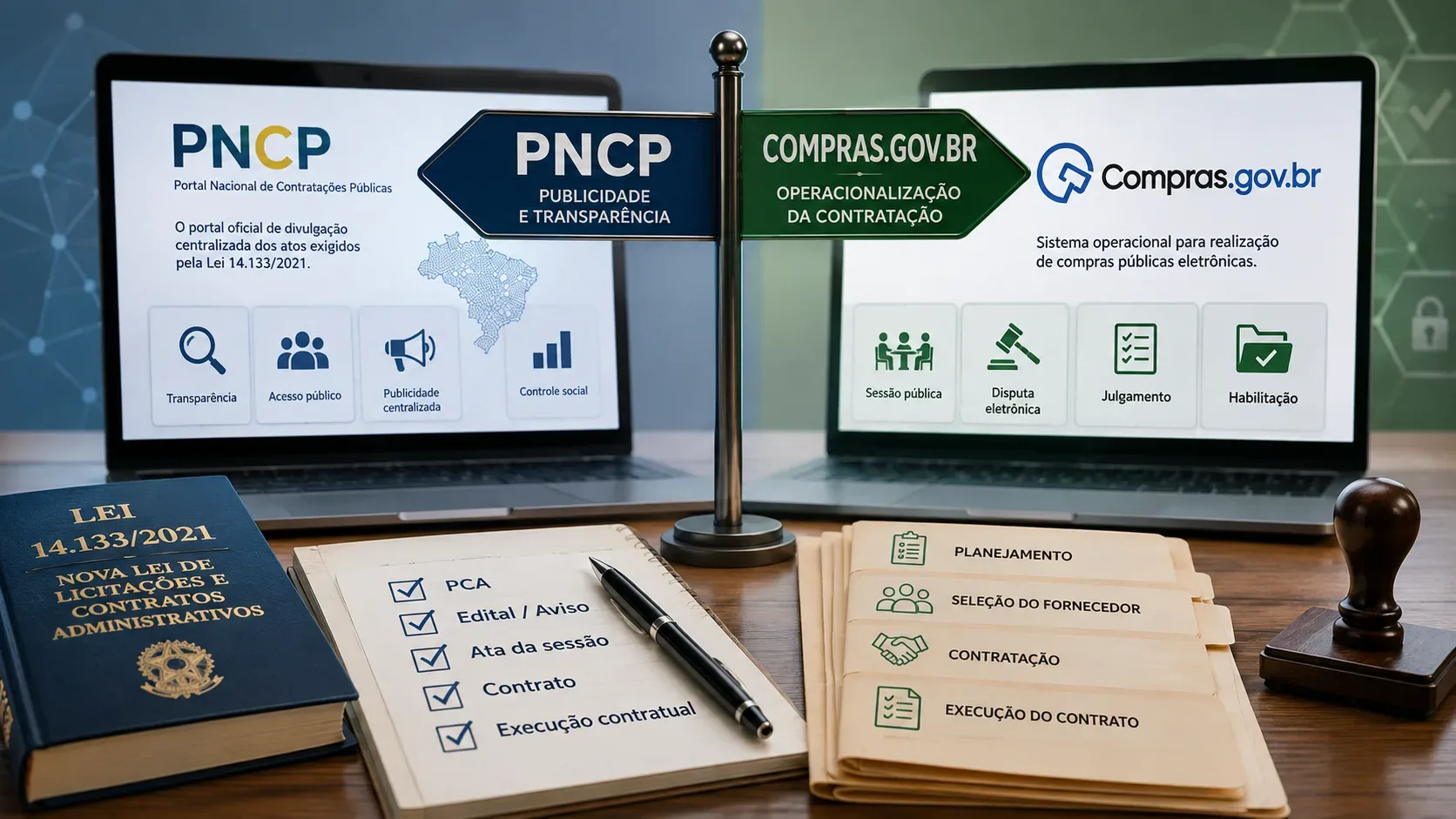
For municipalities with up to 20,000 inhabitants, 2027 does not mark the entry into force of Law 14,133/2021. The law is already in force and, since December 30, 2023, the former Laws 8,666/1993 and 10,520/2002 and the provisions of the RDC repealed by the new law have no longer been an option for new procurement procedures. What ends in 2027 is a specific transition under Article 176, limited to three areas: requirements for public agents, adoption of electronic procedures in bidding, and disclosure rules on an official website.
Law 14,133 was published in the Official Gazette of the Union on April 1, 2021. Because Article 176 granted six years from that publication, the exceptional period runs through March 31, 2027. The Federal Court of Accounts (TCU) expressly uses that date in its methodology for assessing implementation of the new law, and the Court of Accounts of the State of São Paulo (TCE-SP) also guides small municipalities in the same direction. Operationally, the reading is simple: from April 1, 2027 onward, Article 176 will no longer support leaving these three adjustments pending.
Article 176 postpones only three groups of requirements
The first item covers the requirements of Article 7 and the main provision of Article 8. Article 7 addresses competency-based management and the appointment of public agents to essential procurement functions. The requirements include qualifications compatible with the activity, absence of relationships that create conflicts with habitual bidders or contractors, and compliance with segregation-of-duties rules. For the functions covered by Article 7, the law establishes a preference for permanent civil servants or public employees from the Administration's permanent staff.
The main provision of Article 8 is more specific about the contracting agent. It requires the bidding procedure to be conducted by a person appointed from among permanent civil servants or public employees on the Administration's permanent staff. Therefore, a municipality that still depends on a provisional solution for this function needs to treat the issue as a real transition, not as a permanent situation justified by population size.
The second item of Article 176 covers the rule in Article 17, paragraph 2, concerning electronic procedures. After the adaptation period, electronic bidding must operate as the preferred standard. In-person bidding does not disappear from the law, but it becomes exceptional: it must be justified, and the public session must be recorded in minutes and in audio and video, as Article 17 itself provides. Therefore, saying that "in 2027 all in-person bidding will be prohibited" is inaccurate. What ends is the transitional exemption granted to small municipalities regarding adoption of the electronic regime established by the new law.
The third item covers disclosure rules on an official website. The official FAQ of the National Public Procurement Portal (PNCP) interprets Article 176 as the deadline for municipalities with up to 20,000 inhabitants to adopt the PNCP and comply with electronic disclosure rules. Until they adopt the Portal, the sole paragraph of Article 176 requires a provisional solution: publication in the official gazette of information that the law requires to appear on an official website, with publication of an extract allowed, and physical availability of the documents at government offices, without charge beyond the cost of any reproduction.
The cutoff date is March 31, 2027
There is a practical difference between saying "by 2027" and working with the correct date. Law 14,133 was published on April 1, 2021, and the deadline is six years. The TCU records that the exception extends through March 31, 2027. The TCE-SP published guidance using the same date. This makes April 1, 2027 the first day after the transition period.
For municipal administration, the effect of this precision is important. Personnel planning, implementation of an electronic platform, integration with the PNCP and the publicity workflow should not have the generic target of "some point in 2027." The target needs to come before the March-to-April transition, with tests and administrative acts completed before the end of the exceptional period.
It is also prudent not to structure relevant procedures so that they cross the cutoff date while relying only on the transitional rule. Article 176 does not detail a special regime for each ongoing procedure when the deadline expires. The municipality should define, with its legal counsel and the competent court of accounts, how to handle concrete situations that span the transition.
Public agents: the most sensitive point for municipalities with small staffs
Personnel tends to be the most difficult adjustment for small municipalities because changing the name of a function in an administrative order is not enough. Article 7 requires competency-based management and minimum requirements for those who perform essential functions. Article 8 requires the contracting agent to be chosen from among permanent civil servants or public employees on the permanent staff.
In February 2026, the Court of Accounts of the State of Paraná (TCE-PR) issued Decision 364/26 in a case involving the Municipality of Prado Ferreira. The discussion concerned the appointment of commissioned staff to the functions of contracting agent and committee member. The Court applied Article 176 by recognizing the adaptation period and dismissed the representation, but expressly recommended that the municipality prepare an action plan with a timetable and targets, including training, review of procedures, gradual adoption of technological solutions and a possible public competitive examination.
The Paraná decision is not nationwide authorization to keep commissioned appointees indefinitely, nor does it replace the legal analysis required for each municipality. It matters
because it shows how an oversight body treated the deadline: as an opportunity for documented compliance, not as permission to wait until 2027 without taking action. The decision itself emphasized that the exception should not become a permanent rule.
Preparation therefore needs to answer concrete questions. Does the municipality already have permanent civil servants with the profile needed to act as contracting agents? Do they have compatible duties, training and availability? Is there segregation of duties where risk requires separation? Are appointment acts up to date? If the permanent staff is insufficient, will there be training, administrative reorganization or a need for a public competitive examination? These answers need to exist before the deadline and, ideally, be documented in a formal plan.
Electronic bidding: the deadline does not create an absolute ban on in-person procedures
Article 176 gave small municipalities additional time to comply with the rule in Article 17, paragraph 2. Once the transition ends, the municipality must be able to process bidding procedures electronically on a regular basis. This requires more than contracting or registering on a platform a few days before the deadline.
The municipality needs to define the system to be used, user profiles and responsibilities, staff training, internal procedures, the method of publication and integration with the PNCP when applicable. It is also important to test the complete workflow, from preparation of the notice through the session, judgment, award/ratification and transmission of the information that must be published.
In-person procedures remain provided for in Law 14,133, but as a justified exception. Article 17 requires minutes and audio and video recording of the public session. The municipality should avoid two oversimplifications: assuming that Article 176 waived all formalities of an in-person session during the transition, or assuming that after April 2027 no in-person procedure will be legally possible. The analysis must follow the text of Article 17 and the guidance of the external oversight body with jurisdiction over the municipality.
PNCP and official website: the provisional alternative stops being sufficient
The PNCP was created by Article 174 as the official website for centralized and mandatory disclosure of the acts required by Law 14,133. For municipalities with up to 20,000 inhabitants, Article 176 postponed electronic disclosure rules and established a bridge while the Portal had not yet been adopted.
That bridge is the sole paragraph: the official gazette for information required on an official website, with the possibility of publishing an extract, and physical access to documents at the government office. The official PNCP FAQ confirms the interpretation that small municipalities have the six-year period to adopt the Portal and electronic disclosure rules.
After March 31, 2027, the municipality should not plan its publicity as though the official gazette and physical file could continue, by themselves, to replace the electronic disclosure required by law. Implementation needs to include integration of the procurement system with the PNCP, definition of who sends or validates data, verification of the types of acts that must be published, and routines to correct transmission failures.
It is also important to distinguish the PNCP from a simple institutional webpage. The law uses the PNCP as the national portal for centralized disclosure and allows the entity's official website for complementary disclosures. Having a municipal transparency portal does not
automatically mean that all PNCP obligations have been met.
What was not postponed by Article 176
The main source of error is reading Article 176 as though it extended all of Law 14,133 for small municipalities. It did not. The exception expressly mentions three groups and does not create a general suspension of the other rules.
Law 14,133 is already the legal regime for new procurement and contracting. The repeal of Law 8,666, the Auction Law and the RDC provisions identified in Article 193 took effect on December 30, 2023. Contracts validly entered into under earlier regimes may continue to be governed by the rules properly chosen at the relevant time, but that is different from opening new bidding procedures in 2026 under laws that have already been repealed.
Planning, governance, proper definition of the procurement object, studies and documents in the preparatory phase, legal review when required, contract management and oversight, conflict prevention, reasoning of administrative acts, and the other duties under Law 14,133 did not receive a general postponement until 2027. In its guidance on Article 176, the TCE-SP specifically draws attention to the need to adopt the other measures under the new law during the adaptation period.
The annual procurement plan (PCA) is also not an obligation created or postponed by Article 176. The PCA appears in Article 12, item VII, which allows it to be prepared by the bodies responsible for planning, as provided by regulation, and establishes consequences when it is prepared. Therefore, "municipal PCA in 2027" is a different topic. The municipality should check its local regulations and the rules applicable to it, but it should not treat the PCA as a fourth item under Article 176.
Publicity: the PNCP exception does not erase other requirements
Another point that deserves attention is publication of the notice extract. Article 54, paragraph 1, maintains the requirement for publication in the corresponding official gazette and in a widely circulated daily newspaper. Article 176 establishes a deadline for disclosure rules on an official website; it does not expressly say that publication in a widely circulated newspaper is suspended.
This distinction appeared concretely in Paraná. In a proceeding involving the Municipality of Peabiru, published in the TCE-PR Electronic Gazette on March 31, 2026, the Court stated that the Article 176 exception is limited to disclosure rules on an official website and does not extend to publication in a widely circulated newspaper under Article 54, paragraph 1. The same material recalled Full Court Decision 1516/24, according to which, until the legal text is amended or set aside, publication of the extract in the official gazette and in a widely circulated newspaper remains necessary.
This interpretation is especially important for anyone who confuses "I still do not use the PNCP" with "I may reduce publicity." The sole paragraph of Article 176 itself creates provisional publicity obligations, and other legal requirements may coexist with this transition. Because courts of accounts may have specific guidance, the municipal routine should also be checked against the case law and acts of the competent external oversight body.
What must be ready before April 2027
A municipality that still relies on Article 176 needs to turn the remainder of 2026 into a compliance project. On the personnel side, this means mapping all essential functions,
checking the requirements of Article 7, identifying who can serve as contracting agent under Article 8, and resolving any gaps in staffing, qualifications or segregation of duties.
On the technology side, it is necessary to ensure a functioning electronic bidding environment, a trained team and publication integration. Preparation should include real tests of the workflow, not merely purchasing a license or signing a contract with a system provider.
On the publicity side, the municipality should map what it currently publishes in the official gazette, what it already sends to the PNCP, what must appear on an official website and who is responsible for each step. The transition ends when the structure is ready to comply with the rule, not when the municipality starts buying a tool.
Finally, the administration should keep documentation of all measures. TCE-PR Decision 364/26 is a clear signal that planning during the transition may be assessed by external oversight. A formal plan, timetable, training records, appointment acts, system tests, procedural adjustments and personnel decisions help demonstrate that the statutory period was used for effective adaptation.
The correct reading of Article 176 in one sentence
For municipalities with up to 20,000 inhabitants, Article 176 did not postpone Law 14,133 until 2027. It granted until March 31, 2027 to complete three specific adjustments: the public-agent requirements in Article 7 and the main provision of Article 8, the electronic bidding regime in Article 17, paragraph 2, and disclosure rules on an official website, including adoption of the PNCP according to the Portal's official guidance.
From April 1, 2027, those three areas must be incorporated into the municipal routine. Until then, the safest strategy is to treat the deadline as an implementation timetable, review the obligations that already apply today and avoid attributing effects to Article 176 that it does not contain. Because concrete application may depend on local regulations, funding sources and guidance from the competent court of accounts, the final stage of compliance should be validated by the municipality's legal counsel and internal control body.