
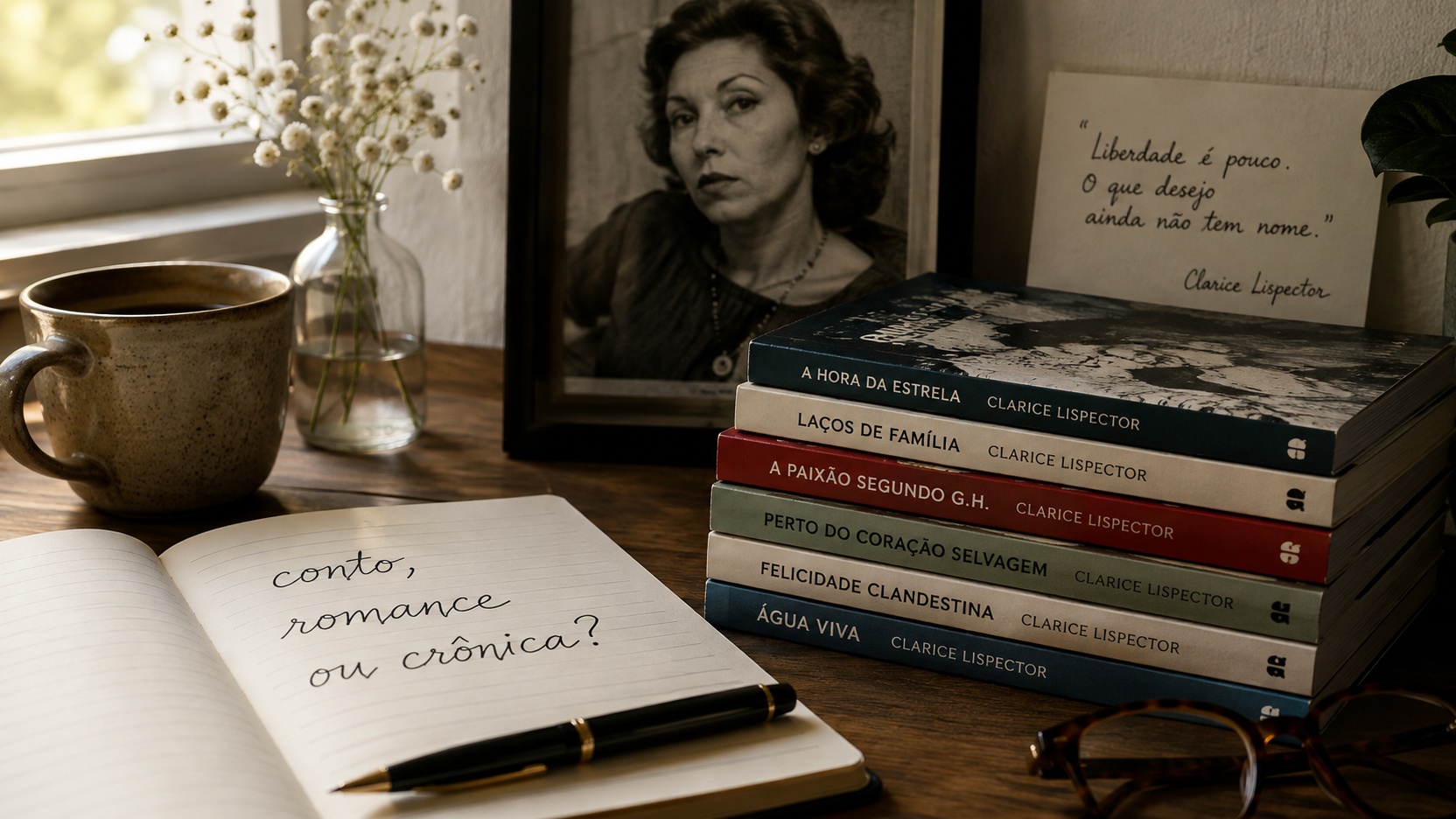
If you want only a quick answer, there are three especially useful entry points. Laços de família works best for readers who want to try Clarice Lispector through self-contained texts. A hora da estrela works best for those who need to follow a single story. A descoberta do mundo works best for readers who enjoy short texts, observations of everyday life, and reading in small doses. The right choice depends less on a book's fame than on the way you like to read.
The idea that there is one single "easy book" by Clarice tends to get in the way. She wrote novels, short stories, chronicles, children's literature, and hybrid works. In some books, plot provides steady support; in others, the center lies in perception, language, and the movement of consciousness. Starting well, therefore, means reducing initial friction without erasing precisely what makes Clarice's writing distinctive.
The matrix that actually helps you choose
To decide, it helps to look at five axes. Linearity is the degree to which the reading relies on a recognizable sequence of events. Length of commitment is how long you need to stay with the same text before reaching a sense of closure. Introspection measures how much external action gives way to thought, sensation, and perception. Formal experimentation indicates how far the structure moves from conventional narrative. And "mature Clarice," in this guide, is not a judgment of quality: it simply refers to how strongly the work concentrates techniques associated with the author's more fully developed phase.
This matrix avoids a common trap. A short book is not necessarily a simple book. A hora da estrela, for example, is brief in many editions, but it works simultaneously with Macabéa's story and with the problem of how to narrate it. On the other hand, a long collection of chronicles can be easier to visit because each text offers a natural stopping point.
If you want to test Clarice's voice in a few pages: Laços de família
Published in 1960, Laços de família brings together 13 short stories. The archive devoted to the author at Instituto Moreira Salles highlights the concentration of these narratives on urban and domestic everyday life, where apparently small events open a crack in the characters' perception. The book received the Jabuti Prize in 1961.
As a first read, its advantage is structural: you do not have to commit immediately to an entire novel. Each story has its own beginning, development, and ending, yet traits strongly associated with Clarice are already visible, such as attention to the ordinary, the sudden rupture of routine, inner intensity, and the sense that an everyday scene is hiding something larger.
In this guide's matrix, Laços de família has medium linearity, a short commitment per text, high introspection, medium experimentation, and strong contact with a Clarice whose style is already consolidated. That makes it the most balanced entry point for readers who do not yet know whether they will like her. If one story does not work for you, the next changes character, situation, and rhythm without requiring you to abandon the entire book.
Within the collection itself, "Amor" is a good sample of the Clarice mechanism: an everyday situation is unsettled by an apparently banal encounter, and the most important change occurs in the way the character perceives the world. If that experience works for you, the next step can be A legião estrangeira, if you want to stay with short stories, or A paixão segundo G.H., if you want to increase the intensity of introspection.
If memory, childhood, and the desire to read attract you: Felicidade clandestina
Felicidade clandestina, from 1971, is another strong entry point through the short story. Instituto Moreira Salles describes the volume as made up of brief, tense narratives and highlights microcosms connected, among other themes, to books, the sea, kissing, and lived experience transformed into fiction.
The title story has a special advantage for a newcomer: the desire for a book is the visible engine of the narrative. There is conflict, waiting, cruelty, pleasure, and memory, but the writing already shifts these elements into a larger inner experience. It is a way of meeting Clarice without having to begin with an abstract structure or a highly experimental narrator.
In the matrix, Felicidade clandestina has medium to high linearity in several stories, short commitment, high introspection, medium experimentation, and a very strong presence of mature Clarice. Compared with Laços de família, it may feel more immediately emotional to readers drawn to childhood, memory, and desire. Laços de família, however, offers a more concentrated sample of the collision between domestic routine and epiphany.
If Felicidade clandestina is your entry point, the next book can be Laços de família to deepen your experience of her short-story technique, or A descoberta do mundo to accompany a Clarice who is closer to everyday life and to her own public persona.
If you need a continuous story: A hora da estrela
A hora da estrela, published in 1977, is classified by Instituto Moreira Salles as a novella. That matters because it is often presented generically as a "short novel," but its brief form does not eliminate its complexity. The book follows Macabéa, a young woman from Alagoas living in Rio de Janeiro, while also following Rodrigo S.M., the narrator who lays bare his difficulties, choices, and dilemmas as he tries to tell her story.
For readers who get lost when a book does not provide a character, a situation, and some progression of events, A hora da estrela usually works better than Perto do coração selvagem or Água viva. There is a recognizable external trajectory: work, relationships, movement through the city, expectations. That line gives the reader a handrail. At the same time, the text questions language, the narrator's position, social inequality, and the very act of turning another person into literary material.
In the matrix, A hora da estrela has medium to high linearity compared with other Clarice books, medium commitment, high introspection, medium to high experimentation, and very strong contact with the author's final phase. It is a good first read for someone who needs plot but wants to encounter mature Clarice without first working through her entire chronology.
The caution is not to confuse brevity with transparency. If you go in expecting only "Macabéa's story," you may be surprised by the narrator's interruptions and the reflection on the text itself. If you accept from the start that there are two intertwined stories - Macabéa's and the attempt to narrate her - the structure becomes much easier to read.
After A hora da estrela, two paths make sense. Laços de família shows how the same ability to shift perception works in short narratives. A paixão segundo G.H. expands the inner experience and drastically reduces the importance of external plot.
If you like reading in fragments: A descoberta do mundo
A descoberta do mundo brings together 468 chronicles originally published in Clarice's weekly column in Jornal do Brasil between 1967 and 1973. The collection, organized chronologically, was published in 1984. The texts move through occasional topics, memories, reflections on writing, observations of everyday life, and zones of intimacy that fiction does not always expose in the same way.
This is the best entry point for readers who usually read newspapers, newsletters, short essays, or texts that take only a few minutes. The continuity of the book is low, but the commitment required by each entry is small. You can read one chronicle, stop, return another day, and still have received a complete unit of experience.
In the matrix, A descoberta do mundo has low linearity as a whole, very short commitment per text, variable but often high introspection, low to medium experimentation, and a strong presence of mature Clarice. The caveat matters: the chronicles do not, by themselves, represent the experience of reading Clarice's fiction. They bring the reader closer to her voice, themes, and way of observing, but they do not replace the formal shock of certain short stories and novels.
If you enter through A descoberta do mundo and enjoy the mixture of everyday life and interiority, Felicidade clandestina is a natural next step. If you want to see how an apparently simple situation can close into a precise fictional mechanism, go next to Laços de família.
If you want to start at the beginning of her career: Perto do coração selvagem
Perto do coração selvagem, published in 1943, is Clarice's debut novel. The book follows Joana and organizes its narrative less through a succession of events than through the character's impressions, digressions, and inner movements, alternating recollections with references to the present.
Starting with it makes sense for a specific profile: readers who enjoy modernist novels, interior flow, time that is not fully linear, and narratives in which language matters as much as what happens. For this reader, the debut is fascinating because it allows you to see decisive elements of the author emerging from her very first book.
In the matrix, Perto do coração selvagem has low to medium linearity, a long commitment, very high introspection, and high experimentation. On the "mature Clarice" axis, it occupies an intermediate position not because it lacks force, but because it is a 1943 book: many central techniques are already there, while others will be radicalized in later works.
If you need constant external action, it is not the gentlest entry point. In that case, A hora da estrela or the short stories tend to offer better support. If, on the other hand, you already read Virginia Woolf, modernist prose, or novels centered on consciousness, starting with the debut may feel more natural than following any list of "easiest books."
After Perto do coração selvagem, Laços de família shows how the author compresses similar tensions into brief narratives. A paixão segundo G.H. lets you observe how far this inward turn can go two decades later.
If you are looking for intensity, not ease: A paixão segundo G.H.
A paixão segundo G.H., from 1964, is one of those cases in which starting with the most famous book may be the right decision for a very specific reader. The narrative begins from a concrete situation: G.H., alone in her apartment, enters the room formerly occupied by the maid, finds a cockroach, and goes through an extreme experience. External plot, however, is minimal compared with the inner expansion triggered by that encounter.
The book's own opening addresses readers of "alma já formada" - literally, an "already formed soul." The phrase should not be read as proof of superiority or as an elitist barrier; it helps explain the kind of surrender the work asks for. G.H. tries to narrate an experience that seems to resist language, and the text advances through approximations, repetitions, negations, and reformulations.
In the matrix, linearity is low, commitment is medium, introspection is very high, experimentation is very high, and contact with mature Clarice is at its maximum. It is not a bad first read if this is exactly what you are already seeking. It is simply a high-friction choice for someone who still needs to discover whether they like the author.
If this book works as your first experience, Água viva is a coherent next step. If it feels too intense, stepping back to Laços de família does not mean "simplifying" Clarice; it means changing the unit of reading and gaining more points of narrative support.
If you do not need plot: Água viva
Água viva, from 1973, is described by Instituto Moreira Salles as a hybrid work, without a conventional plot and without a central theme. The text crosses elements of narrative, poetry, diary, and philosophical essay without settling completely into any of these forms. Its focus is the instant, language, perception, and the act of creating.
For most beginners, it is not the safest entry point because it removes precisely the resource that helps many readers enter a new author: the question "what happens next?" But for readers of prose poetry, fragments, literary essays, or experimental writing, it may be the most direct door into what they are looking for.
In the matrix, Água viva has very low linearity, high mental commitment despite its physical length varying by edition, very high introspection, maximum experimentation, and maximum contact with a formally radical Clarice. Starting with it is not "starting wrong." It is simply choosing the author at her most experimental pole.
So which book fits your reader profile today?
If you still do not know what you are looking for and want the option with the lowest risk of rejecting the author because of format, choose Laços de família. It lets you experience Clarice in short units, with recognizable situations and a strong concentration of her technique.
If you tend to abandon books when there is no continuous story, choose A hora da estrela. The novella offers character, conflict, and progression, but it already gives you a late, metafictional, restless Clarice.
If your routine favors reading in a few-minute sessions, choose A descoberta do mundo. The experience is less like fiction, but it is very well suited to building familiarity with the author's gaze, subjects, and voice without requiring daily continuity.
If childhood, memory, and desire are important emotional entry points for you, Felicidade clandestina may work better than Laços de família. If you prefer following a writer's development from the debut and already tolerate novels that are not very linear, choose Perto do coração selvagem.
If what you want is precisely a difficult, inward, formally risky read, there is no need for "mandatory preparation": A paixão segundo G.H. can be your first book. And if plot is not a requirement and you enjoy hybrid texts, Água viva may be the most honest entry point for your taste.
A path forward after the first book
The first read becomes more useful when it already points toward the second. Readers who start with Laços de família can continue with A hora da estrela and then A paixão segundo G.H., moving from the short story to a continuous narrative and then to a more radical inner experience.
Readers who start with A hora da estrela can go to Felicidade clandestina or Laços de família to observe the same author working through compression. After that, A paixão segundo G.H. shows an even greater reduction of external plot and an even stronger concentration on language.
Readers who enter through the chronicles of A descoberta do mundo can continue with Felicidade clandestina, because certain themes of childhood, intimacy, and memory take on another organization when they pass into fiction. Then Laços de família works as a bridge to the tighter architecture of the short story.
Readers who start with Perto do coração selvagem probably do not need a "facilitating" route. In that case, it is worth moving on to Laços de família and A paixão segundo G.H. to compare, at different moments in her career, the centrality of inner life and the work of language.
The best first Clarice is not the same for every reader
The question "what is Clarice Lispector's easiest book?" sounds objective, but it mixes different kinds of difficulty. One reader may find introspection difficult and enjoy fragmented prose. Another may accept philosophical reflection but need a character they can follow from beginning to end. A third may prefer short texts even when they are dense.
That is why the most concrete choice is this: short stories to try the author without a long commitment; A hora da estrela for a continuous narrative that still gives you mature Clarice; chronicles to read in small doses and get closer to everyday life and the author's voice; Perto do coração selvagem if you already enjoy introspective novels; A paixão segundo G.H. or Água viva if you want to start in the zone of greatest demand and experimentation.
If you are completely undecided, Laços de família is the most balanced starting point. If you know how you like to read, ignore the ranking and choose by format. With Clarice, the best beginning is not the book that promises to be universally simple, but the one that offers the kind of resistance you actually want to cross.