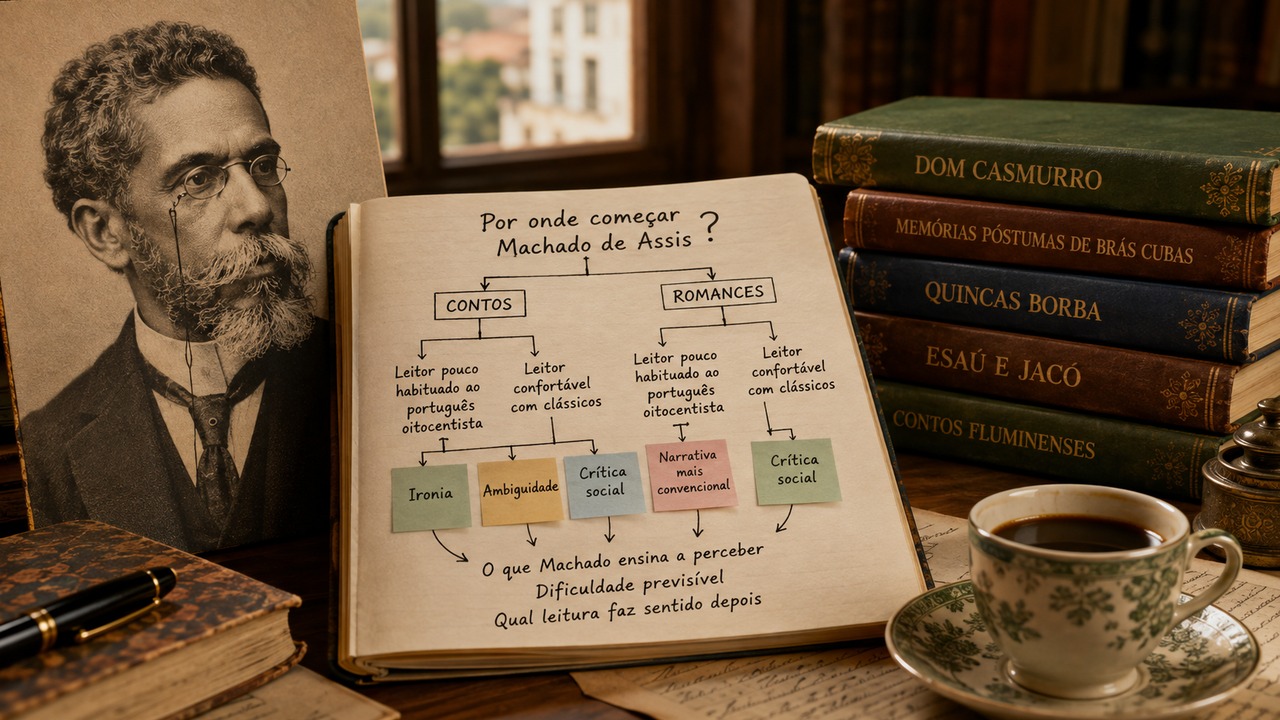

To start reading Machado de Assis, choose the experience you want rather than feeling obliged to follow publication order. If you want a taste of his irony in a few pages, begin with the short stories A cartomante or O espelho. If you prefer a novel about memory, jealousy, and competing versions of events, try Dom Casmurro. For a more irreverent narrator and a fragmented structure, choose Memórias póstumas de Brás Cubas. These are not difficulty rankings: they offer different styles and reading commitments.
Choose a work according to your reading goal
| Goal | Start with | What to notice |
|---|---|---|
| Sample irony in one sitting | A cartomante | How desire, coincidence, and the characters' interpretations drive the story. |
| Explore identity and appearances | O espelho | How social image helps define who someone believes themselves to be. |
| Read about relationships and memory in a novel | Dom Casmurro | The gap between Bentinho's account and what readers can establish. |
| Encounter his best-known narrative break | Memórias póstumas de Brás Cubas | The dead narrator, short chapters, interruptions, and direct address to readers. |
| Follow social satire and ideas | Quincas Borba | Rubião, self-interested relationships, and the ironic use of Humanitism. |
| Prefer a more linear sentimental plot | Helena | Family, conventions, and emotional conflict in an early novel. |
If time is short, enter through the short stories
A cartomante blends suspense and irony around the trust characters place in signs and predictions. Read without anticipating the ending, then ask which certainties belonged to the characters rather than the narrator. In O espelho, a conversation about the soul becomes a reflection on social recognition; notice who tells the story and how he constructs his explanation.
For a different register, try Missa do galo, in which an episode recalled years later depends on gestures, silences, and ambiguity, or Um apólogo, a brief narrative whose personified objects open a way to read relationships of labor, prestige, and recognition. You need not decode every historical reference before a first reading. Note a question and revisit the passage after finishing.
If you prefer a novel, there are distinct entry points
Dom Casmurro: memory and trust in the narrator
Bentinho attempts to reconstruct his life, including his relationship with Capitu. The literary interest goes beyond settling an accusation: it also lies in seeing how a voice selects memories, arranges clues, and seeks readers' agreement. Mark passages in which the narrator interprets other people's intentions, and distinguish them from events the text actually presents.
Memórias póstumas de Brás Cubas: irony and fragmented form
A dead man recounts his life without following conventional chronology. Brief chapters, digressions, and comments addressed to readers are part of the novel's method, not distractions to overlook. Readers who enjoy sharp humor and formal experimentation can begin here, accepting that the narrative interrupts itself.
Quincas Borba: social satire within a continuing plot
Rubião inherits a fortune and enters relationships that reveal self-interest, vanity, and exploitation. The novel makes room for recurring scenes and characters without giving up irony. Humanitism should be read in the work's satirical context, not as a doctrine endorsed by the author. Reading Memórias póstumas first helps you recognize Quincas Borba, but it is not required to follow Rubião's story.
Helena: another period, another expectation
Published in 1876, Helena belongs to the early novels often associated with Romanticism. Its developing plot and family conflicts provide an entry point for those who prefer a more conventional construction. Dividing the work into periods is a reading aid, not a claim that the author abandoned every earlier theme at once.
How to read without turning a classic into an exam
- Choose a short story or read two chapters of a novel before deciding whether its pace suits you.
- Identify who narrates, when they narrate, and what they can know. Narrator and author are not the same person.
- Look for contrasts between statements and events; irony often emerges from that difference.
- Look up words and references that truly block understanding, rather than stopping at every paragraph.
- When finished, reread the opening: in Machado, how a story is told often changes its meaning.
For a practical sequence, read A cartomante, then O espelho, and choose Dom Casmurro or Memórias póstumas de Brás Cubas depending on whether you prefer memory and suspicion or humor and experimentation. The Brazilian Academy of Letters' bibliography documents the publications, while the Ministry of Education and National Library portals help locate works and information about the author. Check the work's title and the completeness of the text when selecting an edition.