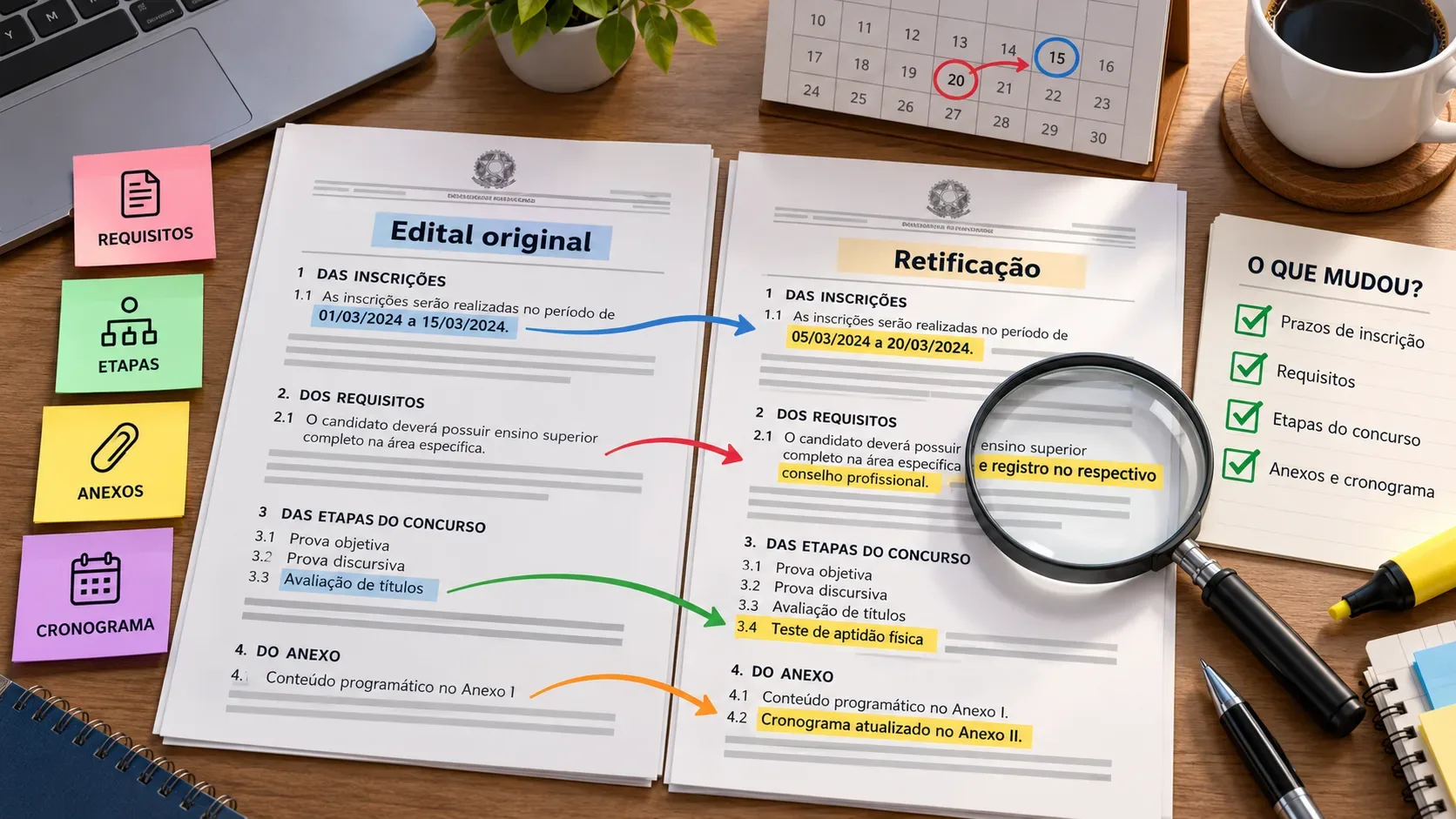
A correction notice for a Brazilian public recruitment exam should not be read as a standalone document. To identify exactly what changed, compare the version that was in force before the amendment with the new wording, record the affected item, and translate the change into a practical effect: deadline, requirement, stage, score, document, annex, or procedure.
This matters because the same selection process may accumulate several corrections. Official pages use different publication formats: some keep the original notice and successive errata, others publish updated annexes, and some provide a consolidated notice with the corrections already incorporated. The review therefore needs to start with the correct version and the chronological order of the publications.
Start with a timeline of the documents
Before comparing any sentence, build a short timeline. Record the original notice, each correction or erratum, annexes that were replaced, and, when available, the consolidated or already corrected version.
This prevents a common mistake: comparing a second correction directly with the original notice when the first correction had already changed the same item. In that situation, the immediately previous text may no longer be the wording from the first notice.
Official examples show why this history is useful. The page for São Pedro do Turvo Public Exam No. 01/2026 keeps the opening notice, two errata, and corrected versions of the normative notice. Brazil's Federal Revenue Service provides a consolidated notice with corrections on its 2022 exam page. In Aracruz, the 2026 exam page groups several correction notices and a specific update to Annex I, which contains the schedule.
Build a side-by-side comparison matrix
A personal spreadsheet, table, or note works best when each change occupies one row. The goal is not to copy the entire correction notice, but to create a verifiable map of what changed and what you need to do because of it.
| Field | What to record | Control question |
|---|---|---|
| Version | Document name, correction number, date, and official link | Am I comparing it with the version that was actually in force before? |
| Affected item | Item, subitem, table, or annex number | Can I locate exactly where the rule appears? |
| Before | Relevant previous wording | What was the rule before the change? |
| After | New wording or replacement content | What was added, removed, or replaced? |
| Practical effect | Impact on deadline, eligibility, test, score, document, or procedure | Does this change require any action from me? |
| Dependencies | Annexes, schedule, tables, and items referenced by the amended passage | Is there another part of the notice that must be reread? |
Step by step: how to identify exactly what changed
- Open the official source. Use the government body or organizing institution page identified for the exam. Avoid treating an old local copy as the final reference when newer official documents have been published.
- Put publications in order. Arrange the notice, corrections, errata, and annexes by date and, when applicable, by number.
- Read the correction looking for change language. Portuguese expressions such as “onde se lê”, “leia-se”, “fica alterado”, “inclui-se”, “exclui-se” and “passa a vigorar” often point to changes, although not every document uses exactly these formulas.
- Return to the corresponding item in the previous version. Also read the paragraph immediately before and after it. An amended sentence may depend on a definition or condition in another subitem.
- Copy only the necessary passage into the “before” field and the new content into the “after” field. This turns a long correction notice into an auditable list of differences.
- Classify the effect. Mark whether the change affects a date, requirement, registration, fee, documentation, reserved places, stage, score, appeal, syllabus, location, annex, or another obligation.
- Review cross-references. If the amended item cites “Annex I”, “item 7.3”, “schedule”, or a table, open that part and check whether it was also replaced.
- Repeat the process for later corrections. A new publication may amend a rule that had already been corrected.
What deserves priority review
Dates and schedule
Compare registration, payment, fee waiver requests, document submission, appeals, call notices, examinations, and any other milestones relevant to your case. Do not assume that changing one date automatically moves every later date. Only mark another deadline as changed when the correction or updated schedule actually changes it.
This is especially important when the schedule is an annex. The official Aracruz exam page, for example, records an update to Schedule Annex I separately from the correction notices to the main notice.
Requirements and documents
Look for changes in education, professional registration, experience, age, licenses, supporting documents, and conditions for appointment or hiring. A single word can change who fits the rule. Record enough of the complete wording to preserve conditions such as “by the date of appointment”, “at registration”, or “when called”, when they appear in the actual document.
Stages, criteria, and scoring
Check whether an objective test, written test, practical test, credential assessment, physical evaluation, racial verification procedure, biopsychosocial assessment, or another stage was added, removed, or reformulated. Then review the eliminatory or classificatory nature of the stage, minimum scores, weights, tie-break criteria, and appeal rules connected to the amended stage.
Annexes, tables, and syllabus
Do not treat the main body as if it were the entire notice. Annexes may contain the schedule, distribution of positions, job duties, syllabus, forms, and scoring criteria. Official pages sometimes publish corrected annexes separately. If a correction says that an annex was replaced, compare both annex versions, not only the paragraph announcing the replacement.
How to use a consolidated or corrected notice
When the authority offers a consolidated version, it is useful as the main reading baseline because it brings incorporated changes into one text. The Federal Revenue Service page for its 2022 public exam, for example, explicitly points to a consolidated notice with the corrections.
Even so, keep the correction history if you need to understand where a change came from. The consolidated text shows how the rule ended up; the correction notice shows which passage changed and in which publication. A consolidated version also represents the state of the notice only up to the amendments it contains. If a later publication exists, the official page must be checked again.
Hypothetical comparison example
The table below is only a fictional example of the method. It does not represent a real public exam.
| Item | Before | After | Practical effect |
|---|---|---|---|
| 3.2 | Registration until May 10 | Registration until May 14 | New deadline to complete registration |
| 5.1 | Degree in the field | Degree in the field and professional registration | Additional eligibility requirement |
| 8.3 | Objective and written tests | Objective test, written test, and credentials assessment | New stage to consider in preparation and ranking |
| Annex I | Exam on June 20 | Exam on June 27 | Exam date changed; other dates must be checked in the updated annex |
The key is to separate the documented fact from its consequence. If the exam date changed, that is documented. The idea that every appeal and result date also moved is only a hypothesis until the updated schedule or another correction confirms it.
Keep a change history
For exams with several corrections, add a status column to your matrix: “current”, “replaced”, or “confirm in latest version”. This reduces the risk of acting on a rule that has already been superseded.
A useful recording sequence is: publication date, document, item, change, practical effect, and required action. If a later correction changes the same item, do not delete the previous row. Mark it as replaced and create a new row. This preserves the change trail.
Common mistakes when reviewing a correction notice
- Reading only the new document: without the earlier wording, it is difficult to measure the real change.
- Comparing with the wrong version: the proper baseline may be an already corrected version, not the original notice.
- Looking only at dates: requirements, documents, stages, scoring, and annexes can also change.
- Ignoring deletions: removing a requirement or stage can matter as much as adding one.
- Not opening replaced annexes: the correction announcement may not display every internal difference in the new annex.
- Relying on third-party summaries: use summaries for orientation, but confirm the rule in the official publication.
- Stopping at the first correction: pages such as Brazil's Unified National Public Exam notice page show that the same process may accumulate several corrections over time.
Final checklist before acting
- Did I confirm the official exam page and the most recent publication?
- Did I order the original notice, corrections, errata, and annexes?
- Did I compare each change with the version that was in force immediately before it?
- Did I record the item, previous text, new text, and practical effect?
- Did I review dates, requirements, stages, criteria, annexes, and schedule?
- Did I open every cross-reference cited by the correction?
- Did I check whether a consolidated or newer corrected notice exists?
- Did I keep a history showing which rules were replaced?
Official pages often tell candidates to follow correction notices and other exam publications. When Piraquara city government announced corrections to a public exam in 2026, it advised candidates to read the documents and regularly monitor the official channels. The method above turns that monitoring into an objective review: correct version, identified difference, and recorded practical consequence.
Sources and references
- Municipality of Ibaté: Public Exam Opening Notice No. 02/2026
- Municipality of São Pedro do Turvo: Public Exam No. 01/2026
- Brazilian Federal Revenue Service: 2022 Public Exam
- Municipality of Aracruz: Public Exam Notice No. 001/2026
- Municipality of Piraquara: corrections to Public Exam No. 018/2026
- Ministry of Management and Innovation in Public Services: Unified National Public Exam notices