
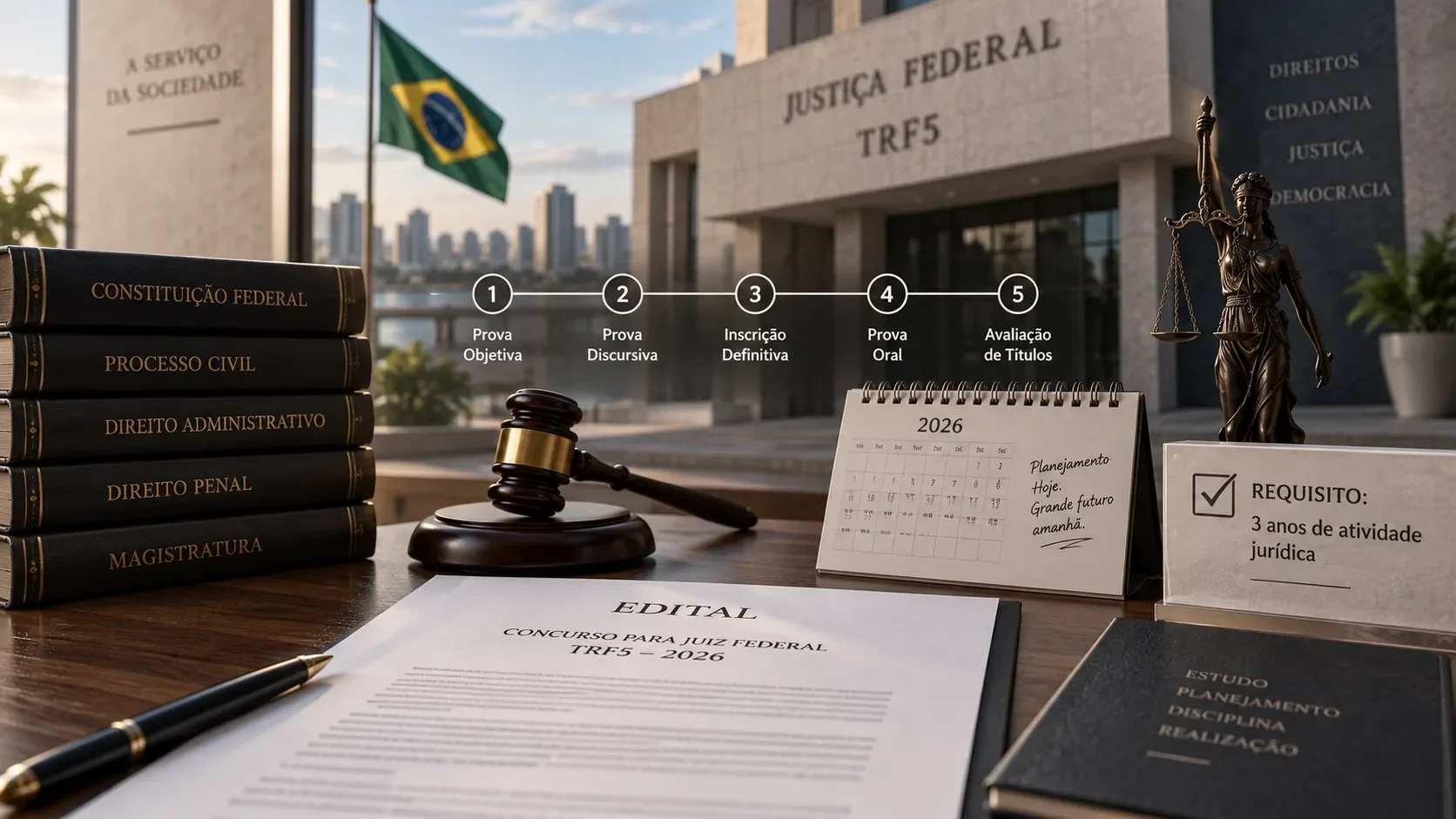
The 16th Public Competition of Brazil's Federal Regional Court of the 5th Region (TRF5) for Federal Substitute Judge offers 11 immediate openings plus a reserve list. Preliminary applications remain open until September 28, 2026, at 4:00 p.m. Brasília time, through Fundação Getulio Vargas (FGV), with a R$350 fee. One point is especially important for anyone deciding whether they are eligible: the preliminary application requires a valid qualification certificate from the National Magistracy Examination (ENAM), but proof of the three years of legal activity is required later, at the definitive registration stage, after the second stage of the competition.
Applicants should also use the updated schedule. TRF5's initial news release, published in August, referred to an objective test on November 29, 2026 and written tests in February 2027. The First Amendment to the Notice, published on September 1, changed those dates: the objective test is now scheduled for December 20, 2026, and the written tests for April 4 and 5, 2027. For application planning, the amended official notice should be treated as the main reference.
What to check before submitting the preliminary application
| Item | Current rule |
|---|---|
| Openings | 11 immediate openings, plus a reserve list. |
| Salary stated in the notice | R$37,765.55 as of the date the notice was published. |
| Applications | From 4:00 p.m. on August 28, 2026 to 4:00 p.m. on September 28, 2026, Brasília time. |
| Fee | R$350; the GRU payment form may be paid until September 29, 2026. PIX payment must use the QR Code generated on the GRU itself. |
| ENAM | A valid qualification certificate from the National Magistracy Examination must be uploaded with the preliminary application. |
| Law degree | The applicant must have completed a Law degree recognized by Brazil's Ministry of Education (MEC). |
| Legal activity | Three years after obtaining the Law degree, to be proven by the definitive registration stage. |
| Organizing body | Fundação Getulio Vargas (FGV), together with the TRF5 Competition Committee. |
For the preliminary application, the candidate must complete the form on the official FGV page, upload the ENAM certificate, an identification document proving nationality and containing a photograph and signature, and a 3x4 cm photograph that meets the notice's specifications. Paying the fee alone is not enough for approval: the required documents must also be correctly submitted.
The three years of legal activity: when and how the requirement is assessed
The notice requires three years of legal activity counted from the date the candidate obtained the Law degree. This point can be confusing because there are two registration moments in the competition. At the preliminary application stage, the candidate declares that the requirement will be met by the definitive registration stage. Documentary proof is submitted only after a candidate passes the second stage and is called for definitive registration.
The notice treats as legal activity, among other situations, work performed exclusively by a Law graduate; actual legal practice, including volunteer practice, with at least five lawyer-only acts per year in distinct cases or matters; positions, jobs or functions requiring predominant use of legal knowledge; service as a court conciliator subject to the minimum workload in the notice; and mediation or arbitration in dispute resolution. Academic internships and any activity performed before obtaining the Law degree do not count.
At definitive registration, proof includes a reliable certificate or declaration covering the legal-activity period and a form listing the periods, locations and activities performed. For positions or functions that do not legally require a Law degree, the candidate must submit a detailed certificate showing the predominant use of legal knowledge, and the Competition Committee will decide whether the document is valid.
How the five stages work
The notice structures the competition into five successive stages. Participation in each stage depends on passing the previous one.
| Stage | What happens | Nature | Known date or milestone |
|---|---|---|---|
| 1st — Objective screening test | 100 multiple-choice questions divided into three subject blocks. | Eliminatory and ranking | December 20, 2026, from 1:00 p.m. to 6:00 p.m. |
| 2nd — Written tests | Essay/discursive test, civil judgment drafting and criminal judgment drafting. | Eliminatory and ranking | April 4, 2027: discursive test in the morning and civil judgment in the afternoon; April 5, 2027: criminal judgment in the afternoon. |
| 3rd — Background and health checks | Background investigation and social inquiry, physical and mental health examination, and psychotechnical examination. Definitive registration is processed at the start of this chapter of the notice and is a mandatory gateway after the written tests. | Eliminatory | Dates will be set in a call notice. The definitive registration request will have a 15-business-day deadline after the call. |
| 4th — Oral examination | Public questioning on a randomly selected topic, evaluating technical knowledge, language, reasoning and argumentation. | Eliminatory and ranking | Date to be published in a specific call notice. |
| 5th — Title/credential assessment | Scoring of credentials submitted by candidates who pass the oral examination. | Ranking only | After the oral-exam result; documentary proof of credentials is submitted at definitive registration. |
First stage: a 100-question objective test
The objective test is scheduled for December 20, 2026 and will last five hours. It will be held in Aracaju, Fortaleza, João Pessoa, Maceió, Natal and Recife. The 100 questions are divided into three blocks: Block I has 40 questions, while Blocks II and III have 30 each.
For the general competition list, the notice requires, at the same time, at least 12 correct answers in Block I, 9 in Block II, 9 in Block III and 60 correct answers overall. In addition to these minimum scores, there is a cap on the number of candidates classified for the second stage based on the total number of applicants. Applicants competing for reserved openings should check the specific rules in the notice because their call-up criteria are not identical to the general list.
Second stage: discursive test and two judgments
After the amendment, the second stage is scheduled for April 4 and 5, 2027. On April 4, the discursive test will run from 8:00 a.m. to noon and the civil judgment test from 3:00 p.m. to 8:00 p.m. On April 5, the criminal judgment test is scheduled from 3:00 p.m. to 8:00 p.m. These tests will also be held in the six state capitals used for the objective test.
Third stage and definitive registration: when eligibility documents are proven
After passing the written tests, candidates must submit a definitive-registration request within 15 business days of the call notice. This is when documents such as the Law diploma, proof of three years of legal activity, electoral compliance and, when applicable, military-service compliance, criminal certificates and background records, a declaration about any criminal investigation or prosecution, a legal-activity form and OAB-related documentation become relevant.
The same section of the notice covers the background investigation and social inquiry, physical and mental health examinations and the psychotechnical examination. Denial of definitive registration or a finding of unfitness/unsuitability may lead to elimination, subject to the appeal rules in the notice.
Fourth stage: oral examination
The oral examination comes after candidates pass the third stage and will be scheduled by a future notice. The examination topic must be drawn publicly at least 24 hours before the questioning. Each examiner may question a candidate for up to 15 minutes, and the final score is the average of the examiners' scores. A minimum score of 6.0 is required to advance to the fifth stage.
Fifth stage: credentials
The credential assessment is ranking-only. A practical detail matters here: documentary proof of credentials must already be submitted at the definitive registration stage, even though the scoring occurs only after the oral examination. Candidates intending to claim professional experience, postgraduate degrees, prior competition approvals or other credentials listed in the notice should therefore organize this documentation before the third stage.
Where the stages take place
The objective and written tests will be held in Aracaju, Fortaleza, João Pessoa, Maceió, Natal and Recife. The notice states that the remaining stages will take place in Recife, subject to exceptions for medical assessment of candidates with disabilities and in-person verification procedures connected to reserved openings, which may occur in the city where the candidate took the first tests under the specific rules.
This matters for budgeting: candidates who do not live in Recife may need to plan for travel and accommodation if they advance. FGV also states that if available seats are insufficient in one test city, candidates may be assigned to nearby cities, without the organizers assuming responsibility for transportation or lodging.
How the 11 initial openings are distributed
For the 11 openings initially offered, the table in the notice shows 7 for the general competition list, 1 for persons with disabilities and 3 for Black candidates (pretos or pardos). There are no initial openings specifically allocated to Indigenous or Quilombola candidates in this first distribution, although the notice sets reservation percentages and recalculation, alternation and reversion rules as new openings arise during the competition's validity period.
The competition is valid for two years and may be extended once for the same period. Openings that arise during that period may be filled under the rules of the notice.
Checklist for deciding whether applying makes sense now
- Confirm that the ENAM qualification certificate is valid and available for upload.
- Check that the Law degree has been completed and is recognized by MEC.
- Project whether the three years of legal activity will be complete by the future definitive registration date — not merely by September 28.
- Prepare the identification document and 3x4 cm photo in the format required by FGV.
- Submit the application by 4:00 p.m. on September 28, 2026; if a fee is due, observe the September 29, 2026 GRU payment deadline.
- Use the amended schedule: objective test on December 20, 2026 and written tests on April 4 and 5, 2027.
- Account for logistics in six capitals during the first two stages and Recife for later stages.
- Start organizing documentary proof of legal activity and credentials that will be required at definitive registration.
What still depends on future call notices
As of September 15, 2026, the notice already fixes the application deadline, the objective-test date and the expected written-test dates, but it does not yet provide a closed calendar for definitive registration, the third stage, the oral examination or the final credential assessment. These milestones will be detailed in future call notices.
For changes, results and new call notices, the safest references are the FGV page for the 16th TRF5 competition and TRF5's official competition area. The TRF5 opening news release remains useful for context, but applicants should verify the schedule in the amended notice and subsequent official publications.