October 31, 1517 is remembered as a landmark of the Protestant Reformation, but the date becomes historically clearer when the 95 Theses are not read as if the entire Reformation already existed in finished form. Martin Luther’s text began as a series of propositions for debate about the efficacy, preaching and pastoral effects of indulgences. It contained sharp criticism, yet it still operated within several assumptions of the Western Church of its time and was not the equivalent of a complete confession of the Protestantism that would develop in the following years.
The starting point: a controversy over indulgences
The theses were traditionally titled a disputation on the power and efficacy of indulgences. In Catholic terms, an indulgence is not simply “buying the forgiveness of a sin.” The Catholic Church’s current doctrinal formulation describes it as remission of the temporal punishment due to sins whose guilt has already been forgiven. This later definition helps distinguish concepts, although it should not be mechanically projected onto every practice, claim and abuse of the early sixteenth century. The official Catholic formulation itself distinguishes indulgence, guilt and penance.
In 1517, Luther’s concern was also pastoral: in his view, the way indulgences were advertised and understood could create false spiritual security. The theses show his fear that people might trust letters of indulgence as a guarantee of salvation, weakening the importance of repentance, penance and charity.
What the 95 Theses actually challenged
A reading of the text of the 95 Theses shows that the controversy cannot be reduced to the generic claim that Luther was simply “against the Church.” The immediate target was more specific.
- Exaggerated promises attached to indulgences. In theses 21, 24 and 32, Luther rejects the idea that indulgences automatically free a person from every penalty or guarantee salvation. His concern was the transformation of an ecclesiastical practice into spiritual certainty.
- Claims to control the fate of souls in purgatory. Theses 25 to 29 question the extent of papal power over souls in purgatory and insist that the result of the Church’s intercession belongs to God rather than to a human transaction.
- Giving money priority over charity. In theses 43 to 46, Luther argues that giving to the poor or lending to the needy is better than spending money on indulgences, especially when doing so harms a household’s own support.
- The way preachers presented the campaign. Theses 50, 51, 70 and 72 distinguish between papal authority and the excesses of indulgence preachers. Luther even argues that if the pope knew about certain exactions, he would prefer a different course.
- The need to place the Gospel at the center. Thesis 62 calls the Gospel of the glory and grace of God the true treasure of the Church. In the theses that follow, Luther contrasts this treasure with the economic appeal of indulgences.
This combination helps explain the document’s force. It was not merely a technical argument about church regulations: it touched repentance, authority, purgatory, money, preaching and the way ordinary people understood assurance of salvation.
What they did not yet mean in 1517
Reading backward from later events can make the theses seem more final than they were. The text itself contains passages that set important limits on that interpretation.
| Anachronistic reading | What the 1517 text supports |
|---|---|
| “Luther rejected all indulgences.” | No. Thesis 38 says papal remission should not be despised; theses 69 and 71 also preserve a positive idea of indulgences when properly understood. |
| “The theses abolished papal authority.” | No. Luther limits and questions certain claims, but he repeatedly speaks of the pope’s intention and authority in ways that try to distinguish the pontiff from abuses by preachers. |
| “A fully formed new church was born on October 31.” | No. The text presents itself as material for an academic disputation. Institutional and confessional division resulted from a later escalation of controversies, condemnations, debates and political decisions. |
| “The 95 Theses already contain the whole Reformation program.” | No. Issues that would later become central — such as the final authority of Scripture in explicit conflict with pope and councils — gained greater formulation and weight as the dispute developed. |
| “Luther was already outside the Roman Church in 1517.” | No. The rupture did not happen all at once. The following years show a radicalization of the conflict leading to Roman condemnation and Luther’s refusal to recant in 1521. |
October 31: what is secure and what remains debated
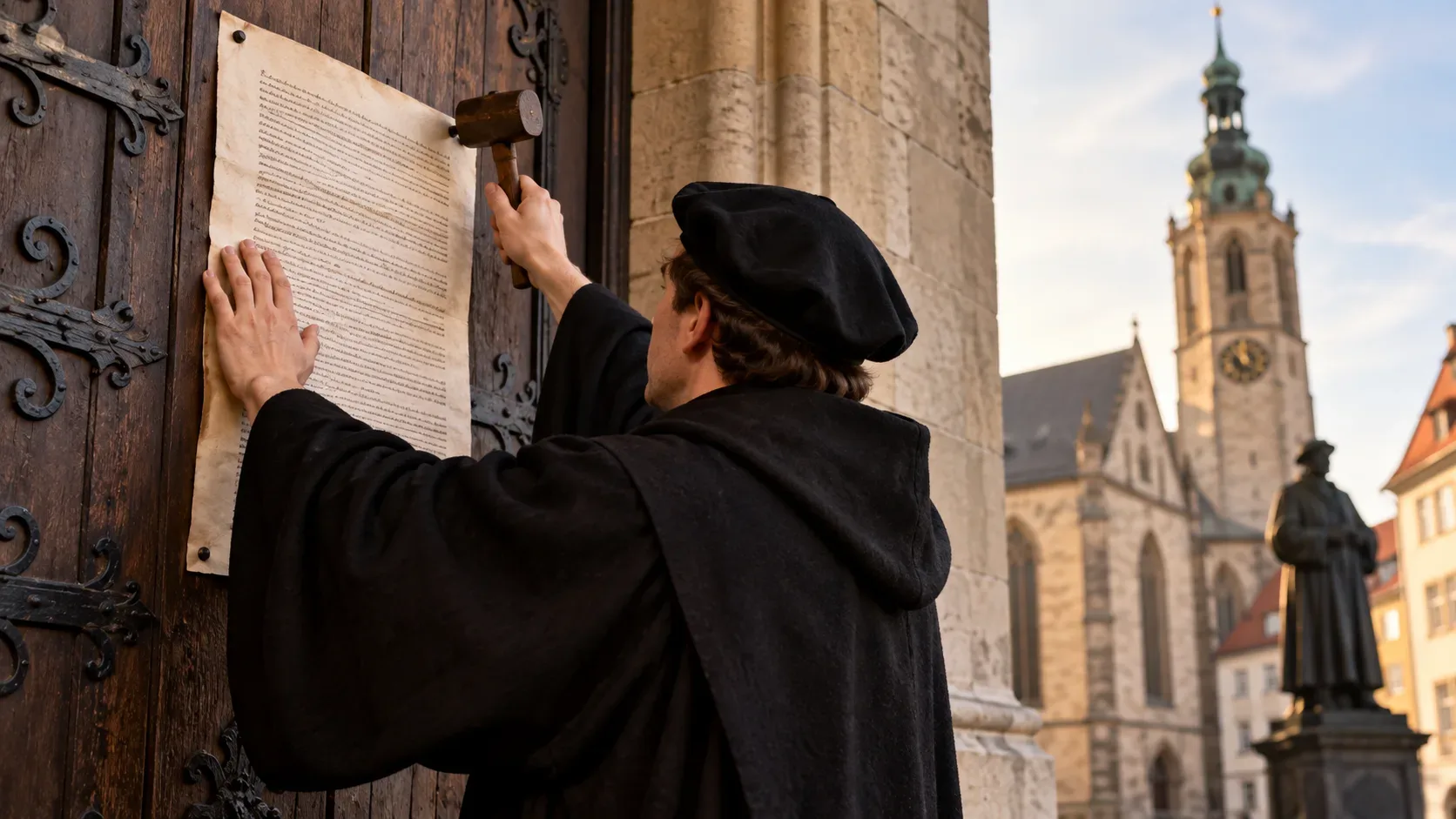
October 31, 1517 is historically secure because the controversy is tied to communications and theses dated to that moment. The most famous detail — Luther personally hammering the theses onto the door of Wittenberg’s Castle Church — requires more caution. The Stiftung Luthergedenkstätten, which operates the LutherMuseen, explains that the posting remains a subject of historical debate: university practice makes publication on church doors used as notice boards plausible, but Luther himself left no contemporary account of the theatrical hammering scene that later became iconic.
A cautious historical formulation, therefore, is that the theses were circulated in Wittenberg and sent for discussion and to ecclesiastical authorities; the hammer image should be treated as an emblematic tradition rather than as a detail established with the same certainty as the existence and circulation of the theses.
Why a dispute over indulgences became a Reformation
The impact came not from a single scene but from a sequence. The theses circulated, drew responses and placed Luther in a controversy that expanded into larger questions of religious authority. The documentary introduction to German History in Documents and Images notes that in 1517 it was not obvious that the dispute would produce what is now called the Reformation and that the possibility of schism became clearer only with later developments.
By 1521 the situation was very different. Luther had been condemned by Rome and, at the Diet of Worms, refused to retract his writings unless he could be convinced by Scripture or evident reason. The documentary record of Worms shows a far more explicit confrontation between Luther’s position and ecclesiastical and imperial authorities. The rupture took shape through this process, not through the 1517 document alone.
This also explains why it is misleading to project mature confessional categories directly onto October 31. The label “Protestant,” territorial confessions, Lutheran and Reformed churches, and more systematic doctrinal formulas belong to later stages of a history that was still open in 1517.
How to read the theses without reducing the Reformation to one act
A sound historical reading begins with the document’s genre: theses for disputation. Instead of searching for a finished manifesto, it is more useful to notice the questions the text opens. How far does authority over penalties and purgatory extend? What happens when a pastoral practice is presented as spiritual guarantee? What place belongs to repentance, mercy and charity? How should doctrine be distinguished from its economic use or popular preaching?
It is also important to separate three levels: the content of the theses, the controversy that followed, and the later developments of the Reformation. Mixing them produces anachronism. Keeping them distinct helps explain how a text still partly embedded in the language and structures of the Church of its time could contribute to a conflict that, within a few years, would challenge religious authority in the Latin West much more deeply.
Sources for checking the episode
- German History in Documents and Images — text and context of the 95 Theses.
- LutherMuseen — historical discussion of the posting of the theses.
- German History in Documents and Images — overview of the Reformations and the escalation of the conflict.
- German History in Documents and Images — Luther and Charles V at the Diet of Worms, 1521.
- Catechism of the Catholic Church — contemporary definition of indulgence.
October 31 can therefore be treated as a genuine landmark without turning it into a simplifying myth: the 95 Theses forcefully challenged the preaching and assurance attached to indulgences, but the confessional break and the theological program now associated with the Protestant Reformation were built through the conflicts of the following years.