
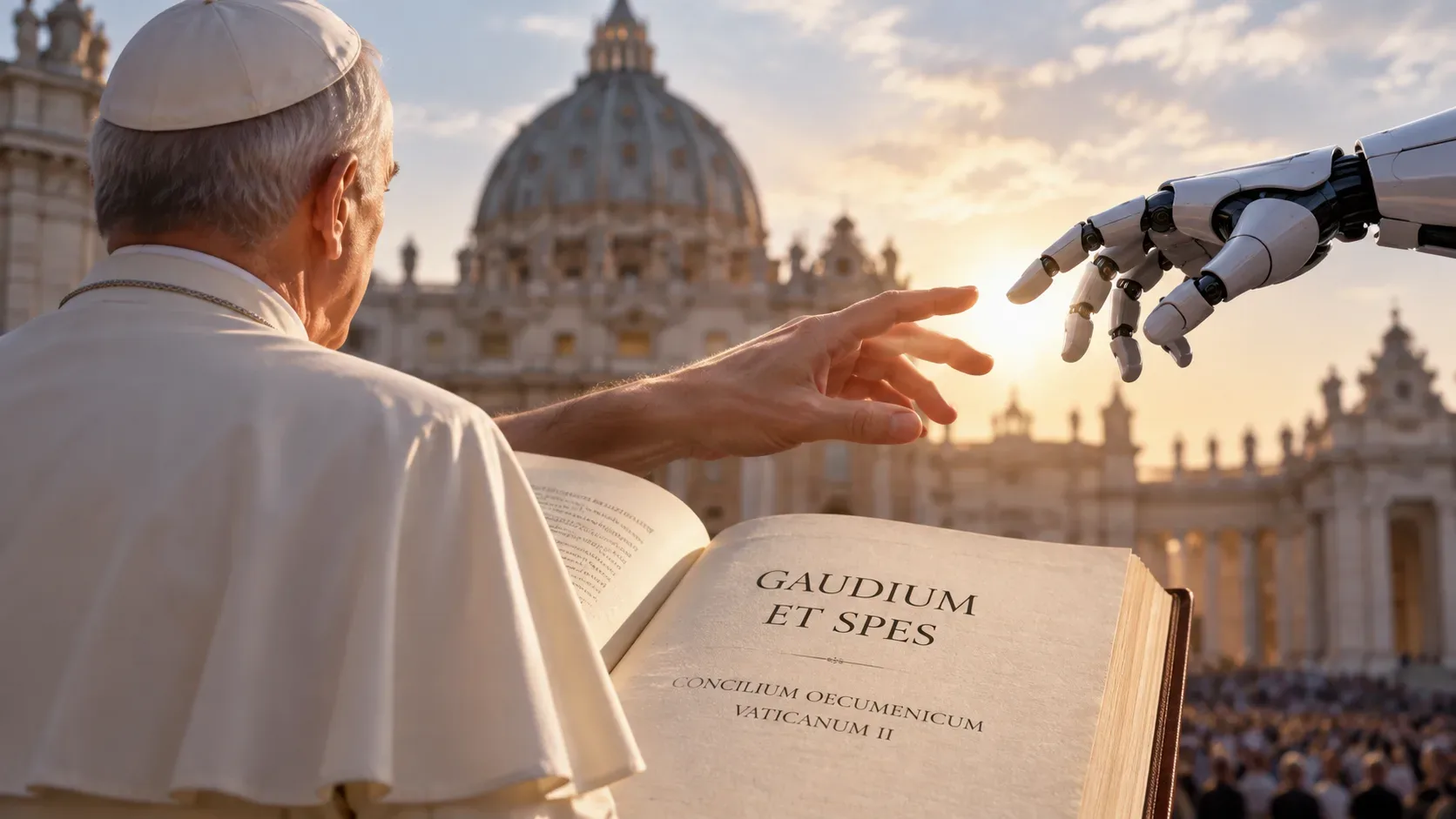
At the General Audience of September 16, 2026, in St. Peter's Square, Leo XIV devoted his catechesis to chapter II of the Pastoral Constitution Gaudium et Spes, especially numbers 23 to 32, on the human community. Bringing that Second Vatican Council text into the present, the Pope placed artificial intelligence inside a clear contrast: technological development opens new possibilities and bridges distances, but relationships can also become less personal, and people may grow accustomed to delegating to algorithms decisions that belong to the human conscience. The formulation appears in the official text of the General Audience of September 16, 2026.
The point is not a blanket rejection of technology. The catechesis uses AI as a current example to recover a broader thesis of Gaudium et Spes: technical progress is fully human only when it remains subordinate to the dignity of the person, the quality of relationships, the common good, and the responsibility of those who act.
What Leo XIV actually said about algorithms
Leo XIV first acknowledged the positive side of technological development, mass media, social media, and the growing use of artificial intelligence. In his account, these tools can open new possibilities, break down barriers, and bridge distances. He then presented the corresponding risk: more virtual and less personal relationships can encourage a habit of transferring to automated systems decisions that are, in his words, “the sole preserve of the human conscience.”
That statement is more specific than a criticism of automation as such. The object of the warning is the moral decision attributed to conscience, not every use of calculation, recommendation, screening, or automated support. The catechesis does not provide a list of permitted and prohibited applications, nor does it establish a technical regulatory framework for AI.
How the catechesis connects to Gaudium et Spes
| Layer | What the text states | Scope for the AI question |
|---|---|---|
| Catechesis of 9/16/2026 | Technology and AI expand possibilities, but they should not lead to a transfer of moral decision making to algorithms. | This is the contemporary application made directly by Leo XIV. |
| Gaudium et Spes 23 | Technical progress multiplies relationships, but true communion depends on interpersonal relationships and respect for the spiritual dignity of the person. | This supplies the central criterion used at the opening of the catechesis. |
| Gaudium et Spes 25-31 | The person is the beginning, subject, and goal of social institutions; the common good, justice, responsibility, and participation should guide collective life. | This helps assess technologies by the effects they have on persons and communities. |
| Gaudium et Spes 16 | Conscience is presented as the intimate core in which the person recognizes a moral obligation to seek good and avoid evil. | It is important doctrinal context, but this number was not cited in the catechesis sentence about AI. |
Why conscience is central to the logic of the document
The September 16 catechesis formally worked with numbers 23 to 32 of Gaudium et Spes. Earlier in the constitution, however, number 16 had addressed the dignity of the moral conscience. There, the Council describes conscience as the intimate place in which a person recognizes a call to love good, avoid evil, seek truth, and answer morally for one's choices. The full text can be read in the official version of Gaudium et Spes.
It is important not to collapse those two moves into one. Leo XIV did not say, in the passage about AI, that he was quoting number 16. What he did was apply the section on the human community to the present, and his formulation about conscience is consistent with the constitution's broader anthropological framework.
The argument of Gaudium et Spes 23-32 applied to artificial intelligence
Technical progress is not enough to create community
Number 23 begins with an observation that sounds especially current: technical advances multiply connections, but connection is not the same as communion. For the Council, the human quality of relationships depends on respect for the spiritual dignity of the person. Leo XIV updates that contrast by noting that digital media and AI can bring people closer while also making relationships more impersonal.
The person must remain at the center of institutions
In number 25, Gaudium et Spes says that the human person is the beginning, subject, and goal of all social institutions. Applied to AI, that criterion shifts the question from “does the system work?” to “does the system serve the person without absorbing that person's responsibility?” This is an interpretation of the conciliar principle, not a detailed technical rule stated by the Pope.
The common good places things at the service of persons
Number 26 defines the common good in relation to the social conditions that allow persons and groups to reach their fulfillment. The same section says that the order of things must be subordinate to the order of persons. In discussions about algorithms, this offers a relevant moral test: efficiency, scale, and speed are not enough if the outcome treats people merely as objects of classification or removes their ability to participate in decisions that affect them.
Responsibility and participation cannot disappear
In numbers 30 and 31, the document criticizes a purely individualistic ethic and insists on responsibility, formation, and participation. This helps explain why total delegation of moral decisions is problematic within the logic of the catechesis. If no one can identify who is answerable for a choice, explain its criteria, or review its effects, technology stops being merely a tool and begins to obscure human responsibility.
What “not delegating to AI” can mean in practice
Leo XIV did not present an operational protocol. The points below are therefore an interpretive synthesis of the catechesis and Gaudium et Spes, not an official Vatican checklist:
- Keep an identifiable human decision maker: systems may support decisions, but moral responsibility should not disappear behind software.
- Preserve explanation and the possibility of review: when a decision directly affects a person, there should be room to understand criteria, challenge errors, and correct injustice.
- Do not reduce a person to data: profiles, probabilities, and classifications can inform an analysis, but they do not exhaust someone's dignity and uniqueness.
- Protect relationships that require presence and care: the catechesis insists that social relationships have real substance and personal depth, especially where vulnerability and mutual responsibility are involved.
- Assess the common good: the question is not only whether the tool benefits one user or organization, but how its effects reach groups, rights, and the wider community.
What Leo XIV did not say
It is equally important to define the limits of the statement. In the September 16 catechesis, Leo XIV did not say that all automation is morally wrong, did not declare that algorithms may never assist decisions, did not list sectors where AI should or should not be used, and did not present a legislative or technological governance proposal.
Nor did he reduce the catechesis to a speech about artificial intelligence. AI appears at the beginning as a contemporary example within a much broader argument about human community, dignity, diversity, the common good, social justice, respect for those who think differently, and responsible participation.
Why the chapter on the human community is decisive
After the warning about algorithms, Leo XIV moves through the themes of Gaudium et Spes 24 to 31. He recalls humanity as one family, the interdependence of person and society, the common good, respect for the person, love even for adversaries, the fundamental equality of all, and the need to overcome individualism through responsibility and participation.
That is why the AI sentence should be read within this sequence. The problem is not simply that a machine “decides.” The problem arises when technical structures weaken conscience, responsibility, relationship with others, or the possibility of directing institutions toward dignity and the common good.
In one sentence: what limit is being proposed
In terms of Leo XIV's argument, technology can help inform, organize, and support human action, but it should not take the place of the moral subject who answers for the choice. The limit is not defined by a rejection of AI, but by the requirement that conscience, dignity, responsibility, and participation remain with persons.