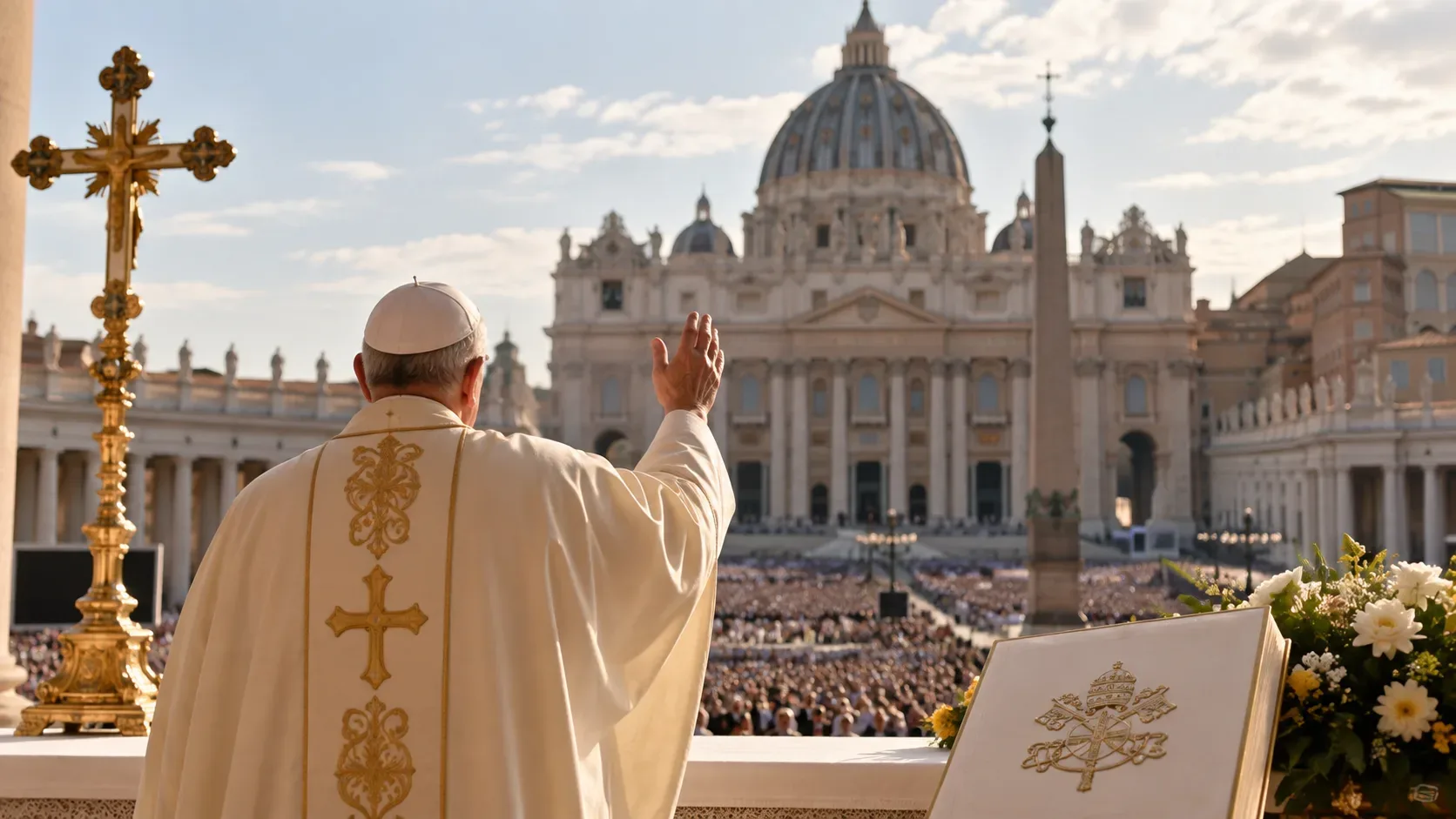

Published on 16 September 2026, the note A Journey of Hope: Sixty Years of Interreligious Dialogue and Fraternity in the Light of the Conciliar Declaration Nostra Aetate was issued jointly by the Dicastery for the Doctrine of the Faith, the Dicastery for Promoting Christian Unity, and the Dicastery for Interreligious Dialogue. Pope Leo XIV had approved the text on 22 June 2026 and ordered its publication. It returns to Nostra Aetate, promulgated by the Second Vatican Council on 28 October 1965, to assess six decades of reception, results, and difficulties.
A date clarification helps explain the context: the declaration reached its 60th anniversary on 28 October 2025. The 2026 note belongs to this extended commemoration. It is not a new conciliar declaration, does not revoke the 1965 text, and does not formally alter its five sections. Its role is to reread the legacy of Nostra Aetate in light of later magisterial teaching and current problems.
What Nostra Aetate established in 1965
Nostra Aetate is brief, but it changed the Catholic framework for relations with other religions. Instead of beginning with differences, the text starts from humanity's common origin and destiny and from the major religious questions about existence. From there, it sets out principles that continued to guide dialogue in later decades.
- Respect for what is true and holy in other religions: the Church recognizes spiritual and moral values present in them without abandoning the Christian confession of Christ.
- Dialogue and cooperation: Catholics are urged to know, preserve, and promote spiritual, moral, and sociocultural goods found in other traditions, with prudence and charity.
- Relations with Muslims: the declaration expresses esteem for Muslims and calls for mutual understanding, social justice, peace, and freedom.
- A distinctive relationship with Judaism: the text recalls the Jewish roots of the Christian faith, encourages study and fraternal dialogue, rejects collective Jewish guilt for the death of Jesus, and deplores antisemitism.
- Fraternity and human dignity: the final section rejects discrimination and violence based on race, color, social condition, or religion.
What the 2026 note reaffirms and develops
The 2026 document does not present a break with the Council. It does the opposite: it seeks to show how the insights of 1965 were developed by Paul VI, John Paul II, Benedict XVI, Francis, and Leo XIV, and how they can be applied to a setting marked by wars, extremism, migration, secularization, and social and environmental crises.
| Theme | Nostra Aetate, 1965 | 2026 note |
|---|---|---|
| Nature of dialogue | Recommends dialogue and cooperation with followers of other religions. | States that dialogue is neither a temporary strategy nor a surrender of Christian identity. It also rejects relativism, syncretism, and the idea of leveling beliefs into a single world religion. |
| Religious freedom | Rejects religious discrimination and, in the passage on Christians and Muslims, links coexistence with peace and freedom. | Explicitly connects dialogue with Dignitatis Humanae and argues that respect among religions requires religious freedom and freedom of conscience. |
| Judaism | Recognizes shared spiritual heritage, rejects collective Jewish guilt, and deplores antisemitism. | Treats Jewish-Christian dialogue as part of understanding Christian identity itself, reaffirms the irrevocability of God's covenant with the Jewish people, and insists on combating antisemitism. |
| Islam | Expresses esteem for Muslims and calls for mutual understanding and cooperation for the common good. | Adds an explicit critique of Islamophobia, distinguishes violent fundamentalism from the peaceful lives of most Muslims, and renews the call for reciprocity in respect for religious freedom. |
| Peace and violence | Calls for joint promotion of justice, moral values, peace, and freedom. | Applies this principle to terrorism, war, political manipulation of religion, and the use of God's name to legitimize violence. |
| Formation for dialogue | Provides the broad orientation for dialogue and cooperation. | Calls for concrete formation in seminaries, theological institutes, and pastoral programs, including knowledge of religions, the history of interreligious relations, and religious literacy. |
| Practical cooperation | Values spiritual, moral, and sociocultural goods and common action. | Highlights local projects, education, humanitarian action, defense of vulnerable people, justice, peace, and care for creation as fields of cooperation. |
Dialogue remains connected to Christian identity
One of the most important interpretive limits appears repeatedly in the note: dialogue does not mean claiming that all religions are identical or that doctrinal differences no longer matter. The text excludes the idea of a world religion that dissolves identities and says encounter should combine clarity about one's own faith, sincere listening, and respect for the other person.
This also applies to Christian mission. The note does not present dialogue and proclamation as incompatible activities. It argues that Christian witness must respect the freedom and dignity of others, without coercion. Therefore, when it criticizes proselytism as a form of conquest, it does not eliminate evangelization but seeks to distinguish it from pressure or imposition.
In the case of Judaism, the theological precision is especially clear. The document reaffirms that God's covenant with the Jewish people is irrevocable, but says this should not be read, in Catholic doctrine, as two parallel paths of salvation. At the same time, it holds that knowing living Judaism and Christianity's Jewish roots helps Christians understand their own faith more deeply.
Why the 2026 document returns to the Second Vatican Council
The return is not limited to quoting Nostra Aetate. The note places it within a network of conciliar texts. It connects interreligious dialogue with the religious freedom articulated in Dignitatis Humanae, the vision of dignity and coexistence in Gaudium et Spes, and, when dealing with Judaism, principles also associated with Dei Verbum and Lumen Gentium.
This reading helps explain what the Vatican describes as enriched continuity. The starting point remains conciliar, but six decades of encounters, documents, papal journeys, commissions, and local initiatives have produced more specific vocabulary and practices. The note organizes that history and projects it onto problems that did not have the same configuration in 1965, including Islamophobia, contemporary political manipulation of religious identities, the ecological crisis, and the need for systematic formation in multireligious settings.
Antisemitism, Islamophobia, and religious violence receive more direct application
Opposition to antisemitism was already at the heart of Nostra Aetate, especially because of the post-Shoah context. The 2026 note recovers this origin and presents the fight against antisemitism as a permanent Christian responsibility. At the same time, it explicitly includes Islamophobia among the prejudices that require discernment, warning against confusing extremist groups with Muslim communities living peacefully in plural societies.
The document also broadens the application of the conciliar principle against religiously justified violence. Rather than remaining only at the level of cordial relations among leaders, it connects dialogue with international conflicts, terrorism, political instrumentalization of faith, and protection of people persecuted for religious reasons. Freedom of conscience appears, in this context, as a basis for authentic relationships.
Formation and local life are the main practical translation
Perhaps the most operational development in the note is its call for a pedagogy of dialogue. The Vatican says it is not enough to state that dialogue matters. Seminaries, theological institutes, and pastoral programs should prepare people who can know other traditions, understand the history of relations among religions, and read cultural and geopolitical factors without reducing others to stereotypes.
The text also gives weight to local experience. Multireligious neighborhoods, educational and humanitarian projects, youth initiatives, and everyday forms of cooperation are treated as real places where the conciliar principle takes shape. The note also allows for conversations and collaboration with members of new religious movements and new religious experiences, while clarifying that such encounters need not automatically be classified as ecumenism or interreligious dialogue in the technical sense.
What is genuinely new, and what remains the same
The doctrinal core of Nostra Aetate remains: common dignity, respect, dialogue, rejection of antisemitism and discrimination, openness to cooperation, and recognition of values present in other traditions. The 2026 note does not rewrite that core.
What it adds is primarily a historical and pastoral reading. After 60 years, the Vatican names concrete fruits, acknowledges resistance, incorporates contemporary problems, and calls for more precise tools for formation and coexistence. For that reason, the best way to read A Journey of Hope is as an authoritative interpretation of the post-conciliar path: less an update to the 1965 text and more an update to its application.
For the primary texts, see the Declaration Nostra Aetate, the note A Journey of Hope, dated 16 September 2026, and the Declaration Dignitatis Humanae.