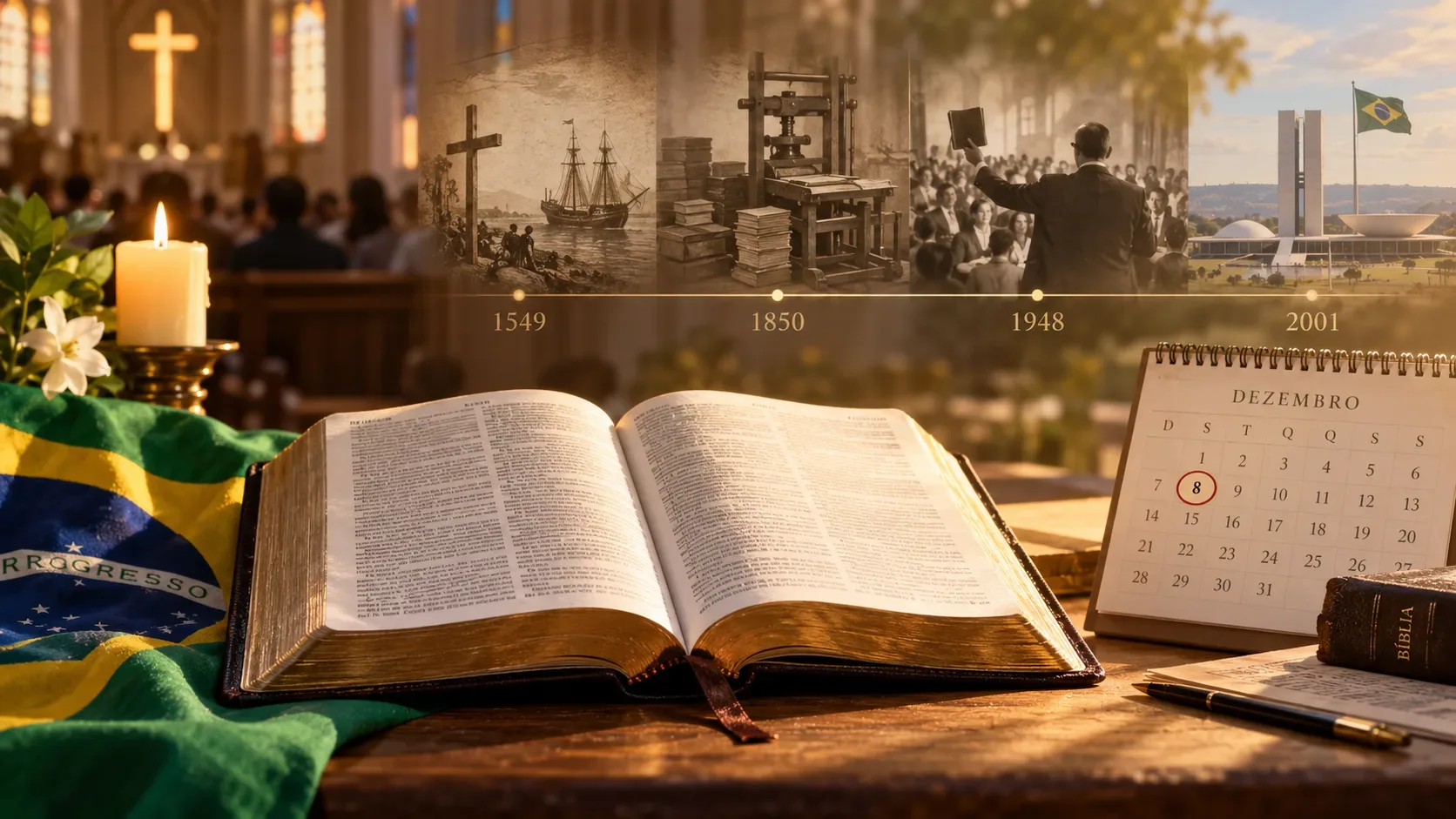
Bible Day is observed in Brazil on the second Sunday of December because that is the rule followed by the tradition promoted by Bible societies and, since 2001, also the rule written into federal law. The Brazilian Bible Society (SBB) traces the celebration to 1549 in Great Britain, when Bishop Thomas Cranmer included in King Edward VI's prayer book a date dedicated to intercession for Bible reading. Brazil's Law No. 10,335 of December 19, 2001, in turn, states explicitly that Bible Day is to be celebrated on the second Sunday of December each year throughout the national territory.
The short answer: tradition first, law later
There are two layers to the answer. The first is religious and historical: the SBB presents the second Sunday of December as part of a tradition whose origin goes back to 1549. The second is legal: in 2001, Brazil's National Congress approved and the Presidency sanctioned Law No. 10,335, turning that convention into an officially instituted national commemorative date.
The official sources consulted do not provide an additional theological, astronomical or administrative explanation for choosing that particular Sunday. They document the tradition and, in the case of the law, establish the rule. It is therefore more accurate to say that the date falls on that Sunday because the historical convention was preserved and later incorporated into Brazilian law, rather than attributing a more specific reason that the sources do not substantiate.
From the 1549 tradition to the celebration in Brazil
According to the SBB, the traditional starting point is 1549 in Great Britain. Bishop Cranmer is said to have included in King Edward VI's prayer book a special day for the population to intercede for the reading of the Bible. The Brazilian organization presents this episode as the origin of Bible Day and associates the observance with the second Sunday of December.
In Brazil, the SBB places the beginning of the observance in 1850, amid the arrival of evangelical Christian missionaries from Europe and the United States. This milestone should not be confused with a national law: it was a religious practice maintained by Christian communities, without the federal recognition that would come more than a century later.
1948: the first public observance recorded by the SBB
The chronology published by the SBB identifies 1948 as another milestone. That year saw the first public Bible Day observance at the Ipiranga Monument in São Paulo. The Brazilian Bible Society was also founded in 1948.
From then on, the organization played an important role in publicizing the date and the Scriptures in Brazil. The SBB itself notes that, in addition to the second Sunday, Bible Day-related activities came to be held throughout the week leading up to the celebration. That broader program of events, however, does not change the legal date: the national reference remains the second Sunday of December.
What Law 10,335/2001 actually changed
Law No. 10,335 was sanctioned on December 19, 2001 and published in the Federal Official Gazette on December 20 of that year. Article 1 institutes Bible Day and states that it is to be celebrated on the second Sunday of December each year throughout Brazil. Article 2 simply provides that the law takes effect on the date of publication. The full text is also available from the Chamber of Deputies.
In other words, the law gave national legal recognition to a celebration that already existed as a religious practice. It is equally important to note what the statute does not say: it does not declare a national holiday, order workplaces to close or require religious participation. It institutes a commemorative date and defines when it is to be observed.
How to calculate Bible Day in any year
Because the law uses a day of the week rather than a fixed calendar date, Bible Day moves from year to year. The calculation is simple: identify the first Sunday in December, which always falls between December 1 and 7, then add seven days. The second Sunday must therefore fall between December 8 and 14.
In 2026, December 1 falls on a Tuesday. The first Sunday of the month is December 6; seven days later, the second Sunday is December 13, 2026.
| Year | Second Sunday of December |
|---|---|
| 2026 | December 13 |
| 2027 | December 12 |
| 2028 | December 10 |
| 2029 | December 9 |
| 2030 | December 8 |
Religious tradition and official recognition are not the same thing
The timeline helps separate two concepts. The religious tradition predates the contemporary Brazilian state: the SBB traces its origin to 1549 and records the observance in Brazil from 1850 onward. Official national recognition is much later and stems from a federal law enacted in 2001.
Law No. 10,335/2001 therefore did not create the religious practice from scratch. It nationally instituted a date that Christian communities had already been observing. Likewise, the fact that the date appears in federal law does not make the observance a religious obligation or, by itself, a public holiday.
Essential Bible Day timeline
- 1549: according to the SBB, the tradition originated in Great Britain with Bishop Cranmer and King Edward VI's prayer book.
- 1850: the SBB places the beginning of the observance in Brazil in this year, associated with the arrival of evangelical missionaries from Europe and the United States.
- 1948: the first public observance recorded by the SBB took place at the Ipiranga Monument in São Paulo; the Brazilian Bible Society was founded in the same year.
- 2001: Law No. 10,335 institutes Bible Day throughout Brazil and fixes the second Sunday of December as its annual date.
What can be stated with confidence
The documents consulted clearly support the current rule and the chronology used by the SBB. Federal law is unambiguous about the second Sunday of December. The SBB, meanwhile, documents the milestones of 1549, 1850 and 1948 and connects the Brazilian observance to the Christian tradition of valuing and reading Scripture.
The point that requires caution is the question, “why exactly the second Sunday?” The sources consulted establish that this is the traditional and legal date, but they do not develop a more detailed historical rationale for selecting that specific Sunday. The factual answer is therefore that, in Brazil, Bible Day falls on the second Sunday of December because this historical convention was adopted by tradition and expressly fixed by Law No. 10,335/2001.