An error notebook is most useful when it stops being an archive of wrong answers and becomes a system for diagnosis, correction, and retesting. The goal is not to copy the correct solution. It is to discover why the answer failed, rebuild the reasoning, and create a future opportunity to retrieve the information without consulting the material.
This design combines two practices well supported by learning research: active retrieval and distributed review. The What Works Clearinghouse guide recommends using tests and quizzes to identify content that still needs to be learned, promote active retrieval, and revisit important content after delays. A broad review of study techniques also rated practice testing and distributed practice among the highest-utility strategies.
What to record for each error
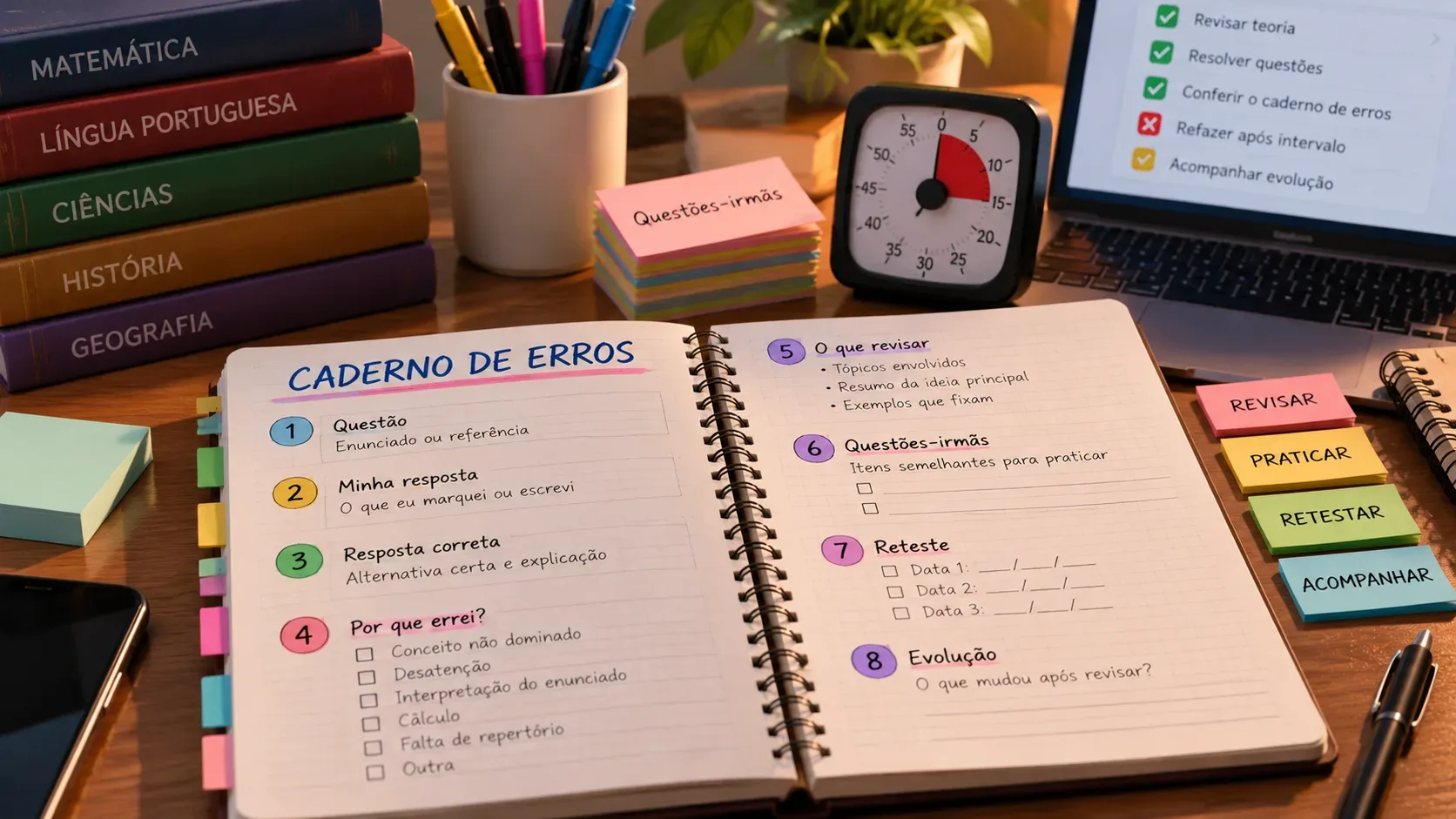
A useful page can be short as long as it forces you to reconstruct the problem. For each question, record the question or reference, your answer, the correct answer with its essential justification, the cause of the error, a correction rule, a sister question, and future retest dates.
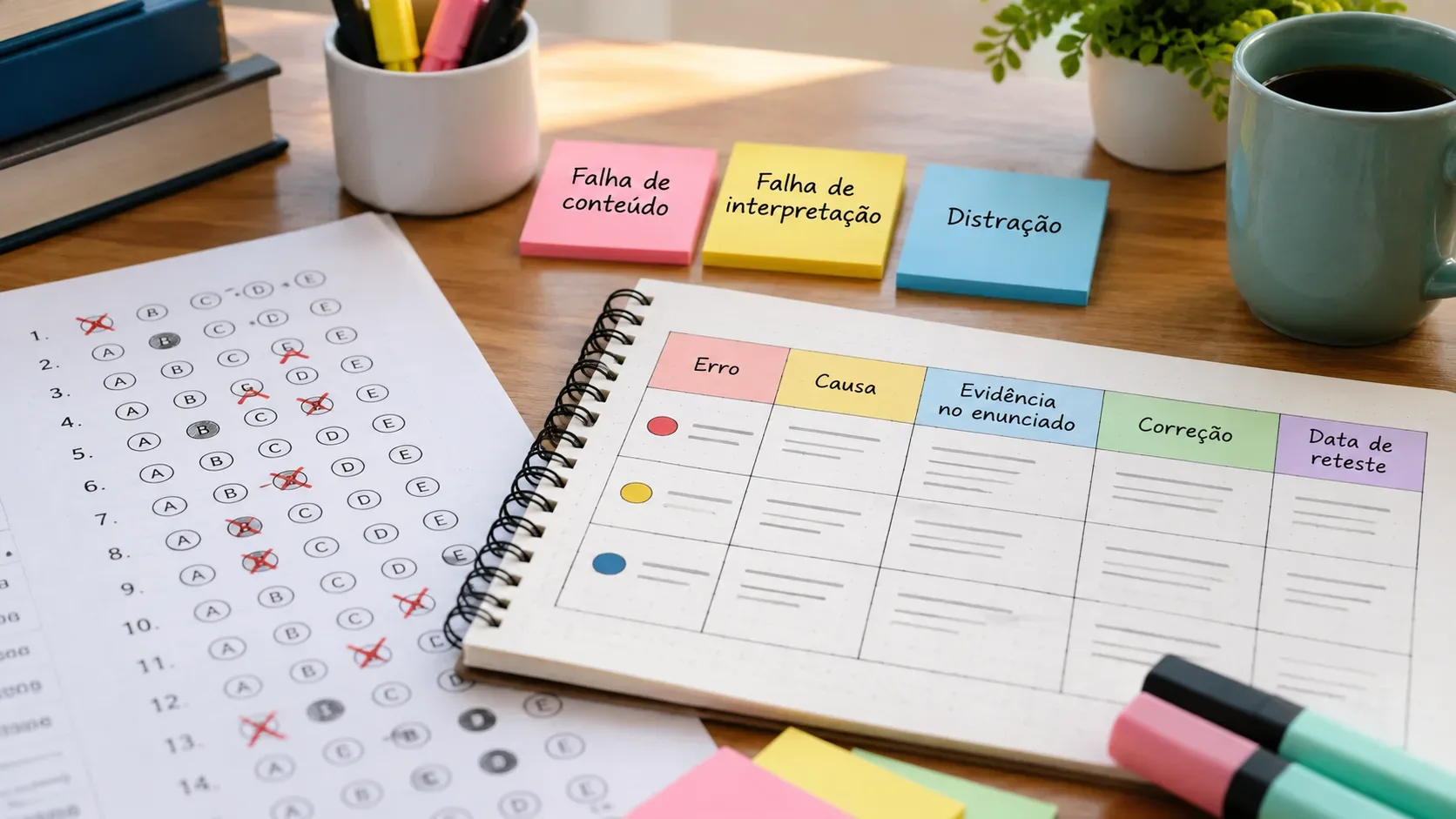
How to classify the cause without creating too many categories
Classification is useful because it determines the next action. A small set of operational categories is usually better than a huge taxonomy.
| Type of failure | Typical sign | Review action |
|---|---|---|
| Concept not mastered | You did not know the required rule, definition, or relationship. | Restudy the core idea, explain it in your own words, then answer a question without notes. |
| Interpretation | You knew the content but misread the command, condition, or data. | Rewrite what the question asks and identify which information actually controls the answer. |
| Procedure | You chose an unsuitable path or skipped a step. | Rebuild the procedure step by step and apply it to a similar problem. |
| Calculation or execution | The reasoning was sound, but there was an arithmetic, algebra, sign, unit, or transcription error. | Locate the exact failed step and redo the calculation without looking at the solution. |
| Verifiable oversight | You ignored a detail you knew how to use, such as a negation, unit, or incompatible option. | Create an objective end-of-question check instead of writing only “pay more attention.” |
| Lack of varied practice | You understood the theory but did not recognize how it appeared in the question. | Solve sister questions that vary the context and format. |
Avoid using “carelessness” as an automatic explanation. If the same pattern keeps returning, a concept, reading, or procedure gap may be hiding behind the label.
Turn correction into active retrieval
After understanding the solution, close the source and try to reconstruct it. Answer the question again, explain the principle aloud, write the steps from memory, or solve a sister question. Retrieval should require information to come out of memory rather than merely feel familiar during rereading.
The What Works Clearinghouse guide recommends quizzes with active retrieval and the use of tests to identify material that still needs to be learned. This gives the notebook a practical role: every error becomes a future question, not a finished note.
Use sister questions to test whether you learned the rule
Redoing the exact same question can measure memory for that item. A sister question preserves the core skill while changing numbers, context, information order, or wording. If you can solve the variation and explain why the method works, you have more useful evidence that the correction generalized.
In mathematics, a percentage error can lead to a new problem with different values and context. In history, a causal confusion can become a question that distinguishes cause, consequence, and context in a nearby case. In language study, a grammar rule can be tested in a different sentence.
Create a retest schedule
There is no single interval that is ideal for every topic and learner. The important principle is to separate attempts over time and return after some forgetting. A simple routine can use a first retest after a few days, another the following week, and increasingly spaced returns for persistent errors.
The What Works Clearinghouse guide recommends spacing learning and reviewing important content after delays of weeks or months. Dunlosky and colleagues also identify distributed practice as a high-utility technique. The notebook schedule should therefore avoid concentrating all corrections on the same day.
What to do when the error returns
A repeated error should not simply duplicate the previous entry. Update the diagnosis. Ask whether the original cause was wrong, whether the correction rule was too vague, or whether the new question required a distinction you still do not master.
- Record the new attempt and the new failure.
- Compare it with the previous diagnosis.
- Refine the correction rule so it becomes observable and actionable.
- Create another sister question, preferably a variation that targets the exact difficulty.
- Schedule another retest instead of closing the item.
For example, if you wrote “sign error” and made the same mistake again, the correction may need to become more specific, such as “before distributing a negative sign, explicitly write the multiplication by -1.” This turns a generic observation into a verifiable procedure.
How to review the notebook without rereading everything
Start with entries whose retest date has arrived or with patterns that repeat. Try to answer before opening the correction. Then compare the result and mark the item as something like “still failing,” “correct with hesitation,” or “consistently correct.” The status helps decide when the item returns to the queue rather than producing a grade about you.
Also watch the distribution of causes. If many errors involve interpretation, the study plan should include practice reading commands and conditions. If conceptual gaps dominate, simply increasing the number of exercises may not solve the problem without rebuilding the foundation.
A minimal page template
An entry can follow this sequence: question, my answer, correct answer, why I was wrong, correction rule, sister question, retest 1, retest 2, and update. This keeps the focus on diagnosis and another attempt.
The notebook works best when it is selective. You do not need to record every isolated mechanical slip. Prioritize errors that reveal gaps, recurring patterns, important concepts, or questions you could not solve again without help.
Sources and limits
The error-notebook method presented here is a practical application of active retrieval, diagnostic testing, and distributed practice. The sources below support those principles, but they do not prescribe one universal notebook format or a fixed retest schedule.