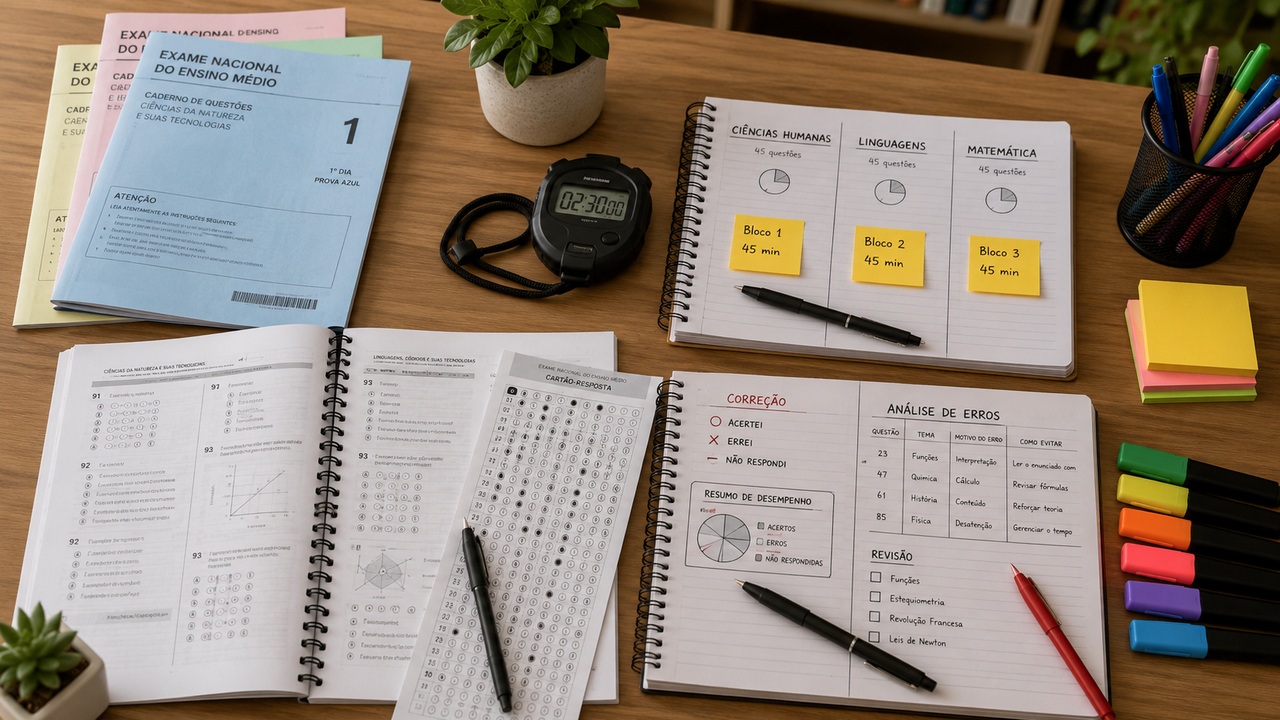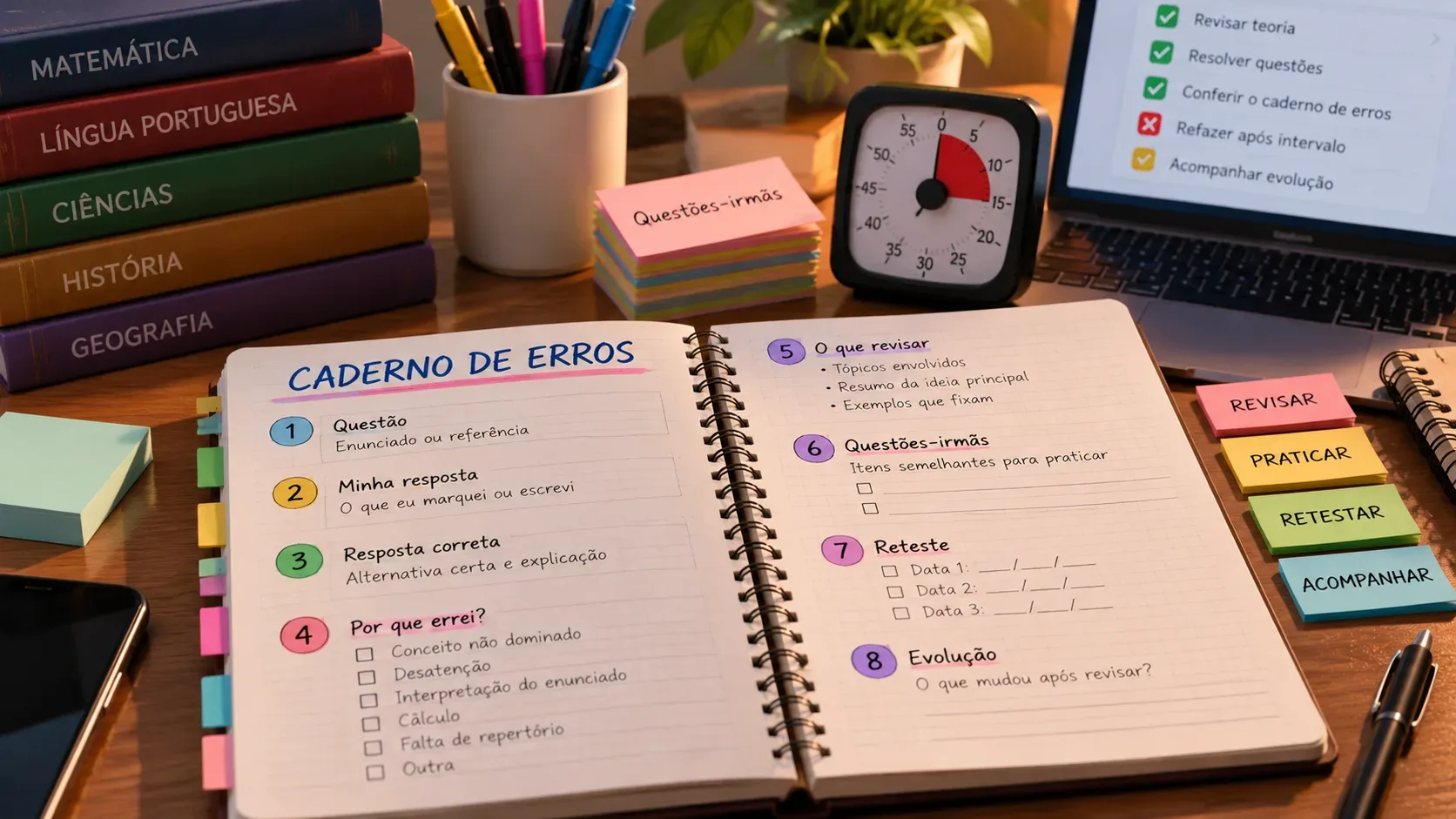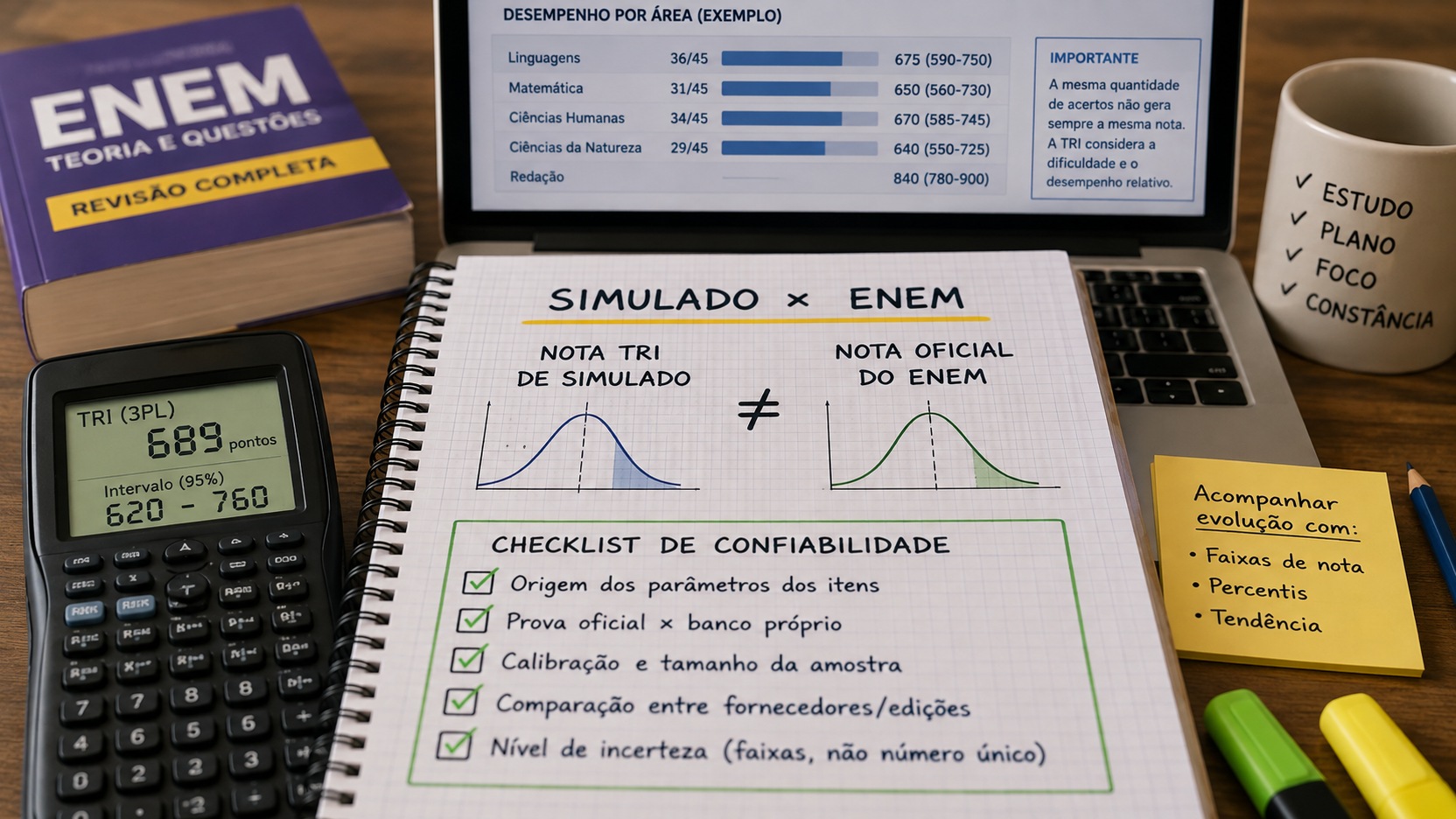
A useful error notebook is not a collection of copied questions. It works as a diagnosis and review system: it identifies why an answer failed, records the evidence showing where the reasoning went off track, defines a brief correction, and turns that correction into a next study action. Then the question or the same content returns in a retest to check whether learning remains beyond the immediate review.
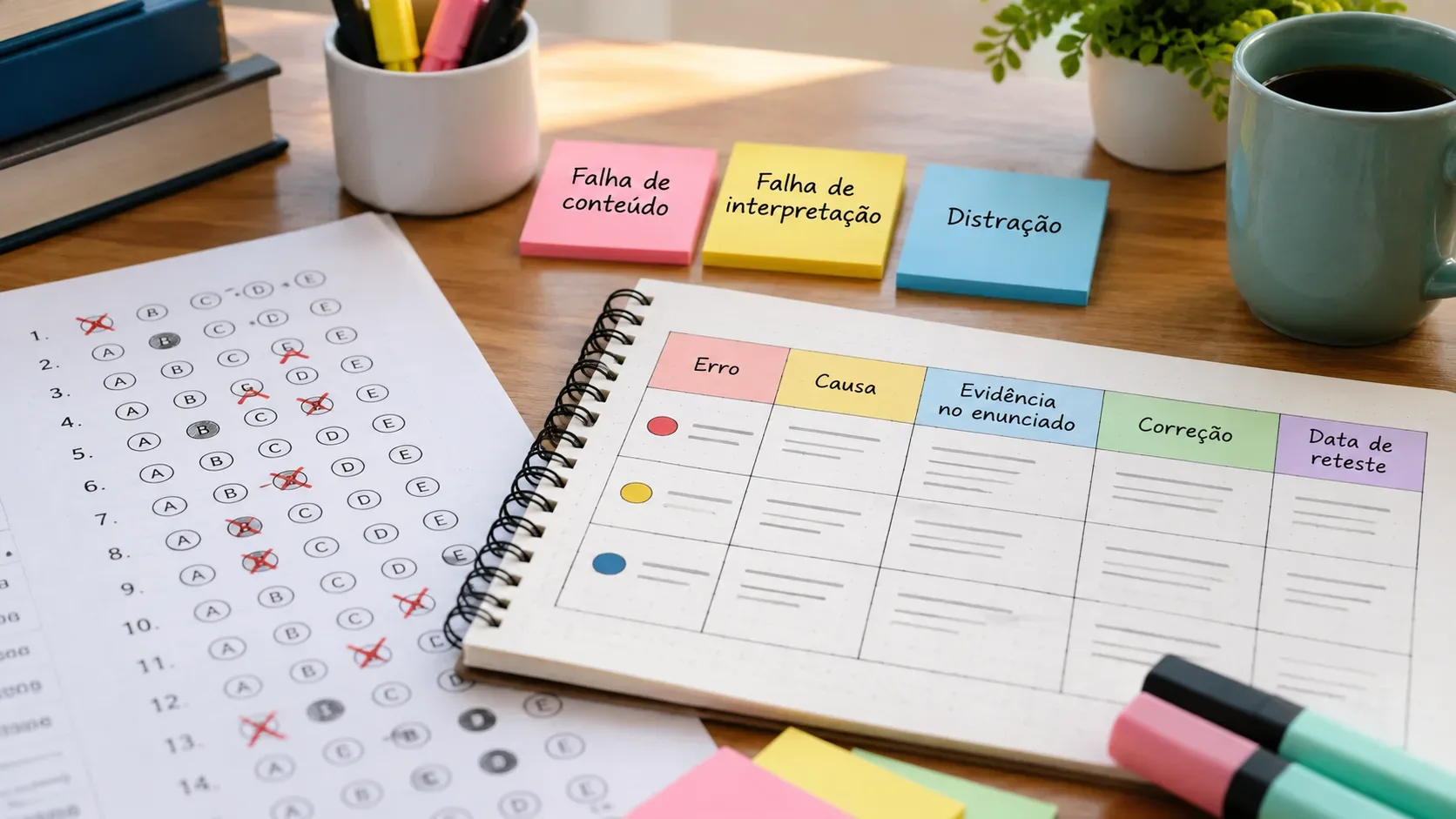
A practical way to organize this process is to separate errors into three operational groups: content failure, interpretation failure, and distraction or execution. This division is not a universal scientific taxonomy, and the categories can overlap. The goal is to make a better study decision, not to assign a psychological label to the student.
What the error notebook needs to answer
After a mock exam, the most useful question is not only “which option was correct?” but “what was missing for me to reach it?”. The Education Endowment Foundation describes metacognitive strategies as ways to plan, monitor, and evaluate one’s own learning. Applied after a mock exam, that means reviewing not only the result but also the process used to answer.
The record should be short enough to be reused. Instead of transcribing pages, note the question identifier, the probable cause, the clue in the prompt that should have guided the answer, the correction, and the retest date. The notebook then becomes a queue of future actions.
1. Content failure: when retrievable knowledge was missing
Classify an error as a content failure when it happened because a necessary fact, concept, rule, formula, procedure, or relationship was not sufficiently available in memory to solve the question. Common examples include not remembering a mathematical property, confusing stages of a biological process, or being unable to explain a grammar rule needed to choose between options.
The main sign is that, even if the question command was understood, knowledge would still be missing to produce the answer. In that case, the correction should not end with “reread the chapter.” A more verifiable action is to review the specific point and then try to retrieve it without consulting the material, using questions, flashcards, an explanation from memory, or new practice items.
This choice is consistent with the literature on retrieval practice. A review by Dunlosky and colleagues rated practice testing and distributed practice among the techniques with the highest overall utility. The What Works Clearinghouse guide also recommends using tests and quizzes to identify what still needs to be learned and to re-expose students to important content.
2. Interpretation failure: when knowledge was not connected correctly to what the question asked
An interpretation failure appears when the student had relevant knowledge but read the command inadequately, ignored a condition, assigned the wrong meaning to a passage, chose an unsuitable representation, or failed to notice which piece of evidence in the prompt was decisive.
The record needs to point to where the breakdown occurred. “I interpreted it wrong” is too vague. It is better to write something such as “the command asked for the exception and I looked for the general rule,” “the text distinguished cause from consequence and I treated them as equivalent,” or “the question required an inference, but I selected information that was only explicit.”
The next action should reconstruct the reasoning. Rewrite the command as a simple sentence, mark the words that restrict the answer, and explain why the correct option is supported by the prompt. When possible, solve another question that uses the same skill in a different context. The focus here is not memorizing the previous option, but recognizing the kind of decision the task requires.
3. Distraction or execution: when the method was right but the answer was lost along the way
Distraction or execution errors include slips such as copying a number incorrectly, forgetting a unit, changing a sign in a calculation, marking a different option on the answer sheet than the one selected, or skipping a condition that had already been identified in the scratch work.
This category requires care because calling every apparently simple error “distraction” prevents diagnosis. Before using the label, look for evidence in your work that the concept and method were correct up to the point of the slip. If you did not know why a unit had to be converted, for example, the problem may be content, not merely attention.
The most useful correction is often a process control. Examples include checking units before substituting values, circling words such as “except” or “incorrect,” comparing the option marked on the answer sheet with the one chosen in the booklet, or reserving a final check for signs and decimal places. The goal is to create an observable step that reduces repetition of the same type of failure.
Error notebook table model
The model below keeps only fields that help decide what to do next. The “evidence in the prompt” column is especially important because it forces the student to justify the diagnosis instead of choosing a cause by impression.
| Error | Cause | Evidence in the prompt | Correction | Retest date |
|---|---|---|---|---|
| Question 12, successive percentages | Content | There was an increase and then a discount on different bases; I treated them as direct cancellation | Review multiplicative factors and solve 3 questions without consulting an example | Schedule it after an interval |
| Question 27, argumentative text | Interpretation | The command asked for an inference by the author; I chose a statement that was only explicit in the text | Rewrite the command and justify the option with two pieces of textual evidence | Schedule it after an interval |
| Question 41, unit conversion | Distraction or execution | The reasoning was correct, but I used km/h in a formula that required m/s | Add the checkpoint “compatible units?” before substitution | Schedule it after an interval |
How to fill in the notebook after a mock exam
- Review your own scratch work first. Before reading a detailed solution, try to locate the point where you chose the path for the question. This helps preserve evidence of the reasoning you actually used.
- Compare it with the answer key and a reliable explanation. Feedback helps correct the response and prevents an incorrect option from becoming reinforced. In a study by Butler and Roediger using multiple-choice tests, immediate or delayed feedback increased correct responses and reduced intrusions from incorrect alternatives on a later test, compared with the no-feedback condition.
- Choose one primary cause. If there is more than one, record the main one and add a secondary note. A question can begin with poor interpretation and end with a content error.
- Write the evidence. Copy only the word, condition, datum, or step that should have guided the decision. You do not need to reproduce the entire prompt.
- Define an executable correction. “Study more” is not a clear action. Prefer “review rule X and answer five items,” “redo the question without looking at the solution,” or “create a unit checklist.”
- Schedule a retest. The question should return after some interval and be answered without consulting the correction. If you can only get it right while looking at the notebook, the record has not yet demonstrated independent retrieval.
How to decide the cause without fooling yourself
Three questions help test the diagnosis:
- Could I explain the required concept without looking at the material? If not, the failure probably includes content.
- Did I know the concept but fail to notice what the command or data required? That points to interpretation or strategy selection.
- Was the method correct in the scratch work and did the error appear in a mechanical step or in marking the answer? That supports classification as distraction or execution.
When the answer is not clear, use “mixed” as a note and choose the action that attacks the weakest link. The value of the notebook depends more on the quality of the next action than on the purity of the label.
Why the retest should not be only an immediate repetition
Redoing the question right after reading the solution may mainly measure fresh memory of the explanation. To check whether the knowledge can be retrieved more independently, it is useful to insert an interval and try again without consulting the answer.
The What Works Clearinghouse recommends spacing learning and returning to important content after delays, as well as using tests and quizzes to identify what needs study. Dunlosky and colleagues also identify distributed practice and practice testing as techniques with broad utility. Those sources do not prescribe one mandatory schedule for every student. As an operational rule, you can combine a short retest a few days later with another check farther ahead, adjusting the interval to the proximity of the exam and the difficulty of the content.
The retest should be active. Try to answer the original question without consulting the note or, even better, answer a new question that requires the same knowledge. The study by Karpicke and Blunt is one of the works showing benefits of retrieval practice for meaningful learning, including comprehension and inference questions.
How to turn the notebook into a weekly plan
At the end of the week, do not only count how many errors were recorded. Look for patterns that indicate the next priority.
- If several failures are content errors in the same topic, return to that core material and use active retrieval before simply increasing the number of questions.
- If interpretation failures predominate, group questions with similar commands and practice identifying the task, restrictions, and evidence before answering.
- If the same execution error repeats, turn the correction into a fixed process checkpoint.
- If the retest is still wrong, do not delete the record. Update the cause, correction, and next date. A recurring error may indicate that the initial diagnosis was incomplete.
It is also useful to record an “uncertain correct answer” when the right answer came from a guess or elimination without sufficient mastery. It does not need to be entered as an error, but it can enter the retest queue. This prevents the accuracy percentage from hiding gaps that have not actually been resolved.
What to avoid
- Copying every missed question in full and never reviewing it.
- Using “distraction” as the automatic explanation for any simple error.
- Writing a correction so long that the notebook becomes a second textbook.
- Retesting while looking at the solution or repeating only the memorized option.
- Measuring progress only by the number of pages filled, rather than by fewer recurring errors and performance on retests.
The error notebook works best when each entry closes a cycle: error, cause, evidence, correction, action, and retest. The mock exam stops being only a score and starts producing concrete instructions for the next study session.
Sources and references
- Education Endowment Foundation: Metacognition and Self-Regulated Learning, second edition
- What Works Clearinghouse: Organizing Instruction and Study to Improve Student Learning
- Dunlosky et al.: Improving Students’ Learning With Effective Learning Techniques
- Butler and Roediger: Feedback enhances the positive effects and reduces the negative effects of multiple-choice testing
- Karpicke and Blunt: Retrieval practice produces more learning than elaborative studying with concept mapping