Interleaved review does not mean studying everything at the same time. It means organizing a session so that you deliberately alternate between two or more types of content or problems that you have already started learning, returning to each after an interval. The goal is to make you recognize which knowledge or strategy applies to each item instead of repeating a long sequence of the same type.
In practice, an interleaved session might mix equation, ratio, and percentage problems, or alternate questions from two related chapters. It does not require opening several subjects simultaneously, switching tasks every minute, or trying to attend to unrelated content at once. The focus remains on one task at a time.
What separates interleaving from random mixing
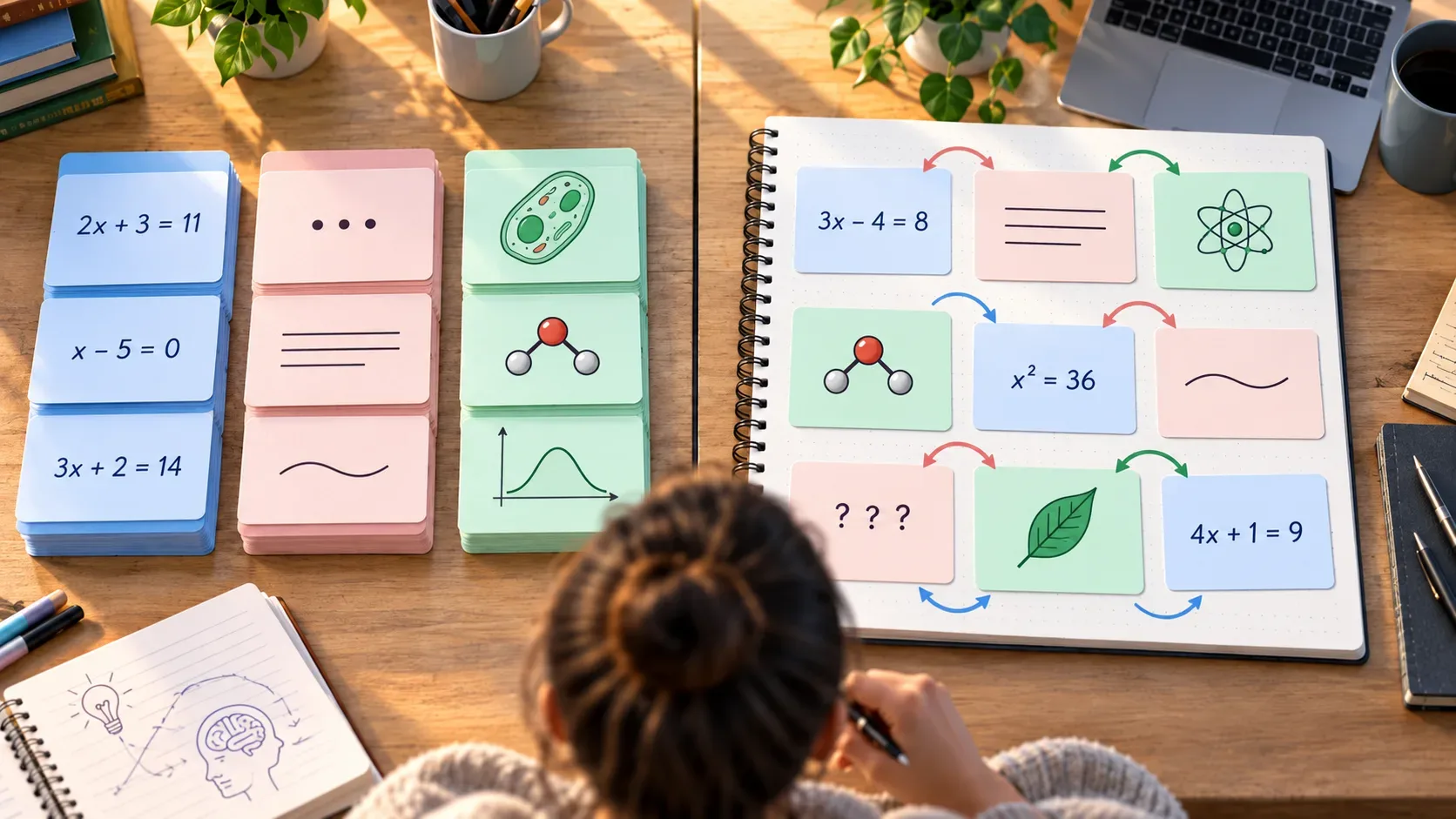
In blocked practice, you solve many items of the same type in a row. That makes it easier to recognize the required technique because the block itself provides a cue: if every exercise is about percentages, you already know which procedure to use before reading the next prompt. In interleaved practice, different types appear near one another, so you must decide which approach fits each case.
This discrimination effort is one proposed reason for the benefits of interleaving. In a mathematics experiment with grade 7 students, interleaved practice led to higher later performance than blocked practice on an unannounced test. A later meta-analysis, however, showed that the effect is not identical for every kind of material: outcomes vary with the task and with similarities among the categories being learned. Interleaving is therefore a tool, not a rule to mix any topics indiscriminately.
How to build an interleaved session without losing the thread
A simple plan is to work with three short blocks of related content and return to each more than once. Instead of A-A-A-A, then B-B-B-B, then C-C-C-C, you might use A-B-C-A-C-B. Each letter can represent one question, a small set of questions, or a brief retrieval attempt. The key is to finish each unit before switching.
- Choose two to four related topics. Prefer material that could appear together on an exam, assignment, or application task. In mathematics, this can mean problem types requiring different strategies. In history, it can mean comparing processes or periods that are often confused.
- Establish a minimum foundation in each topic. If content is completely new, a more focused introduction may be useful before mixing it with other material. Interleaving works better as a way to organize practice and review than as a replacement for all initial explanation.
- Attempt an answer before checking it. Solve the problem, explain the idea quietly, write what you remember, or answer a question without looking at the material. Then check and correct. This retesting turns review into retrieval practice, a strategy supported by strong evidence for retention.
- Switch topics after completing one unit of work. Alternation does not need to happen every minute. It can occur after a difficult problem, three flashcards, a mini-quiz, or ten to fifteen minutes of focused practice.
- Return to the topic later in the same session or in another session. The return creates spacing and requires a new retrieval attempt instead of extending a single uninterrupted exposure.
An example 50-minute session
Suppose you want to review three mathematics areas: ratios and proportions, percentages, and linear equations. A session could look like this:
- 0 to 5 min: quick retest of all three topics without notes;
- 5 to 15 min: two ratio and proportion problems;
- 15 to 25 min: two equation problems;
- 25 to 35 min: two percentage problems;
- 35 to 45 min: three mixed problems with no label identifying the type;
- 45 to 50 min: correct errors and note what should reappear in the next retest.
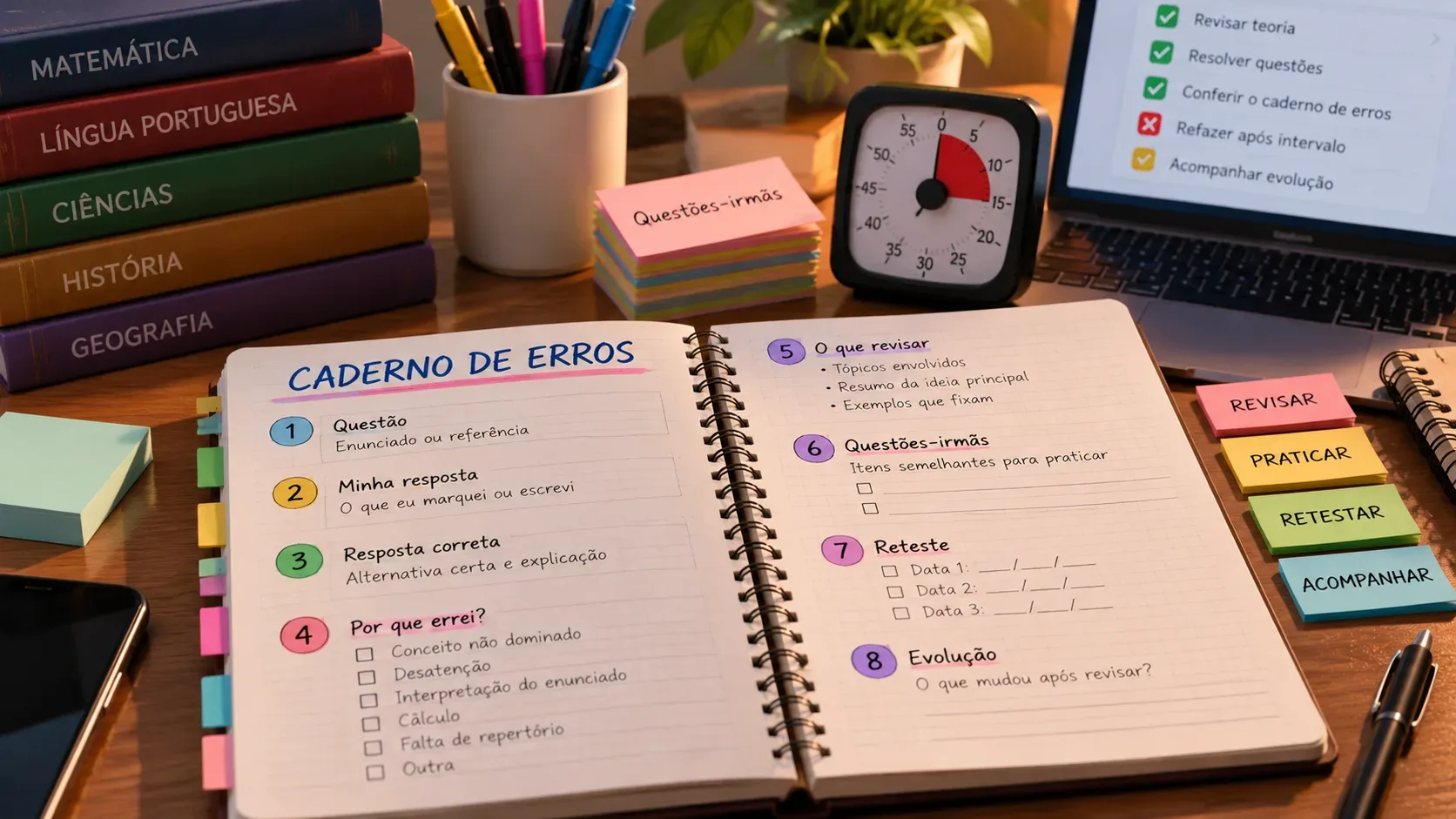
The mixed block at the end is especially important. You are no longer given the chapter cue and must identify the strategy before carrying out the procedure. If you make an error, record why. The problem may be missing knowledge, incorrect strategy selection, calculation, or reading the prompt. That distinction helps determine what to revisit later.
Interleaving, spacing, and retesting are not the same thing
Interleaving means alternating categories or problem types. Spacing means distributing study over time, leaving intervals between encounters with the same material. Retesting or retrieval practice means trying to remember or solve before looking back at the answer. All three can be used in the same routine, but they play different roles.
A practical way to combine them is to end each session with a short mixed quiz and begin the next session with another retest of the same topics. This alternates categories within practice, creates an interval between encounters, and uses active retrieval to check what remains accessible from memory.
How to avoid the feeling that you are studying everything at once
- Limit the number of topics. Two or three are often enough for one session. Adding too many can turn the method into distraction.
- Keep only the necessary material open. Interleaving content does not mean interleaving notifications, videos, messages, and unrelated browser tabs.
- Use a predefined switching sequence. Decide the order before starting so you do not spend mental energy choosing the next topic at every transition.
- Do not switch in the middle of an attempt. Finish the question, explanation, or planned retrieval before changing topics.
- Track errors by topic. The session should produce information about what needs another encounter, not merely a feeling of variety.
When focused blocked practice still makes sense
Evidence for interleaving does not mean that all blocked practice is useless. When a procedure is completely new, prerequisites are missing, or the learner cannot yet carry out the basic steps, a short focused block can reduce the initial burden. Once the basic structure is available, interleaving nearby categories can require more active strategy selection.
It is also important not to generalize findings from one domain to every other domain. A meta-analysis of interleaving studies found average benefits but substantial variation across materials. For words and some expository texts, for example, results were less clear than for visual and mathematical tasks. The best routine is therefore one in which alternation serves a concrete purpose: comparison, discrimination, strategy selection, and retrieval.
How to tell whether the session worked
Do not rely only on the feeling of fluency. Blocked practice can feel easier because the problem type keeps repeating. A more useful check occurs when you return after an interval and can answer without the immediate cues from the previous examples.
At the end of the session, mark each topic as retrieved independently, retrieved with a cue, or not retrieved. At the next session, start with items that required a cue or failed. If performance improves without depending on the order of the previous examples, that is a stronger learning signal than simply finishing a uniform worksheet.
In short, interleaved review means alternating related practices according to a plan while keeping attention on one task at a time. A useful combination is: attempt without notes, alternate categories, correct with feedback, and retest after an interval. This preserves focus and turns variety into decision-making and retrieval rather than multitasking.
Sources and references
- Dunlosky et al. (2013): Improving Students’ Learning With Effective Learning Techniques
- Rohrer, Dedrick, and Burgess (2014): The benefit of interleaved mathematics practice is not limited to superficially similar kinds of problems
- Brunmair and Richter (2019): Similarity matters: A meta-analysis of interleaved learning and its moderators
- Yang et al. (2021): Testing (quizzing) boosts classroom learning: A systematic and meta-analytic review