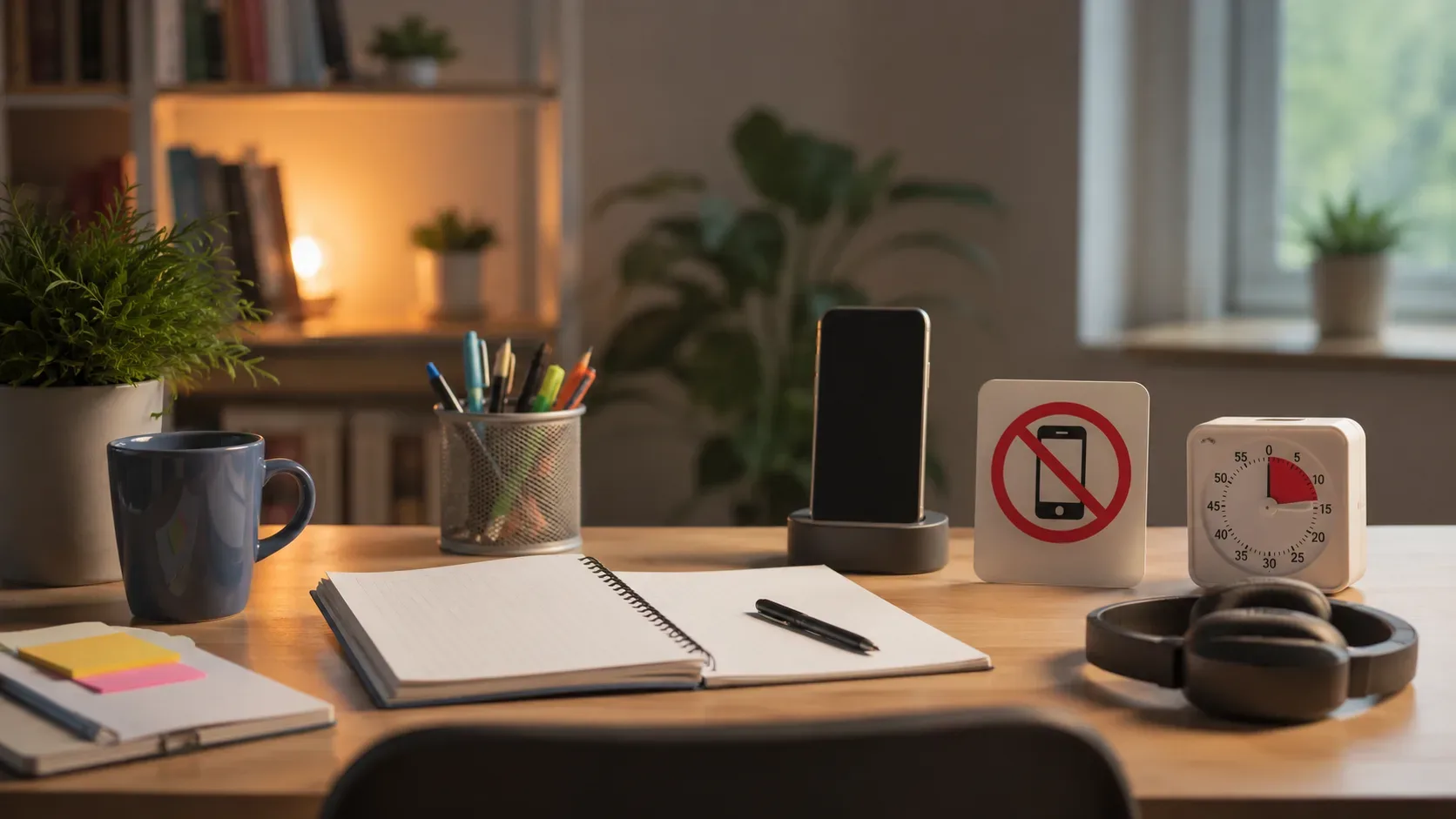
Before changing techniques, applications or schedules, it's worth finding out which distraction really interrupts your studying. The cell phone can be the main problem, but it is also possible to lose track because of notifications on the computer, conversations around, open tabs or a poorly defined task.
To understand how to avoid distractions when studying, this guide proposes a seven-day personal experiment. You'll do two benchmark sessions, test four changes separately, and repeat the most promising one. The goal is not to achieve “full focus”, but rather to produce a simple comparison between real-world conditions.
The proposal was motivated by a report published by Nature on August 3, 2026, which brought together studies on distraction, goals, interruptions and characteristics of the environment. The report opens with data from a commercial survey of adults in the United States; These numbers are not used here to describe Brazilian students, as population, habits and collection method are not equivalent.
Why measure before changing everything
“Distraction” can describe different phenomena: a notification that appears, the desire to check your cell phone without any alert, a conversation nearby, voluntarily switching tabs or even abandoning an activity because the next step is not clear.
A study by the Human Screenome Project analyzed more than six million screenshots taken by 132 smartphone users over several weeks. The researchers found wide variation between individual digital experiences, showing how overall averages can hide very different routines. This reinforces a practical idea: your interruption pattern needs to be observed, not assumed.
The cell phone evidence itself requires caution. In two experiments, the presence of the device was associated with lower performance on measures of working memory and fluid intelligence, especially when the phone was visible and nearby. The study, however, did not find the same effect on a behavioral measure of sustained attention. So it doesn't prove that leaving your phone in another room will improve any study session, but it does offer a concrete change to test.
In a 2026 survey of 84 university students in Taiwan, hiding notifications changed cell phone browsing patterns, but did not produce a direct difference in the learning test between the groups. The authors concluded that hiding alerts may be insufficient when the device remains accessible and the person remains mentally vigilant about it.
These results help avoid two simplifications: not every attention problem comes down to total screen time, and no single setting works for everyone.
Prepare the seven-day experiment
Choose an activity that can be repeated under similar conditions, such as solving questions, reviewing flashcards, reading a chapter, or producing a summary. Whenever possible, keep constant:
- session time;
- the planned duration;
- the type and difficulty of the task;
- the location, except on the day the noise is tested;
- the sleeping, eating and tiredness conditions recorded in the observations.
It is not necessary to study for a specific number of minutes. Choose a realistic duration and use the same duration for all seven days. Very different sessions make comparison difficult.
What to register
Before you begin, define a unit of output: questions answered, pages reviewed, cards retrieved correctly, paragraphs written, or other observable output.
During or immediately after the session, record:
- external interruptions: alerts, calls, people, conversations, noises or events that diverted the activity;
- self-interruptions: voluntary cell phone consultations, opening tabs unrelated to the task, getting up unnecessarily or changing subjects;
- production: result completed in the chosen unit;
- perceived focus: score from 1 to 5;
- observations: unusual difficulty, sleep, family urgency, technical problem or other factor that could distort the day.
Count as an interruption every time you abandon the main task, even for a few seconds. Do not try to measure with scientific precision the time needed to “return to focus”; a consistent count is already more useful than a complicated and irregular estimate.
The weekly experiment table
| Day | Condition tested | Task and duration | External interrupts | Self-interrupts | Production | Focus from 1 to 5 | Observations |
|---|---|---|---|---|---|---|---|
| 1 | Baseline A: usual environment | ||||||
| 2 | Baseline B: repeat usual environment | ||||||
| 3 | Cell phone outside study space | ||||||
| 4 | Communications grouped in a later window | ||||||
| 5 | Single task space and visible goal | ||||||
| 6 | Reduction of unpredictable conversations and noise | ||||||
| 7 | Repeat of the most promising change |
For the first two days, don't try to behave better just because you're registering. Use your usual environment. This baseline is necessary to compare subsequent changes.
Change 1: take your cell phone out of your study space
On the third day, place the device in another room or in an enclosed space that requires getting up to reach it. Don't just turn it face down next to the notebook. Also mute connected devices that play alerts, such as watches and headphones.
If your cell phone is used as a stopwatch, choose a clock, a simple timer or a tool on your computer that does not require opening communication applications. If there is a real possibility of an emergency, agree in advance on a contact channel or a specific exception.
There are two reasons to test distance, not just willpower. Notifications can impair performance in an attention task even when the person does not interact with the device. Furthermore, the study on the mere presence of the smartphone suggests that keeping it nearby can consume cognitive resources in some conditions, although the effects do not appear in all measures.
At the end of the session, ask: Did I consult the device less? Did I produce more? Did I start thinking about him insistently? The change is only worth it if the benefit outweighs the discomfort or worry generated.
Change 2: Group messages and digital interruptions
On the fourth day, return the cell phone to its usual baseline position and only change the communication flow. Close email, WhatsApp Web, social networks, direct messages and other tools that may interrupt the task. Set a single time to check them after the session.
It's also worth telling people close to you: “I'm going to study until a certain time and then I'll respond.” The intention is not to become permanently unavailable, but to trade unpredictable outages for a known window.
In a study of 13 knowledge workers, five days without access to email was associated with fewer switches between windows, longer periods of doing the same activity, and lower stress as measured by heart rate variability. The sample was small, made up of adults at work, and does not allow us to conclude that students will have the same results. Still, it supports the test of delimited periods without messages.
The 2026 university research adds a caveat: hiding notifications without dealing with the habit of checking your device may just trade frequent checks for longer accesses. Therefore, this day includes both blocking alerts and an explicit time to respond.
Change 3: Set up a single-task space
On the fifth day, make only the materials needed for an activity visible. Close tabs, documents and notebooks that belong to other subjects. On one sheet, write an observable goal:
“At the end of this session, I will have…”
Complete with something verifiable, like:
- resolved 15 questions and corrected errors;
- produced a one-page summary;
- reviewed 30 cards;
- read a section and answered five questions;
- writing the introduction of an essay.
In three experiments with reaction time tasks, specific and progressively difficult goals reduced behavioral lapses in attention and lessened the loss of performance over the course of the activity. The experiments did not evaluate school grades or demonstrate that more difficult goals are always better. The prudent application is to use a specific, challenging, and achievable goal rather than a vague command like “study hard.”
The removal of unrelated materials is an editorial adaptation of the single-task principle, not an intervention identical to that used in the experiments. Its function is to make the next step visible and reduce environmental invitations to change the subject.
Change 4: Reduce unpredictable noise
On the sixth day, test a space with less talking, television, barking, calls or other sounds that carry information and change in unpredictable ways. You can move to a quieter room, arrange a quiet time with others, or use hearing protection that doesn't add new content.
Do not introduce music that day if it was not part of the baseline. Finding out whether music helps or hinders would require another test, as changing noise and soundtrack at the same time prevents knowing which variable produced the result.
In an experiment with 20 participants, the sounds of a baby crying and dogs barking increased physiological indicators of arousal and were associated with worse and slower performance on a math task, compared to control noise. The effects were not consistent across measures: there was no significant difference in the spatial memory task. This does not prove that absolute silence is ideal, but it justifies testing the reduction of unpredictable sounds in activities that require calculation or manipulation of information.
If it is not possible to control the noise, record the type and timing of the occurrences. Sometimes, the gain of the experiment is not discovering the perfect environment, but identifying which time in the house offers the most stable conditions.
Day 7: repeat, don't combine
Compare days 3 to 6 and choose the change that presented the best balance between:
- fewer interruptions;
- equal or greater production;
- better perceived focus;
- acceptable practical cost.
On the seventh day, repeat just this change. Don't combine distant cell phones, silence, blocking messages and a rearranged desk all at once. A second observation reduces the chance of choosing an outcome that occurred just because the material was easier or because you slept better.
As a rule of thumb — not as a statistical test — consider a change promising when it improves at least two of the three main indicators, without creating a significant problem:
- total interruptions;
- production;
- perceived focus.
After the week, you can test a combination of the two best changes for another seven days. In this second cycle, the question is no longer “which one works in isolation?” and becomes “are they still useful when used together?”.
Why the plant didn't make it into the four main changes
The Nature report also cites a study with 23 students aged 11 to 13 that compared the observation of a real plant, an artificial plant, a photograph and the absence of a plant. Real plant exposure was associated with differences in electroencephalography measurements and more positive evaluations of comfort and naturalness.
The sample was small and the study evaluated a brief exposure, not a week of study or prolonged academic performance. Therefore, a plant could be an interesting variable for a second experiment, but it was not prioritized over cell phones, messages, task definition and noise.
This is an important example of careful reading: a finding can justify a low-stakes test without holding out the promise of “increasing concentration” for any student.
What this protocol fails to prove
A week doesn't turn a personal routine into a controlled scientific experiment. The difficulty of the subject, schedule, sleep, family obligations and motivation can change from one day to the next.
The protocol also does not show that a strategy will work for the entire semester. Some changes are useful at first and lose their effect when they stop being new. Therefore, registration must be repeated when the result begins to worsen.
The goal is to make a better decision than “I think my problem is my cell phone.” At the end of the week, you will have a more concrete hypothesis, such as:
- “My biggest losses come from messages on the computer”;
- “The cell phone only bothers me when it’s within reach”;
- “I interrupt the task because I start without knowing what I have to complete”;
- “Close conversations affect calculation exercises more than reading.”
These conclusions are more useful because they indicate a specific change.
Frequently asked questions
What if I need my cell phone to study?
Download the material before the session, activate airplane mode when possible and use the device only for the necessary function. Log any switches to unrelated applications as auto-interrupt.
Can I use an app blocker?
You can, but treat the blocker as its own intervention. Don't install several tools on the same day that you change the position of your phone, as you won't know which one made a difference.
Does music count as a distraction?
It depends on the task, the song and the person. Keep the musical condition constant during this week. Then do a separate test comparing the same type of activity with and without music.
What if other people stop the study?
Agree a visible end time and explain when you can respond. Still, record interruptions. The data helps you figure out whether the problem requires an individual change or a domestic arrangement.
Next step: apply the environment to your Enem plan
Save this page or copy the table to your notes. Once you've identified the most useful fit, take it to your Enem syllabus and review of the Enem skills matrix.
The environment does not replace content planning. It reduces obstacles so that the plan has a chance to be executed.