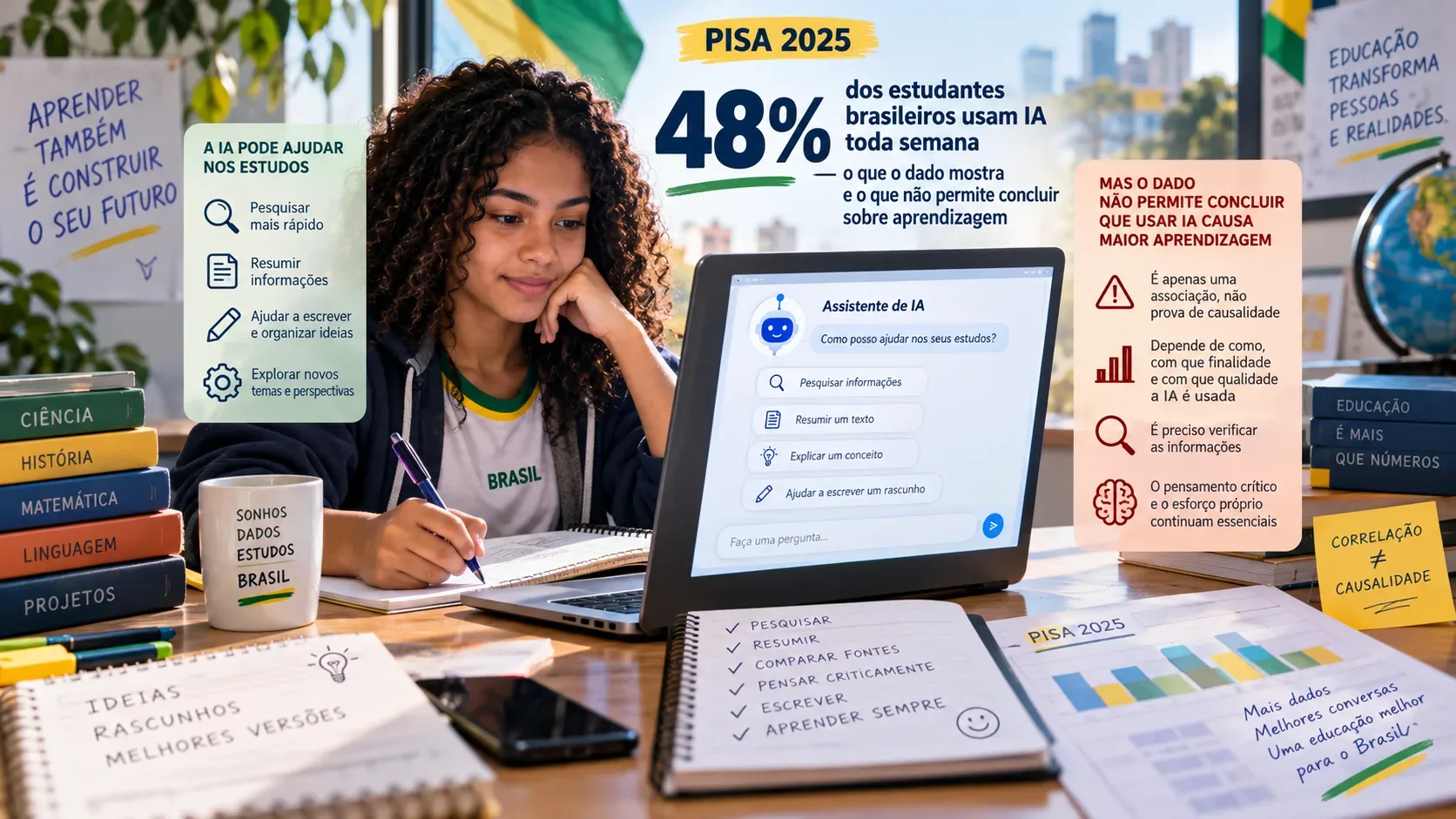
The finding that 48% of students in Brazil use AI chatbots to help them learn at least once a week shows that artificial intelligence is already part of the school routine for a large share of the young people assessed in PISA 2025. Brazil is close to the OECD average of 46%. But the figure does not, by itself, show that these students learned more — or less — because of AI.
That distinction matters because PISA combines contextual questionnaires, based on students’ self-reports, with performance measures. This makes it possible to observe patterns and associations, but it does not turn tool-use frequency into a causal experiment. The OECD itself describes the relationship between AI use and science performance as complex.
What PISA 2025 measured about AI use
In the Brazil country note released by the OECD in September 2026, students reported using AI chatbots for several school-related activities. The broadest indicator was “to help me learn”: 48% said they did so at least weekly. The note also highlights preliminary research, summarising and drafting.
| AI use for studying | Brazil | OECD average | What the figure supports |
|---|---|---|---|
| Helping to learn at least weekly | 48% | 46% | Regular use is common and close to the OECD average. |
| Preliminary research on a topic | 40% | 31% | Research is the most prominent specific use in the Brazil note. |
| Summarising a text that had to be read | 31% | 30% | Use for summarisation is almost aligned with the OECD average. |
| Drafting text for a written assignment | 27% | 29% | AI-supported writing is also frequent, but not a majority practice. |
| Never or almost never using AI for any examined task | 11% | 14% | Non-use exists, but it is a minority pattern. |
Main source: the OECD’s PISA 2025 country note for Brazil. These percentages describe students’ responses about the activities examined; they do not directly measure the quality of AI output, time saved or learning gains from each task.
The 48% figure is not an effectiveness score
It is tempting to read “48% use AI every week” and immediately ask whether the tool “improved” performance. PISA 2025 does not support that direct leap. There are at least four reasons.
- Self-selection: students with different resources, curiosity, difficulties and study habits may choose to use AI at different frequencies.
- Use is not a standardised treatment: asking for an explanation, copying a ready-made answer, reviewing a draft and generating a summary are cognitively very different experiences.
- Performance and use are observed in the same setting: an association can reflect prior factors such as socio-economic background, digital access, school support and previous knowledge.
- Frequency does not measure quality: two people who use a chatbot “weekly” may use it in opposite ways — one to test reasoning, the other to avoid reasoning.
In the full report, the OECD says that, on average, students who use AI weekly for the broad purpose of “helping me learn” tend to have science performance similar to non-users after accounting for socio-economic background. Very frequent or very occasional use is associated with lower results in several comparisons. For specific tasks such as summarising and researching, the pattern also changes with frequency. The OECD explicitly warns that these relationships do not establish causality. See the chapter on school life and digital use in PISA 2025 Results, Volume I.
What the result suggests for students who study with AI
The practical gain is not in treating “use AI” and “do not use AI” as two closed methods. It lies in deciding which parts of the mental work can be supported without removing the activity that actually produces learning.
Research: use AI to open paths, not to close the search
A chatbot can suggest terms, questions, authors and initial explanations. The risk begins when generated output becomes the final source. For factual claims, locate the original source, check date, context and authorship, and compare at least one independent reference when the topic is important or contested.
Summarising: read before delegating the synthesis
If AI summarises a text before you read it, it may save time but can also remove the effort of selecting main ideas and relationships between arguments. A stronger routine is to read first, note what you think is central and only then compare your summary with the AI version. Afterwards, explain the content without looking at either one.
Drafting: ask for critique and alternatives, not a submission-ready text
For written assignments, AI can act as a provisional reader: spotting gaps, testing clarity, suggesting counterarguments or offering alternative structures. If it produces the entire text from the start, the student may outsource planning, knowledge retrieval, evidence selection and sentence formulation — processes that also build writing skill.
Learning: prefer hints that preserve effort
In mathematics, science or reading, ask for a hint, an intermediate question or an analogous example before asking for the solution. A useful rule is: try first, consult second, redo without help and explain in your own words. This keeps AI in a supporting role and makes verification part of studying.
“Cognitive outsourcing” is a possible risk, not a verdict
The term describes situations in which a person transfers to a tool a mental step they could perform themselves. That can be useful — calculators, maps and search engines have done this for decades — but in education there is a difference between outsourcing a peripheral task and outsourcing the very practice one is trying to learn.
Recent research helps explain why simple conclusions are unhelpful. A systematic review and meta-analysis of experimental and quasi-experimental studies found overall positive effects of generative AI on learning outcomes, but also very high heterogeneity across contexts and study designs. In a complementary direction, a randomised trial with university students found lower retention after 45 days among participants who used unrestricted ChatGPT as a study aid. That experiment does not establish the same effect for Brazilian teenagers, but it illustrates why mode of use and cognitive effort matter.
The more responsible interpretation is therefore not “AI improves learning” or “AI harms learning”. It is: effects depend on the goal, task, frequency, rules and the way the tool is integrated into the learning process.
Checking AI answers also has to be taught
PISA 2025 includes another relevant indicator: according to the OECD dashboard, about 51.2% of students in Brazil reported opportunities in class to assess the quality of AI-generated information, below the OECD average of 62.6%. This suggests that use is already widespread, while classroom practice in critical evaluation has not yet reached everyone.
A verification routine can be short:
- identify which claims in the response are verifiable;
- ask for or locate primary sources;
- check whether the source actually supports the claim;
- verify dates, units, definitions and context around numbers;
- compare a second source when an error would matter;
- finish by answering or explaining without copying the chatbot’s wording.
How to read the 48% without overclaiming
The number is strong as a picture of behaviour: in 2025, using AI to learn was a weekly routine for nearly half of the Brazilian students assessed. It also shows that research, summarisation and writing are concrete parts of that adoption. What it does not provide is a causal answer about grades, retention, comprehension or critical thinking.
For students and schools, the more useful question becomes less “is AI allowed?” and more “at which stage does it help without replacing the reasoning we want to develop?”. That distinction between support and substitution is where the PISA data become pedagogically useful.