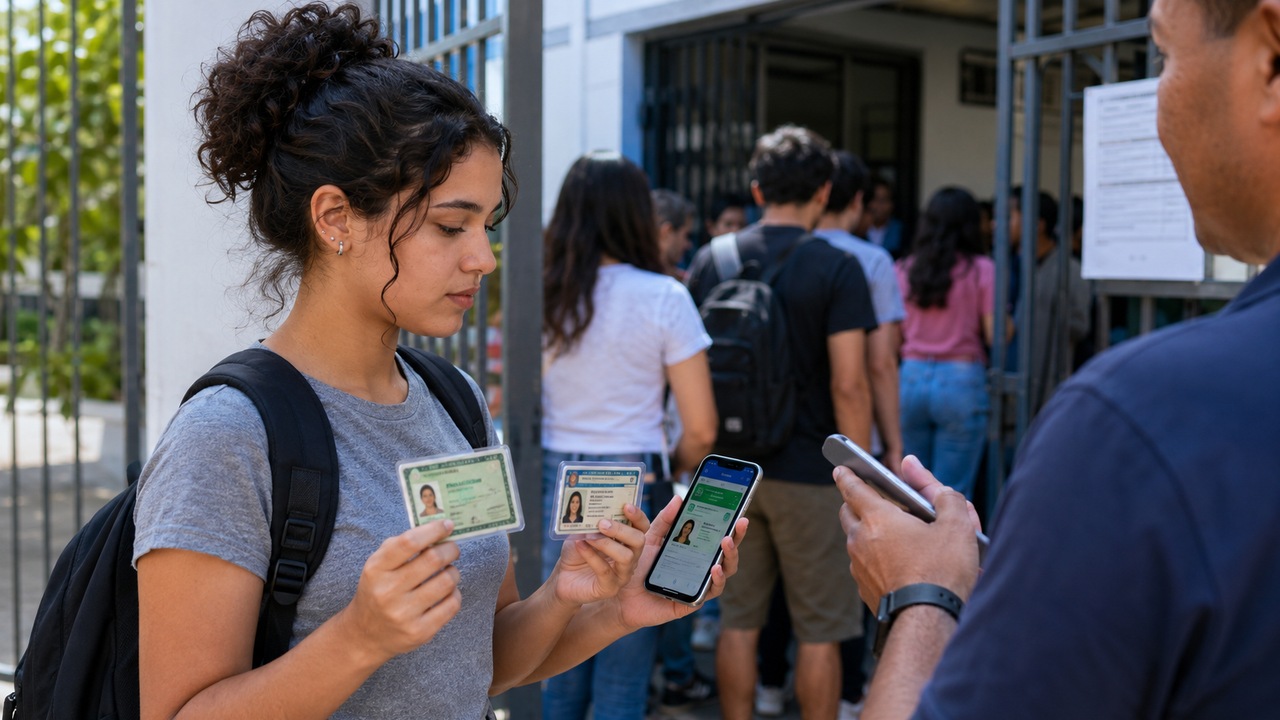
The central rule for Enem 2026 is simple: to enter and take the exam, a Brazilian participant must present an official photo identification document that is among those accepted by the public notice. A physical RG, the National Identity Card (Carteira de Identidade Nacional, CIN) and the National Driver's License (Carteira Nacional de Habilitação, CNH) are on the list. The e-Título can also be used digitally, as long as it includes a photo and is shown in the official app. Problems begin when a candidate brings a copy, a screenshot, a document outside the list or relies on an app that will not open when needed.
The regular Enem 2026 exams are scheduled for November 8 and 15. On both days, the gates open at 12:00 p.m. and close at 1:00 p.m., Brasília time. A valid document is not a minor bureaucratic detail: the public notice states that anyone who arrives without an accepted ID must wait outside the exam site until they can receive a valid document, and that must happen before the gates close.
RG, CIN, CNH and e-Título: the direct answer
Physical RG
Yes. Public Notice No. 64, dated May 21, 2026, accepts identity cards issued by State Public Security Departments, the Armed Forces, the Military Police and the Federal Police. In practice, a physical RG issued by one of these authorities remains a valid identification option for Enem 2026.
What does not work is replacing the original document with a photocopy. The public notice rejects copies of valid documents even when they are notarized or certified. If you plan to use a physical RG, bring the document itself.
Physical CIN
Yes. The Carteira de Identidade Nacional is expressly included among the valid documents for Brazilian participants. Therefore, a physical CIN can be presented at the gate as an original official photo ID.
For anyone who already has the new identity card, this is one of the most straightforward choices because the document is named directly in the identification section of the public notice, without requiring interpretation of broader categories.
CNH
Yes. The Carteira Nacional de Habilitação is accepted under Law No. 9,503 of September 23, 1997. The rule also makes clear that a CNH in a model issued before that law is not accepted.
A CNH can be a practical alternative for anyone who would rather not depend on a phone on exam day. If you use the digital version, however, the specific rule for electronic documents applies: it must include a photo and be displayed in the official app or in the Gov.br app, as provided by the public notice.
e-Título
Yes, but there is a decisive difference between the e-Título and a printed voter registration card. The public notice accepts the e-Título as a digital photo ID shown in the official app. The printed Título Eleitoral, by contrast, is expressly listed among the documents that will not be accepted.
This means that having a paper voter registration card does not satisfy Enem's identification requirement. To use the electoral option, what counts is the e-Título with a photo in the official environment required by the rule.
A digital document is not the same as an image of the document
The public notice accepts digital documents with a photo, but not just any file showing your data. For Brazilian participants, item 10.1 lists the e-Título, CNH and CIN in digital format and requires them to be presented in their respective official apps or in the Gov.br app.
That detail rules out common shortcuts. A screenshot, a photo saved in the gallery, an exported PDF, a printout of the digital document or a screen opened outside the official app does not replace the required presentation. The public notice itself rejects digital documents shown outside official apps and digital documents that do not display a photo.
There is also an operational risk: Inep states that it is not responsible if the official app or Gov.br fails to work because of a technical problem with the device, a communication failure, congestion or another factor that prevents the document from being displayed. Therefore, anyone with a valid physical document can reduce risk by bringing it as a backup, even if they intend to use the digital version.
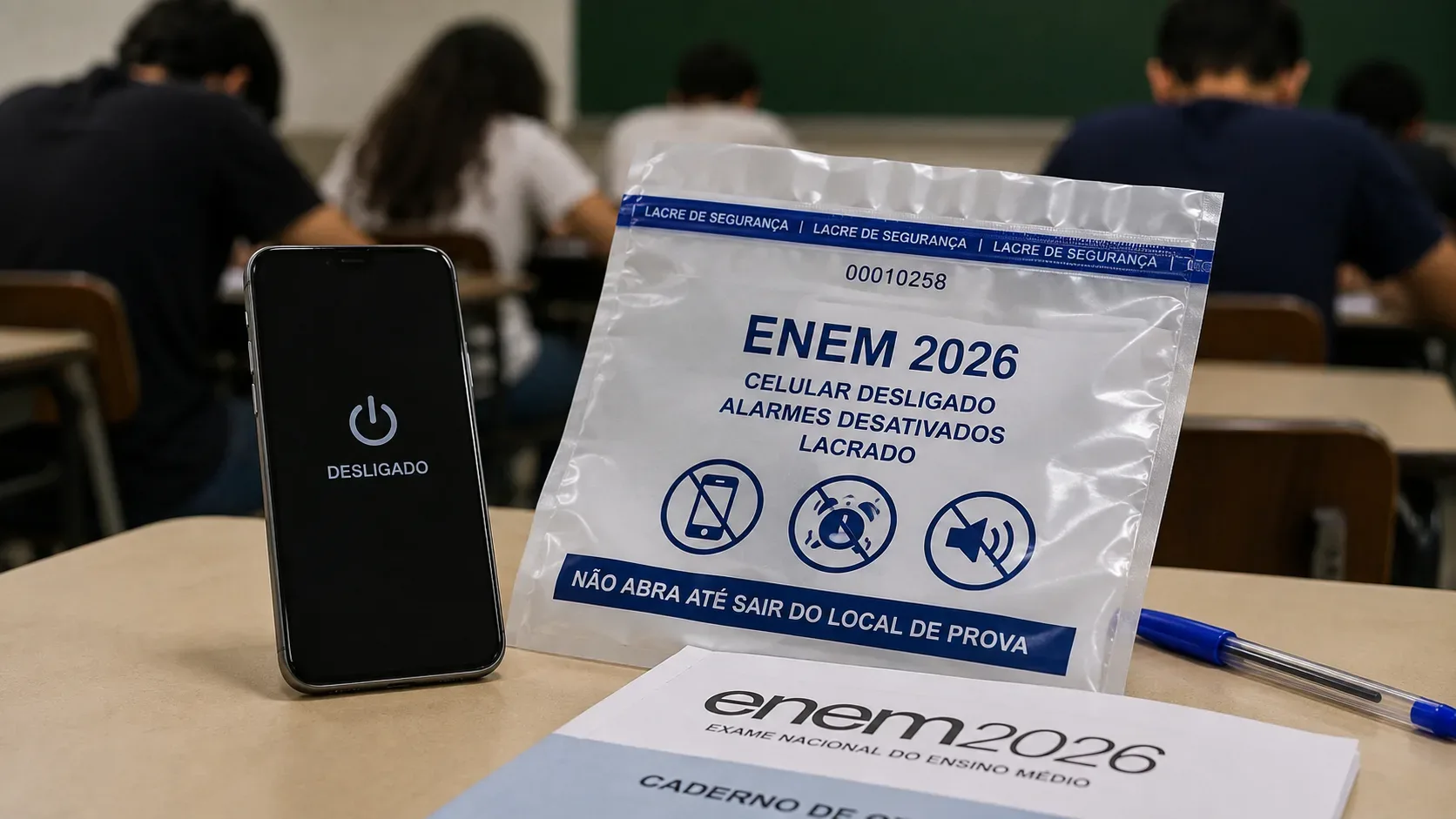
After the entry procedures, the phone is not available for use during the exam. Electronic devices must be switched off and stored in the designated belongings envelope in accordance with the exam rules.
What about a digital RG? Official pages conflict
This point deserves attention. Public Notice No. 64 of 2026, in item 10.1, letter g, lists the e-Título, CNH and CIN as digital documents with a photo. The following item on refusals
says that digital documents not cited in that letter will not be accepted.
At the same time, an Inep guidance page about Enem exam day, updated on May 22, 2026, also mentions a “digital RG” among the accepted digital documents. In other words, the official information currently available is inconsistent.
Because the public notice is the document that formally establishes the rules for the edition and contains a specific list of digital documents, the safest choice is not to rely exclusively on a digital RG that is not the digital CIN. If that is the only identification available, it is worth checking for any later update or guidance from Inep before the exam and, whenever possible, bringing another document expressly listed in the public notice.
Other documents accepted by the public notice
In addition to RG, CIN, CNH and e-Título, a Brazilian participant may use a passport, a Carteira de Trabalho e Previdência Social issued after January 27, 1997, and identification issued by a professional order or council that has legal validity as an identity document.
The list is restrictive enough that it is risky to rely on documents that look official but are not covered. The criterion is not simply “having a name and photo”; the document must fall within one of the categories recognized by the Enem 2026 rule.
What is not accepted at the gate
The public notice gives several examples of refused identification: a police report, protocols or receipts, the Certificate of Exemption from Incorporation (Certificado de Dispensa de Incorporação), the Reservist Certificate (Certificado de Reservista), a birth certificate, a marriage certificate, a printed Título Eleitoral, a student ID, the Administrative Indigenous Birth Registry (Registro Administrativo de Nascimento Indígena, Rani), badges, functional IDs of any kind and copies of valid documents, even when certified.
Digital documents that are not on the public notice's specific list are also refused, as are documents shown outside an official app and documents without a photo. For anyone checking their bag the night before, this part of the rule is just as important as knowing what is accepted: many of these are real documents, but they do not satisfy the identification requirement for the exam.
Does a damaged, illegible document or a very different photo prevent the exam?
Not necessarily. The public notice provides for special identification when the participant presents the original version of an accepted official document but it is damaged, illegible or the person's appearance is different enough to make identification difficult. In this procedure, personal information may be collected and a photo may be taken of the participant's face and of the document presented.
This provision does not turn an unaccepted document into a valid one. It applies to an original official document that belongs to the accepted list but has a problem of condition, legibility or visual correspondence. Therefore, it is not a solution for someone who arrives only with a police report, a copy, a student ID or another excluded item.
I arrived without a valid document: what happens?
The rule is strict because time is short. A participant without a valid document must wait outside the exam site until they can receive one of the documents provided for in the public notice. Entry must take place before 1:00 p.m., when the gates close. After that time, entry is prohibited.
That is why “someone can bring my document later” is only a possible strategy if the delivery happens in time. The best approach is to check your identification before leaving home and, if you plan to use a digital document, open the app early enough to notice any access problem.
Does the Registration Confirmation Card replace the ID?
No. The Registration Confirmation Card provides important information, such as the exam site, and the public notice recommends that participants bring it on both days. But it does not replace the official photo identification document required to enter the exam room.
Likewise, the Attendance Declaration serves a different purpose: it proves attendance when a participant needs that record. Neither of these papers takes the place of an RG, CIN, CNH or another valid document.
How to choose the safest document to bring
If you have a physical RG in good condition, a physical CIN or a valid CNH, any of these options reduces your dependence on battery power, connectivity and app operation. If you intend to use the e-Título, digital CNH or digital CIN, check beforehand that the document displays a photo and that the official app opens correctly.
It is also sensible to avoid a solution that depends on a debatable interpretation. In 2026, this is especially relevant to the digital RG because of the discrepancy between the wording of the public notice and an Inep guidance page. A document expressly listed in the public notice is the most predictable choice.
On November 8 and again on November 15, make the same check. Enem requires identification on both exam days. Arriving early and bringing a document that does not depend on improvisation is a simple way to prevent an identification issue from becoming the reason you are left outside the gate.