
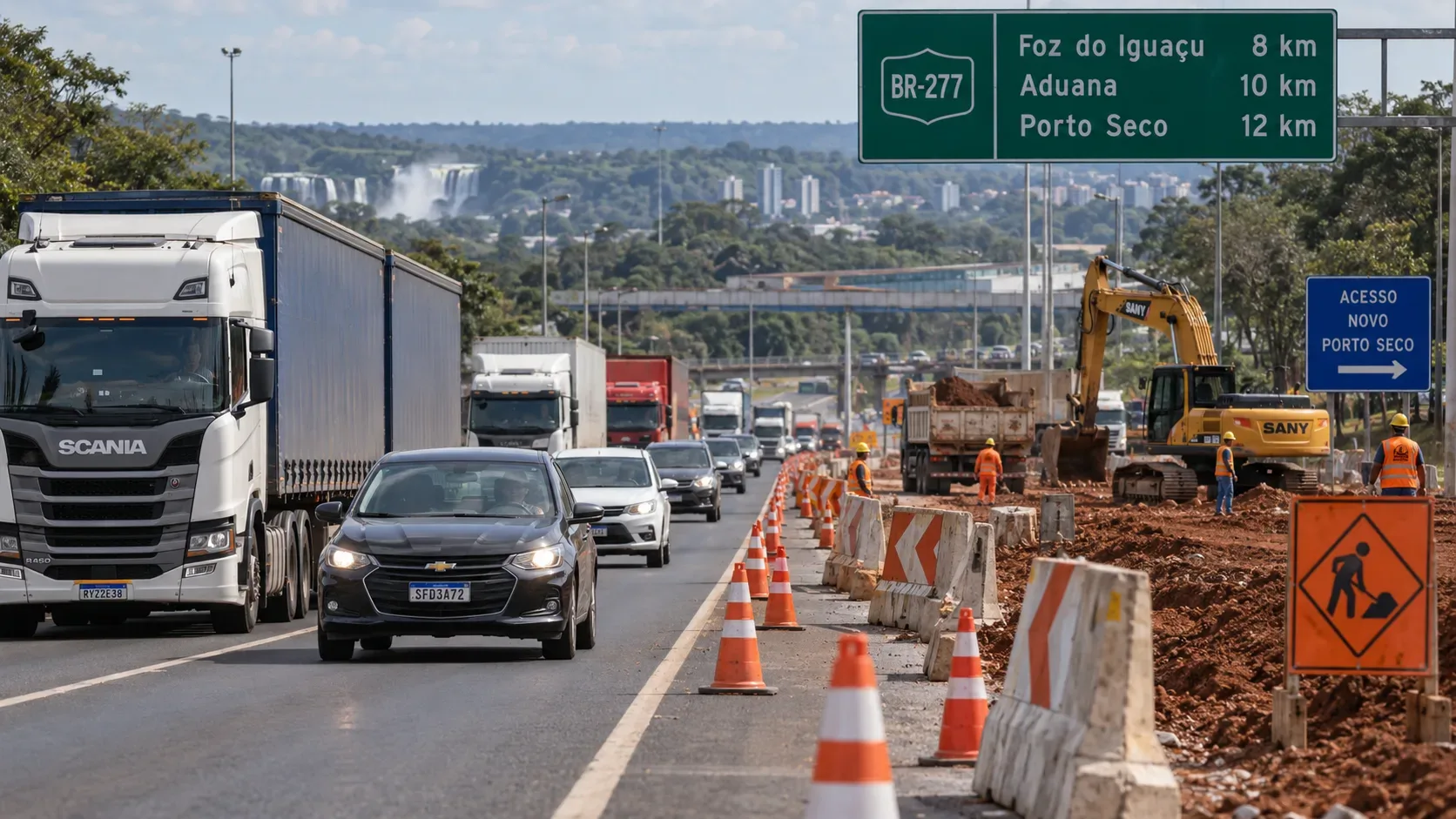
Drivers using BR-277 at the entrance to Foz do Iguaçu should account for reduced road capacity in the direction of Cascavel. The first phase of the intervention began on September 18, 2026 and covers about 400 meters, between kilometer markers 719.900 and 719.500. In this segment, the second traffic lane and the shoulder are closed, while vehicles continue through the remaining open lane.
Where the partial BR-277 closure is located
| Item | Situation in the first phase |
|---|---|
| Section | Between km 719.900 and km 719.500 |
| Affected direction | Foz do Iguaçu toward Cascavel |
| Approximate length | 400 meters |
| What is closed | Second traffic lane and shoulder |
| How traffic gets through | Using the lane that remains open |
The work zone is in the area of the future dry port, close to the Posto Gasparin area. The notice reproduced by H2FOZ says temporary signs, warning devices and nighttime signaling will be used to guide drivers during the work.
Why the lane was closed
The restriction allows work to advance on the extension of the marginal road that will provide access to the new Foz do Iguaçu dry port. The work is being carried out by Multilog. The work schedule and the temporary traffic plan for each phase were presented to and validated by EPR Iguaçu, the concessionaire responsible for this section, and the Federal Highway Police.
The intervention is supported by an authorization from Brazil's National Land Transport Agency. SUROD Decision No. 1,068, dated August 12, 2026 authorizes an access project with adjustments to the marginal road within the BR-277 right of way, from km 719+483 to km 720+761. That authorized interval is broader than the roughly 400 meters occupied by the first traffic restriction, so the two measurements should not be treated as the same thing.
What the impact is for drivers
In the initial phase, there is no announced full highway closure or mandatory detour. Traffic continues in the remaining lane, but taking one traffic lane and the shoulder out of service reduces the capacity of the segment and may cause slower traffic during busier periods.
For drivers heading toward Cascavel, the key point is the approach to km 719.900 through km 719.500, where vehicles must merge into the open lane. The notices reviewed do not indicate the same restriction on the opposite carriageway during this first phase.
How long the first phase is expected to last
The initial communication says the work will be divided into phases and that traffic arrangements may change as construction progresses. A report by Meio Dia Paraná said the initial phase was expected to run through the end of October. Because later configurations depend on construction progress, drivers should check updated notices before trips on later dates.
How to plan the route
- Allow extra time when passing the Foz do Iguaçu entrance toward Cascavel.
- Reduce speed before the work zone and avoid last minute lane changes.
- Follow cones, barriers, temporary signs and instructions from crews on site.
- At night, pay extra attention to temporary signaling and any temporary speed limits posted.
- Before leaving, check EPR Iguaçu's channels to see whether the work phase or traffic pattern has changed.
EPR Iguaçu also lists 0800 277 0163 for free medical and mechanical assistance on the highway. The number and the concessionaire's official information channels were reported by Rádio Cultura Foz.
What to watch for in the next updates
The main point is to separate the confirmed situation from future phases. The partial closure of the approximately 400 meter section is confirmed, with one lane and the shoulder closed toward Cascavel and traffic continuing in the remaining lane. Any further lane changes, expansion of the work zone or different traffic arrangements will be defined and announced as construction advances. For anyone relying on BR-277, the practical approach is to leave extra travel time and check road signs and concessionaire notices on the day of the trip.