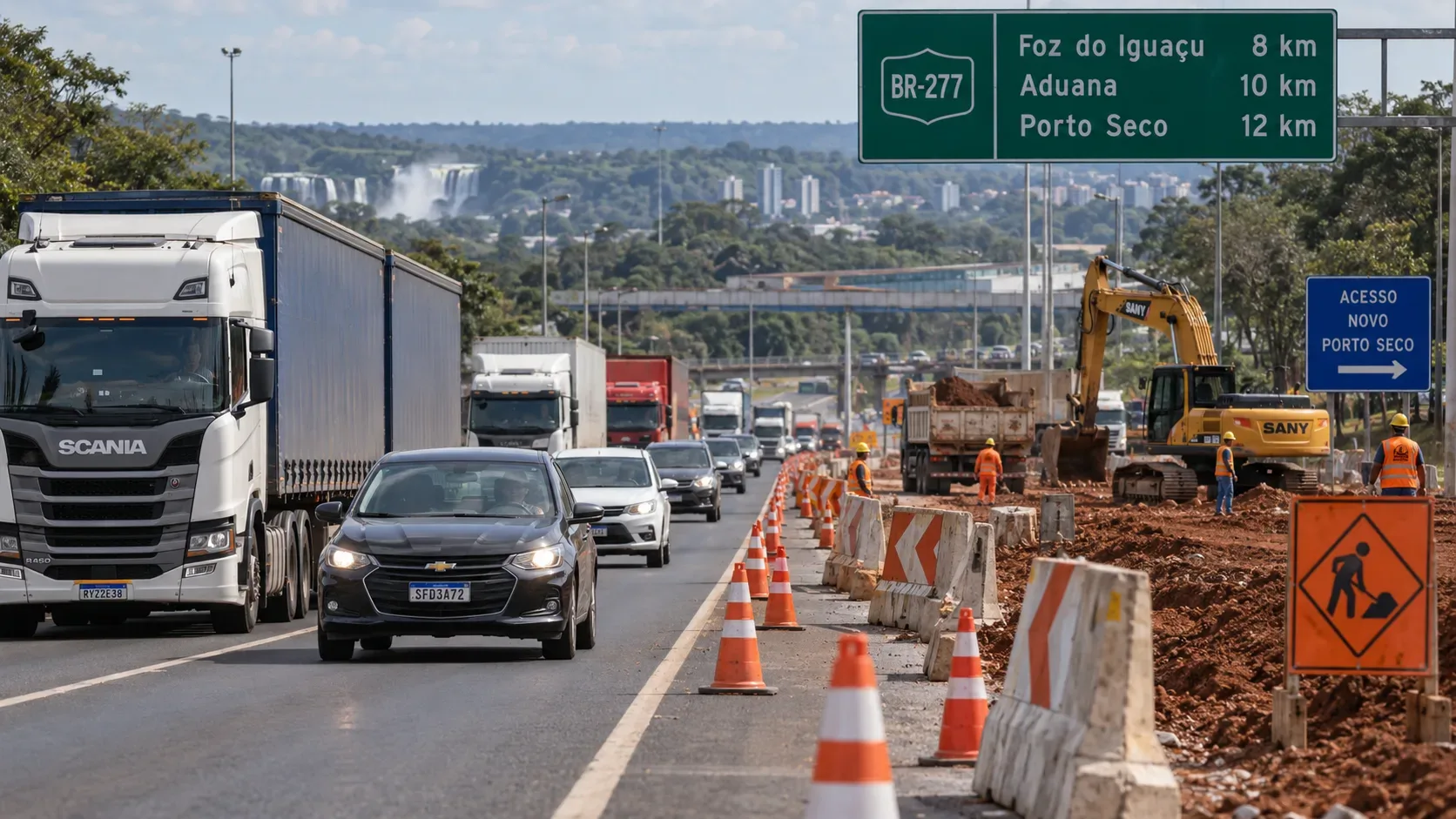
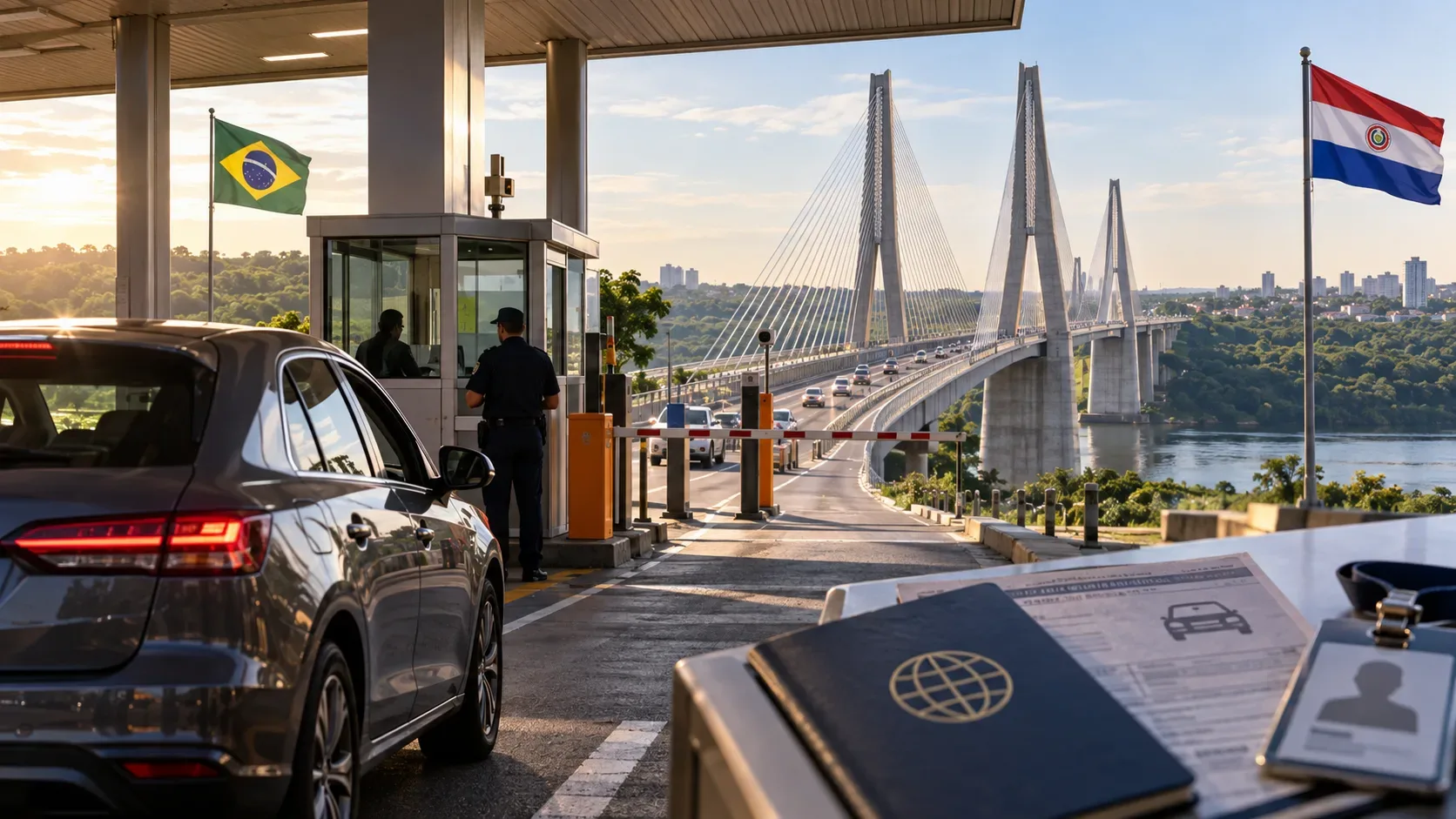
Since September 14, 2026, the Integration Bridge between Foz do Iguaçu and Presidente Franco has been open to private cars under a restricted local border traffic arrangement. The change does not mean a general opening of the bridge to automobiles. The official schedule allows light vehicles from 7 a.m. to 1 p.m. only for residents of the linked border localities and requires the Border Local Traffic Document, known by the Portuguese and Spanish acronym DTVF, for the driver and every other occupant.
In practice, the new arrangement serves residents of Foz do Iguaçu in Brazil and Ciudad del Este, Presidente Franco and Hernandarias in Paraguay. The rule was announced by Paraguay's National Directorate of Migration and took effect on September 14. Brazil's customs authorization for the crossing was also updated to include passenger cars used by residents of those localities who hold a DTVF.
Who may cross the Integration Bridge by car
Private automobile traffic is tied to the Mercosur linked border localities regime. In this stage of operations, eligibility is limited to residents of Foz do Iguaçu, Ciudad del Este, Presidente Franco and Hernandarias.
| Situation | May use the bridge by car? | Main condition | Hours |
|---|---|---|---|
| Resident of Foz do Iguaçu | Yes | DTVF and the other documents required for international crossing | 7 a.m. to 1 p.m. |
| Resident of Ciudad del Este | Yes | DTVF and the other documents required for international crossing | 7 a.m. to 1 p.m. |
| Resident of Presidente Franco | Yes | DTVF and the other documents required for international crossing | 7 a.m. to 1 p.m. |
| Resident of Hernandarias | Yes | DTVF and the other documents required for international crossing | 7 a.m. to 1 p.m. |
| Tourist or resident of another city | Not under this arrangement | The private car regime is restricted to the linked localities listed in the schedule | Not applicable |
A key point is that the driver's DTVF alone is not enough. According to the official notice, the driver and all other occupants must carry the document. The requirement applies to each person seeking to use this local border traffic arrangement.
Which documents to carry for the crossing
The DTVF gives access to the special arrangement, but it does not replace a passport or another valid travel document and it does not waive immigration registration. Paraguay's migration authority states that holders must present the DTVF together with their travel document and register entry and exit at the authorized control posts.
Drivers must also comply with the normal requirements for international vehicle circulation within Mercosur. The practical documents fall into two groups:
- For every occupant: DTVF and a valid travel or identity document accepted for the crossing, plus completion of immigration control.
- For the driver and vehicle: a valid driver's license, vehicle registration or ownership document and international third party liability insurance, commonly known as Carta Verde, when applicable to vehicles registered in Mercosur member states.
For Brazilian vehicles entering Paraguay, guidance from the Consulate General of Brazil in Asunción lists an identity document or passport, a physical driver's license, vehicle documents and Carta Verde insurance. The same guidance says that when the driver is not the owner, proper authorization from the vehicle owner is required. Because third party vehicle requirements can differ by direction of travel and vehicle status, travelers should confirm the required form before departure.
Where to apply for the DTVF
One particular feature of the agreement is that the document is issued by the authority of the country in whose border territory the person wants to exercise the rights granted by the regime. This means the process is not simply handled in the country where the applicant lives.
- Resident of Foz do Iguaçu seeking to use the regime in Paraguay: Paraguay's National Directorate of Migration says it accepts applications from Mercosur nationals domiciled in a linked Brazilian border locality. The listed service point is the Admission Office in Ciudad del Este, on Avenida Rogelio Benítez near 4 de Mayo.
- Paraguayan resident of a linked locality seeking to use the regime in Brazil: Paraguay's migration authority instructs applicants to complete the process with Brazilian authorities and states that in the Foz do Iguaçu area the procedure is handled by the Federal Police.
Decree No. 12,948 of April 27, 2026, which promulgated the Agreement on Linked Border Localities, confirms the DTVF framework and identifies the Federal Police as the Brazilian issuing authority for the corresponding border document.
Requirements published by Paraguay for issuing the DTVF
For applications received by Paraguay's National Directorate of Migration, the authority published a specific checklist. The items include:
- a completed and signed DTVF application form;
- the original and one authenticated copy of a passport or another travel document;
- the original and one authenticated copy of a utility bill in the holder's name as proof of address;
- an apostilled criminal record certificate covering the previous five years;
- payment of the applicable fee.
According to the official page published on September 1, 2026, Paraguay's DTVF is valid for five years, may be renewed for another five years and should be issued within up to 72 business hours after the requirements are verified. At the time of publication, the stated fee was PYG 234,154. Because administrative fees and procedures may be updated, applicants should check Paraguay Migration's DTVF guidance page before filing the request.
What is still not open to private cars
The authorization that began on September 14 is specific. It does not turn the Integration Bridge into a general route for every passenger car. People who do not live in one of the four covered localities or do not hold a DTVF are not part of this local border traffic arrangement.
Customs clearance of merchandise has also not been enabled at the Integration Bridge border crossing. The official notice limits the arrangement to goods considered subsistence items under the agreement. In other words, access for cars should not be interpreted as a broad opening for commercial operations or merchandise transport.
People without a DTVF may use other authorized border crossings under the ordinary migration rules and travel arrangements in force. Paraguay's National Directorate of Migration makes this point in its explanation of the document.
How the other traffic categories operate on the bridge
The private car schedule was added to an operation that already had different rules for buses and freight. The August 31 notice kept those other categories in force and changed the hours for large empty trucks.
| Traffic category | Operating rule |
|---|---|
| Private cars under the local border regime | 7 a.m. to 1 p.m. for residents of the linked localities, with a DTVF for the driver and occupants |
| International urban passenger service between Presidente Franco and Foz do Iguaçu | 7 a.m. to 7 p.m. under the local regime and with DTVF |
| Smaller freight transport | 7 a.m. to 7 p.m. for empty entry and exit via the Integration Bridge, with the loaded return through the Friendship Bridge |
| Large empty trucks | 6 p.m. to 5 a.m. |
| Closed circuit passenger services whose final destination is not Ciudad del Este or Foz do Iguaçu | 24 hours |
| Regular international passenger lines | 24 hours |
Checklist before driving to the crossing
- Confirm that every occupant is eligible for the regime and has a valid DTVF.
- Carry each person's accepted travel or identity document.
- Bring the driver's license and vehicle document.
- Confirm that Carta Verde insurance is valid for the international trip.
- If the driver is not the owner, verify the authorization required for the direction of travel.
- Plan to arrive within the 7 a.m. to 1 p.m. window for private cars.
- Complete the normal exit and entry controls at the immigration posts.
- Do not rely on the bridge for customs clearance of merchandise outside the permitted regime.
To avoid an unnecessary trip, travelers should check the official Integration Bridge schedule on the day of travel as well as current guidance from the migration and customs authorities of both countries. The arrangement is recent and is part of the gradual opening of the new border corridor.