
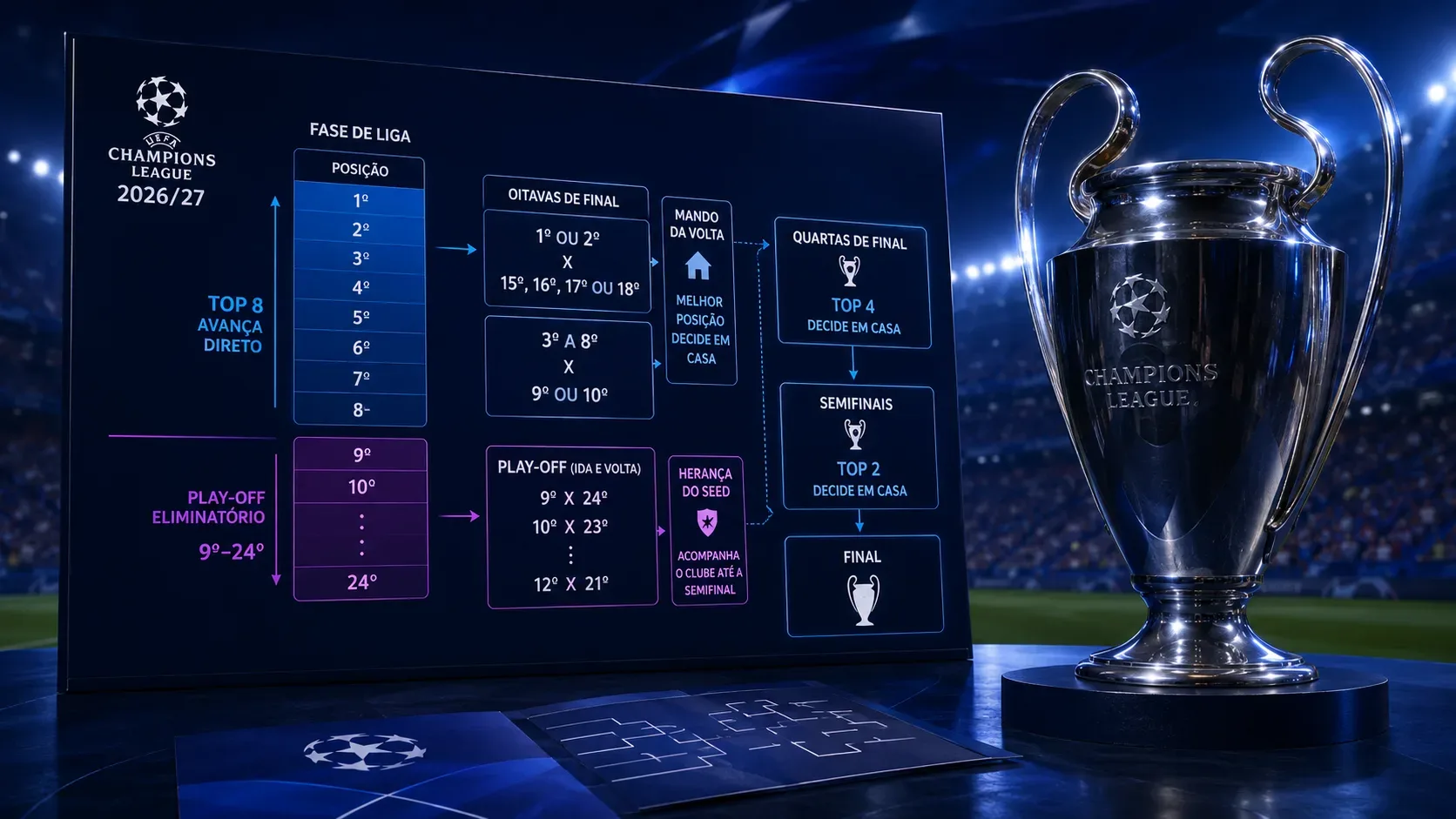
In the 2026/27 Champions League, the final league-phase position does more than decide who advances. It acts as a seed that reserves a lane in the knockout bracket: it determines which groups of opponents can appear in the play-offs and round of 16 and, for the highest-ranked teams, preserves the right to play the second leg at home in the quarter-finals and semi-finals as well. The key point is that once the draws place clubs in the bracket positions set by the regulations, the route is fixed; UEFA does not create a new ranking of the surviving teams after every round.
Article 17 of the 2026/27 regulations sets the first cut: 1st to 8th qualify directly for the round of 16, 9th to 24th enter the knockout phase play-offs, and 25th to 36th are eliminated. Article 19 and Annex B then turn those positions into seed pairings, bracket paths and second-leg home advantage.
The practical map: position, possible opponents and second-leg venue
| League position | First stage | Reserved path | Second leg |
|---|---|---|---|
| 1st–2nd | Round of 16 | Enters against the winner of the 15th/16th vs 17th/18th path | In principle at home in the round of 16, quarter-finals and semi-finals while that seed remains alive |
| 3rd–4th | Round of 16 | Enters against the winner of the 13th/14th vs 19th/20th path | In principle at home in the round of 16 and quarter-finals; no automatic protection for the semi-final second leg |
| 5th–6th | Round of 16 | Enters against the winner of the 11th/12th vs 21st/22nd path | In principle at home in the round of 16; later rounds follow the already fixed bracket order |
| 7th–8th | Round of 16 | Enters against the winner of the 9th/10th vs 23rd/24th path | In principle at home in the round of 16; later rounds follow the already fixed bracket order |
| 9th–10th | Play-off | Against 23rd or 24th; if through, enters the 7th/8th path | In principle at home in the play-off second leg; in the round of 16 the 7th/8th seed has the home second leg |
| 11th–12th | Play-off | Against 21st or 22nd; if through, enters the 5th/6th path | In principle at home in the play-off second leg |
| 13th–14th | Play-off | Against 19th or 20th; if through, enters the 3rd/4th path | In principle at home in the play-off second leg |
| 15th–16th | Play-off | Against 17th or 18th; if through, enters the 1st/2nd path | In principle at home in the play-off second leg |
| 17th–18th | Play-off | Against 15th or 16th; subsequent 1st/2nd path | In principle away in the play-off second leg |
| 19th–20th | Play-off | Against 13th or 14th; subsequent 3rd/4th path | In principle away in the play-off second leg |
| 21st–22nd | Play-off | Against 11th or 12th; subsequent 5th/6th path | In principle away in the play-off second leg |
| 23rd–24th | Play-off | Against 9th or 10th; subsequent 7th/8th path | In principle away in the play-off second leg |
| 25th–36th | Eliminated | Does not enter the knockout phase | — |
This table condenses the structure in the regulations. Within each pair — 1st/2nd, 3rd/4th, 5th/6th and 7th/8th in the round of 16; 9th/10th, 11th/12th, 13th/14th and 15th/16th in the play-offs — the draw decides which club occupies each of the two corresponding bracket slots. So knowing that a team finished first, for example, does not identify a named opponent months in advance: it defines the bracket lane and the seeds that can feed into it.
The cut-off points that actually change the advantage
The practical effect becomes clearer at the boundaries between positions. These thresholds, more than every individual number, change the route:
- 8th vs 9th: 8th skips the play-off and goes directly to the round of 16; 9th must survive two extra matches, although it is seeded in the play-off and, in principle, hosts the second leg.
- 16th vs 17th: both enter the play-off, but 16th is in the seeded block and 17th in the unseeded block. Under the standard rule, that changes where the second leg is played.
- 4th vs 5th: both go directly to the round of 16 and host the second leg there, but only seeds 1st to 4th carry second-leg home protection into the quarter-finals.
- 2nd vs 3rd: both have the second leg at home in the round of 16 and quarter-finals, but seeds 1st and 2nd are the only ones that also carry that protection into the semi-finals.
- 24th vs 25th: 24th still reaches the play-off; 25th is eliminated.
What changes between finishing 1st and 2nd?
In terms of second-leg protection, 1st and 2nd are in the same tier. Both go directly to the round of 16, enter against the winner of the 15th/16th vs 17th/18th lane and, while their respective seed remains alive, have the second leg at home in the round of 16, quarter-finals and semi-finals. The round-of-16 draw distributes the two clubs in the 1st/2nd pair into the reserved bracket positions, so the league position defines the seed pair while the draw defines the exact side.
That is why the stronger structural boundary is not 1st versus 2nd but 2nd versus 3rd: dropping from second to third means losing the automatic second-leg home protection in a possible semi-final.
Why is 4th worth more than 5th even though both are in the round of 16?
The regulations treat 1st to 4th as seeded teams for the quarter-final second-leg order. A club that finishes fourth and reaches the quarter-finals through its path therefore plays the second leg at home in principle. The fifth-placed club also qualified directly for the round of 16 and hosted the second leg there, but it does not receive the same quarter-final guarantee.
This is one of the differences hidden by a simple “top eight go straight through” summary. Position inside the top eight still matters because the benefit is graduated: top eight protects the round of 16; top four extends protection to the quarter-finals; top two extends it to the semi-finals as well.
Why do 8th and 9th face such different scenarios?
The eighth-placed team is already in the round of 16. Ninth, despite being the best club in the play-off block, still has to eliminate 23rd or 24th over two legs. If it advances, it enters the lane reserved for 7th/8th. In the round of 16, the top-eight team is the seed and, in principle, plays the second leg at home.
So finishing ninth does not give a club a “near top-eight” status in the bracket. It provides a privileged position within the play-off, but still includes an extra round and a round-of-16 path controlled by the 7th/8th seed.
How seed inheritance works
The most important detail in Article 19.04 is that the advantage is not recalculated from the league positions of the teams still alive. If a protected seed is eliminated, the club that eliminates it takes over that seed's position in the path.
For example, imagine a club that finished 17th, knocked out a 15th/16th-placed side in the play-off and then eliminated the team occupying seed 1 in the round of 16. From that point, it assumes that seed's position in the bracket. If it reaches the quarter-finals and semi-finals through the same lane, it receives the second-leg order that had been reserved for seed 1. UEFA explicitly states that the seeding order is not recalculated round by round to reward the “highest-ranked remaining team”.
The same logic explains how a lower-ranked club can end up hosting the second leg of a semi-final: not because its original league position has become high, but because it took the place of a 1st- or 2nd-ranked seed in the bracket.
Is the bracket redrawn after the round of 16?
No. The quarter-final and semi-final structure already follows Annex B. The play-off and round-of-16 draws place clubs into reserved positions; from there, the winners follow the bracket route. There is no new draw that reorders every surviving club according to the league-phase table.
In practice, a better finish helps control the type of route, but it cannot guarantee an easy opponent. A club can know which ranking bands feed into its lane; the actual names depend on which team lands in each slot and who survives the earlier ties.
Is “second leg at home” an absolute rule?
UEFA's text uses the wording “in principle”. Seeded clubs play the second leg at home in the play-offs and round of 16; in the quarter-finals that protection belongs to seeds 1st to 4th, and in the semi-finals to seeds 1st and 2nd. Article 19 also allows the UEFA administration to adapt draw conditions or assign positions to address relevant constraints.
In addition, Article 20 says that all knockout ties except the final are normally played over two legs. The final is a single match, so there is no second-leg home advantage. The silver side of the bracket is only the nominal home team for administrative purposes.
When does this path take effect in the 2026/27 Champions League?
The league phase ends on 27 January 2027. The play-offs follow on 16/17 and 23/24 February, the round of 16 on 9/10 and 16/17 March, the quarter-finals on 6/7 and 13/14 April, and the semi-finals on 27/28 April and 4/5 May. The final is scheduled for 5 June 2027 in Madrid, according to UEFA's published calendar.
How to read the league table without relying on shortcuts
To convert the standings into a practical knockout consequence, read the blocks in this order: first ask whether the club is in the top eight, the 9th–24th block or outside the knockout phase; then identify its seed pair; finally, check how far that seed preserves the home second leg.
- 1st–2nd: most protected route, with the second leg at home through the semi-finals while the seed survives.
- 3rd–4th: second leg at home through the quarter-finals.
- 5th–8th: home second-leg advantage in the round of 16, with no automatic extension to later rounds.
- 9th–16th: seeded in the play-off and, in principle, hosts the second leg in that round.
- 17th–24th: unseeded in the play-off and, in principle, plays the second leg away.
- 25th–36th: eliminated.
So the question “is it worth chasing 1st, 4th or 8th?” has an objective answer: each cut-off preserves a different advantage. The 2026/27 regulations make the league-phase ranking part of the knockout stage before the first knockout tie is even played.