In the 2026/27 Champions League, direct confrontation is not a tiebreaker for the league phase. If two or more clubs finish with the same score, UEFA starts with the goal difference and follows a sequence of ten criteria defined in Article 18 of the season's regulations. The order goes through goals scored, performance away from home, opponents' results, discipline and, only at the end, club coefficient.
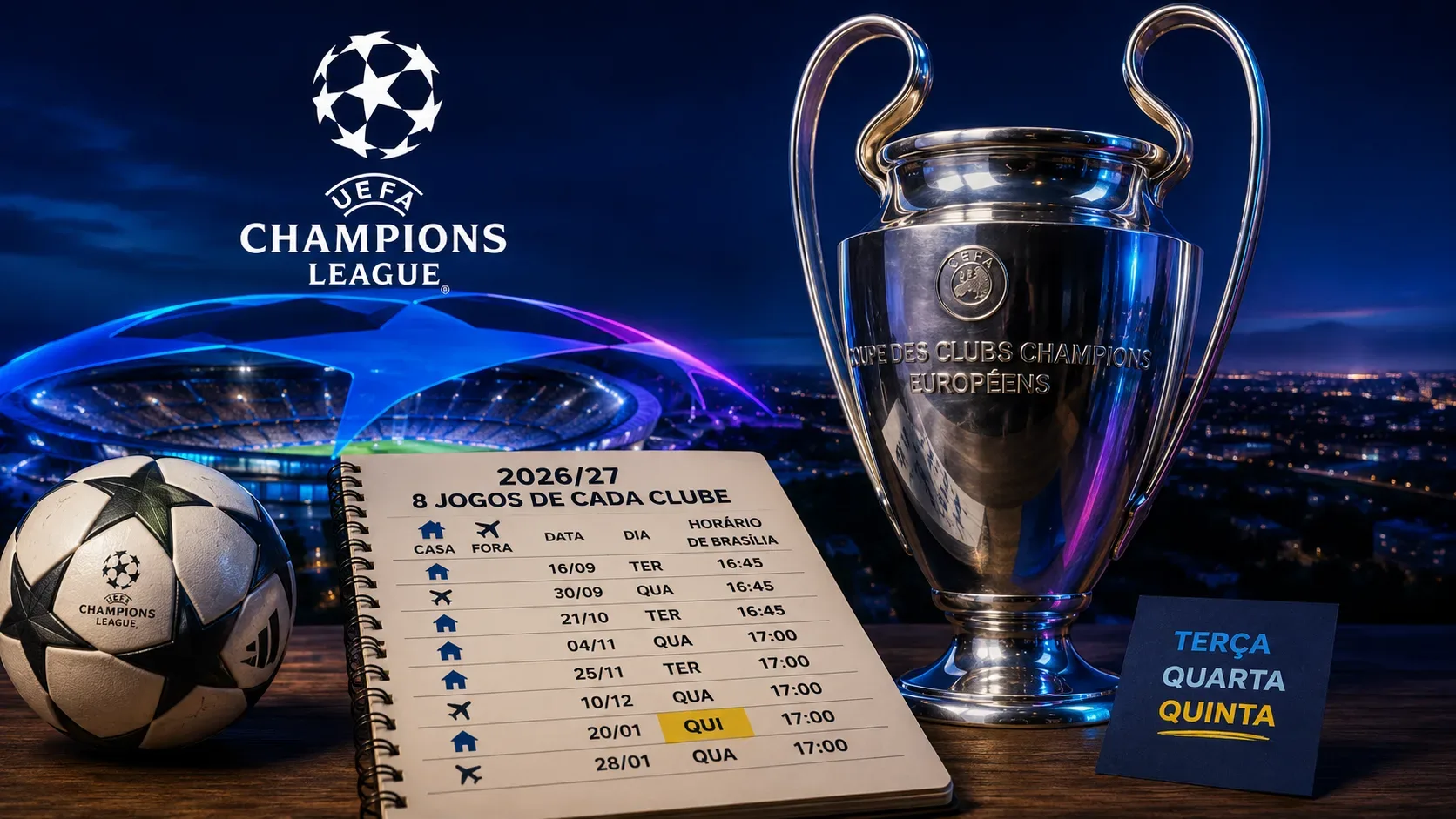
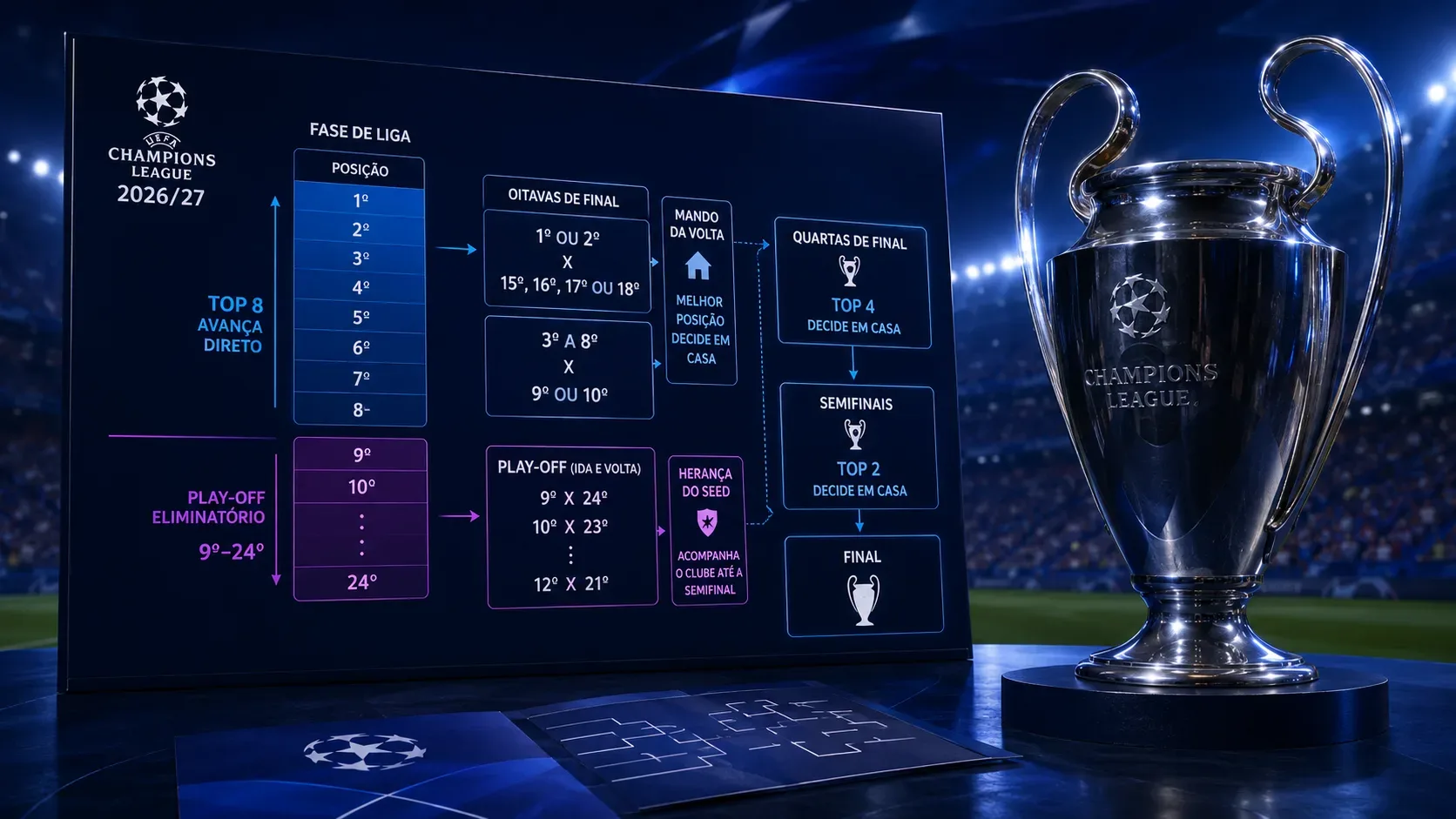
The rule applies to the final classification of the league phase. This matters because the position can separate a direct place in the round of 16, going to the playoffs or elimination. Due to the structure of the competition, the 36 clubs are in a single table; each team plays eight games against eight different opponents, four at home and four away. In the end, the first eight advance directly to the round of 16, 9th to 24th place go to the knockout stage playoffs and 25th to 36th are eliminated.
Why direct confrontation is not a tiebreaker
Direct confrontation does not appear among the ten criteria of Article 18. Therefore, even if two tied clubs faced each other in the league phase, the result of that game does not take precedence over balance, goals or any other official criteria.
The format helps to understand this choice. The table brings together 36 teams, but each club faces only eight of them. In many ties, the teams being compared will not have even played each other. Furthermore, clubs play different schedules, against different opponents. A head-to-head tiebreaker would be applicable in some combinations and impossible in others.
This is different from the old logic of groups, in which the same four clubs played each other in turn and return and direct confrontation could be used uniformly within that group. In the current league phase, UEFA has adopted a sequence starting with each team's cumulative performance across the eight games.
The official order of the 10 criteria
Article 18 states that the criteria are applied one after the other. We only move on to the next when equality remains in the previous criterion.
1. Goal difference in the league stage
The first tiebreaker is the difference between goals scored and goals conceded in the eight games. If two clubs finish with the same points, whoever has the greater balance is ahead.
This criterion makes each goal relevant even when the outcome of a match already seems decided. A victory by three goals can have a different impact than a minimal victory when the classification reaches the final round tight.
2. Most goals scored
If the balance is also equal, UEFA compares how many goals each team scored in the entire league phase. The club with the most goals scored occupies the top position.
Here it doesn't matter which opponent the goals were scored against. It is the total offensive production in the eight games that is included in the comparison.
3. Most goals scored away from home
If the tie persists, the total number of goals scored as a visitor during the league phase is entered. This is not a direct confrontation or an away goal rule in knockout matches; it is simply an accumulated statistic from the four games played away from home.
4. Most wins
If points, balance, total goals and away goals are equal, the next criterion is the number of wins in the eight games. The club that won the most matches is ahead.
Two teams can reach the same score through different paths. One may have more wins and losses, while another has accumulated more draws. If the three previous criteria do not separate the clubs, the number of victories will decide.
5. Most wins away from home
Then, UEFA checks which team won the most matches as a visitor. It is the fifth and final criterion based exclusively on the club's own results before the comparison passes to the performance of the opponents faced.
6. Highest total of opponents' points
If equality continues, the table will now consider each club's eight opponents. The points obtained by these opponents in the league phase are added together. The team whose list of opponents has accumulated the most points has the advantage.
In practice, this criterion works as a measure of the strength of the calendar based on what the opponents actually did in the competition. It’s not enough to look at the clubs’ reputation before the tournament; The points they actually won in the league stage count.
7. Best collective goal difference of opponents
If the opponents' points total is also equal, the aggregate goal difference of these opponents in the league phase is compared. The club whose opponents have the best collective balance is ahead.
This is a second level of comparison of the difficulty of the path taken. First come the opponents' points; then their goal difference.
8. Most goals scored collectively by opponents
If the tie persists, UEFA adds up the goals scored by each club's opponents during the league phase. Whoever has faced the group of opponents with the highest total of goals scored receives the
top position.
Criteria 6, 7 and 8 depend on the final performance of the opponents. Therefore, they only become completely closed when the league phase is over and all eight games for each team have been completed.
9. Lowest total of disciplinary points
If nothing separates the clubs before, discipline comes in. Whoever has the lowest total of disciplinary points accumulated by players and team officials in league stage games wins the tiebreaker.
In UEFA's calculation, a yellow card is worth 1 disciplinary point. A red card is worth 3. An expulsion resulting from two yellow cards in the same game is also worth 3 points. Since the goal is to have the lowest total, fewer punishments mean an advantage.
10. Highest club coefficient
If equality survives until the ninth criterion, the last resort is the UEFA club coefficient, as per Annex D of the regulations. The club with the highest coefficient is ahead.
The coefficient only appears at the end of the sequence. Therefore, European tradition or historical position in the ranking cannot overcome a rival that has an advantage in terms of balance, goals, victories, strength of opponents or discipline.
Three examples to apply the rule without getting lost
Example 1: same points, different balances
Imagine Club A and Club B with 16 points. Club A finished with 14 goals scored and 7 conceded, a balance of +7. Club B scored 13 and conceded 8, a balance of +5. The comparison ends immediately with the first criterion: Club A is ahead. It doesn't matter if Club B won the match between them, if such a match existed.
Example 2: draw until away wins
Now consider two clubs with 15 points, +4 balance, 12 goals scored, 6 away goals, 4 wins and 2 away wins. The first five criteria don't cut it. Then the opponents enter. If Club C's eight opponents have 94 points in the league stage and Club D's have 89, Club C is ahead by the sixth criterion.
This example shows why just looking at the traditional line of the table may not be enough in an extreme draw. The position also depends on what the opponents did.
Example 3: the discipline decides before the coefficient
Suppose that Club E and Club F remain strictly equal until the eighth criterion. Club E ended the phase with 10 disciplinary points and Club F with 13. Club E is ahead by the ninth criterion. The club coefficient is not even consulted.
If the two also had the same disciplinary total, then the highest club coefficient would be used as the tenth and final tiebreaker.
How to read the table without falling into three common confusions
The first confusion is looking for direct confrontation. It is not on the Article 18 list and should not be used to reverse the order established by official criteria.
The second is to look at goal difference. The balance is the first tiebreaker, but not the only one. In a table with 36 clubs, ties in points and balance can quickly lead to goals scored, goals
away, victories and, in rarer situations, the performance of the opponents.
The third is to treat coefficient as a shortcut. He is the last criterion. Before it there are eight sporting comparisons linked to league stage games and a disciplinary comparison.
What about during the rounds, before the phase ends?
The text of Article 18 of regulation 2026/27 formulates the ten criteria for teams tied on points after the conclusion of the league stage games. In explanatory material published by UEFA itself for 2025/26, the organization reported that, between the first and seventh rounds, it used the first five criteria to separate teams when displaying the table; if equality remained in all of them, the clubs appeared with the same position and were ordered alphabetically by abbreviated name.
This provisional display detail should not be confused with the final tiebreaker for the 2026/27 season. To know who officially finishes ahead after the eighth round, the safe reference is the complete sequence of ten criteria in the current regulations.
What can really change the classification in the last round
As goal difference comes first, a goal scored or conceded at the end of a match can change positions even when the tied clubs are in different games. If the balance stays the same, the total number of goals will have the same decisive weight.
In deeper ties, the classification can also change due to third party results. An opponent who wins in the final round increases his own score and, in doing so, can increase the sum used in the sixth criterion by a club that faced him. The same goes for balance and opponents' goals in the following criteria.
For this reason, in a final round with many clubs close together, the table can change in more than one layer at the same time: due to the result of the team itself and, in cases of extreme equality, due to what happens in the matches of the opponents that made up its calendar.
The rule of thumb for checking any tie
To check the order correctly, always start with the points and do not skip steps. If there is equality, compare goal difference; then goals scored; away goals; victories; away wins. Only then examine the three collective indicators of the opponents. If there is still a tie, check the disciplinary points and, finally, the club coefficient.
This sequence solves the central question of Champions 2026/27: direct confrontation does not decide the league phase because it is not part of Article 18. The final classification is constructed by a fixed chain of ten criteria, applied in order, without choosing the tiebreaker that seems most intuitive for each case.