
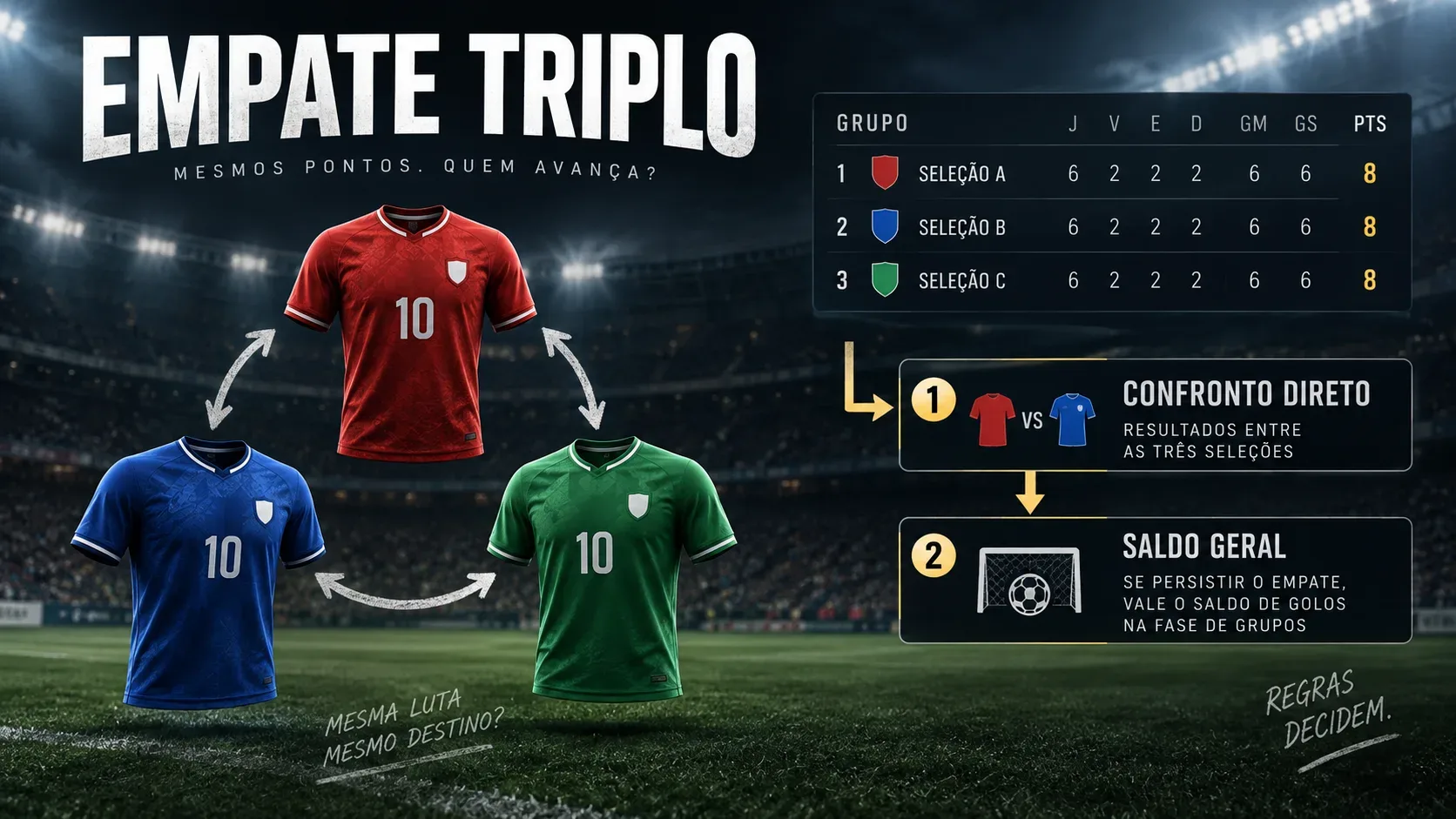
In a three-team tie in the 2026/27 UEFA Nations League league phase, overall goal difference is not the first tiebreaker. The regulations start with the matches played among the tied teams themselves. In that mini-table, UEFA compares, in order, points, goal difference and goals scored. Only after that process, if the tie remains under Article 15, do figures from all group matches come into play.
This detail can make the full table misleading if read too quickly. A team may have a better overall goal difference and still rank behind another because head-to-head results among the tied teams come first. Article 15 of the official 2026/27 UEFA Nations League regulations sets out this sequence.
What is the Nations League tiebreaker order?
When two or more teams finish the league phase level on points, the criteria are applied in this order:
- more points obtained in matches among the tied teams;
- better goal difference in those matches among the tied teams;
- more goals scored in those matches among the tied teams;
- if only some teams remain level after the previous three criteria, those three criteria are reapplied exclusively to matches among the teams that are still tied;
- better goal difference in all group matches;
- more goals scored in all group matches;
- more away goals scored in all group matches;
- more wins in all group matches;
- more away wins in all group matches;
- lower disciplinary points total, based on cards received by players and team officials;
- higher position in the 2026/27 UEFA Nations League access list.
The regulations also state that, in the league phase, each team plays every other team in its group once at home and once away. A win is worth three points, a draw one and a defeat zero, as set out in Article 14.
The key detail in a three-way tie: the mini-table can be recalculated
The fourth step is the easiest one to miss. If three teams start level and the head-to-head criteria separate one of them while the other two remain tied, UEFA does not automatically jump to overall goal difference. Points, goal difference and goals scored are first applied again, this time only to the matches between the two teams that remain level.
Only if that reapplication also fails to break the tie do the general group criteria begin, starting with goal difference in all group matches.
Simulation 1: head-to-head separates one team and leaves two tied
Consider three fictional teams, A, B and C, that finish the group on the same number of points. In the six matches among them, the results are: A 2-0 B; B 1-0 A; A 1-1 C; C 0-0 A; B 2-1 C; C 1-0 B.
| Team | Head-to-head points | Goal difference | Goals scored |
|---|---|---|---|
| B | 6 | -1 | 3 |
| A | 5 | +1 | 3 |
| C | 5 | 0 | 3 |
B ranks ahead because it collected six points in the matches against A and C. A and C, however, remain level on five points. At this stage, the comparison between A and C is recalculated using only their two matches: 1-1 and 0-0. Both teams take two points, have a goal difference of zero and score one goal. Because the reapplication still does not separate A and C, the regulations move to the general group criteria for those two teams. If A has, for example, an overall goal difference of +4 and C has +2, A ranks ahead of C.
Notice that A's +1 goal difference in the original three-team mini-table is not used directly to decide the ranking against C once B has been separated. The rules require the first three criteria to be recalculated only between the teams that remain tied.
Simulation 2: head-to-head is completely level and overall goal difference decides
Now suppose A, B and C again finish level on group points and, among themselves, each team wins two matches 1-0 and loses two matches 1-0. Each therefore has six head-to-head points, a goal difference of zero and two goals scored. The first three criteria remain equal.
To make the example verifiable, imagine that all three also collect the same six points against a fourth team in the group, but by different margins. Their overall points stay level while their goal difference across all matches changes:
| Team | Group points | Overall goal difference | Goals scored in group |
|---|---|---|---|
| A | 12 | +8 | 10 |
| B | 12 | +5 | 8 |
| C | 12 | +3 | 6 |
Because the head-to-head record among A, B and C produces no separation, the first applicable general criterion is goal difference in all group matches. In this scenario, A ranks ahead of B, and B ahead of C. Total group goals would only be needed if two or more teams still had the same overall goal difference.
Head-to-head or overall goal difference: which should you check first?
For a tie on points, check the results among the tied teams first. Overall goal difference matters, but it comes only after the head-to-head sequence and, when required, after that sequence has been reapplied to the teams that remain level.
- Two-team tie: compare the matches between those two teams first.
- Three-team or larger tie: build a mini-table using only matches among the tied teams.
- One team is separated while others remain level: reapply points, goal difference and goals scored only among the remaining teams.
- The tie still remains: use goal difference in all group matches, followed by the other general criteria.
When do away goals outside head-to-head enter?
In the 2026/27 list, away goals are not one of the first three head-to-head criteria. After overall goal difference and total goals scored in all group matches, the regulations consider away goals scored in all group matches. They are followed by total wins, away wins, disciplinary points and, finally, access-list position.
For discipline, UEFA assigns three points for a red card, one point for a yellow card and three points for a sending-off caused by two yellow cards in the same match. The lower total is better.
How to follow a three-way tie on the final matchday
During a final round, the safest method is to keep two calculations separate. First, track the overall points to identify which teams are tied. Then build a temporary mini-table using only the results among those teams. If the mini-table settles every position, overall goal difference does not enter. If it settles only one position, recalculate head-to-head for the remaining teams before looking at overall figures.
This also explains why a live table based mainly on goal difference can look different from the final regulatory outcome while several matches are still in progress. Article 15 applies to the standings at the end of the league phase, when the teams that actually finish level on points can be identified.
Rule summary
In the 2026/27 UEFA Nations League, head-to-head comes before overall goal difference. In a three-way tie, UEFA compares points, goal difference and goals scored in matches among the three teams. If one team is separated and two remain tied, those criteria are applied again only to the matches between the remaining two. Goal difference from all group matches enters only if that process does not resolve the tie.