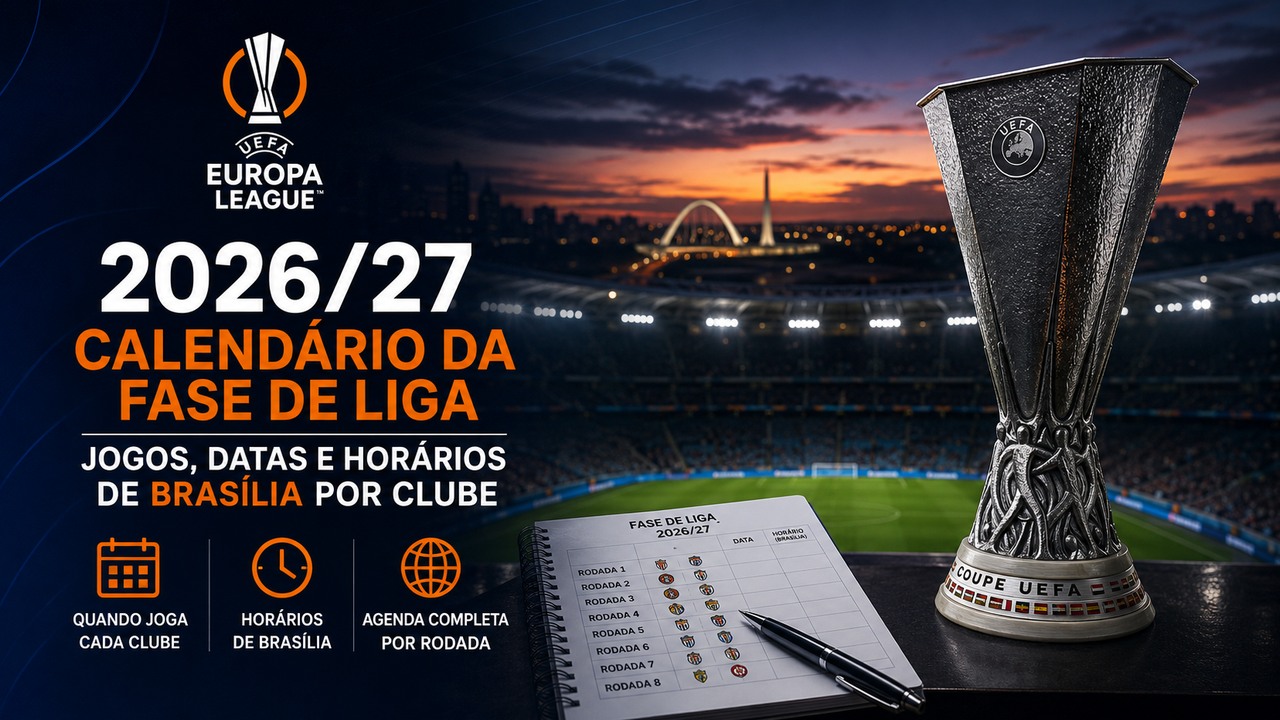
The draw for the 2026/27 Europa League league phase will be held on Friday, August 28, in Monaco. UEFA scheduled the ceremony for 1:00 p.m. in the local time announced for the event; in Brazil, that corresponds to 8:00 a.m. Brasília time. The key detail is that the draw takes place one day after the second legs of the Europa League play-offs, so the final list of 36 participants will only be complete on the eve of the draw.
The league phase begins on September 16 and 17 and will give each club eight matches. The draw does more than reveal opponents: it also determines which fixtures will be played at home and which will be away. The specific dates, kick-off times for each match and any calendar adjustments will remain under UEFA's responsibility after the pairings are made.
What time is the Europa League 2026/27 draw in Brazil
The ceremony is scheduled to begin at 8:00 a.m. on Friday, August 28, Brasília time. The reference comes from the official time published by UEFA for Monaco, where the event will be held. The Portuguese version of the official page also states 12:00 p.m. in mainland Portugal, which leads to the same conversion for Brasília.
Anyone planning to follow the draw should open UEFA's official Europa League page shortly before it begins. The organization already maintains a page dedicated to the event and has said that the seeded teams, possible groupings and the detailed procedure will be published on the morning of the draw. This matters because the operational format of the draw can be updated, so it is not advisable to assume, before the official release, that the execution will be identical to the previous season.
Why all 36 participants are not confirmed yet
The league phase will have 36 clubs. According to the access structure published by UEFA, 13 places are filled directly, including the berth reserved for the Conference League champion. Another 12 go to the winners of the Europa League play-offs, whose second legs finish on August 27.
The remaining 11 places are filled by teams transferred from Champions League qualifying, including losers from the third qualifying round and the competition's play-offs. This system explains why the Europa League field continues changing until practically the eve of the draw.
As of August 25, 2026, therefore, it is not correct to treat any partial list as the final group of 36. The Champions League play-off results are completed on August 25 and 26, while the 12 decisive Europa League ties are concluded on the 27th. Only after that can UEFA close the full set of clubs and organize the definitive pots.
How the four pots work
The 2026/27 Europa League regulations establish that the 36 clubs are divided into four pots of nine. The order uses the club coefficient ranking established at the start of the season.
Being in Pot 1 does not mean avoiding Pot 1 opponents. Each team will face two clubs from each of the four pots, including its own pot. For each pot, one of those matches will be at home and the other away. By the end of the draw, each participant will have eight different opponents, four home matches and four away matches.
That is one of the most important differences from the old group-stage model. The pot still organizes the draw, but it does not act as a barrier that prevents matches between teams of a similar level.
What restrictions the draw must respect
The regulations state that, in principle, clubs from the same national association cannot face each other in the league phase. They also limit to two the maximum number of opponents from
the same foreign association.
In practice, an English club should not be drawn against another English club at this stage, and it cannot receive three opponents, for example, from the same Spanish league. UEFA, however, retains the possibility of adapting conditions if that is necessary to avoid deadlocks in the draw or to meet restrictions determined by the competition bodies.
UEFA itself has said that possible groupings and the specific operational procedure for the draw will be announced on the 28th. For that reason, any explanation published before that update should separate what is already established in the regulations from what still depends on the event document.
What will be decided in the draw
The main result of the draw will be each club's list of eight opponents. Because every team receives two opponents from each pot, the full design of the league phase emerges at once, without the formation of fixed groups.
The home designation for each fixture will also be determined. For each pot, one opponent will be faced at home and the other away. At the end of the process, all clubs will have four home matches and four away matches.
The draw therefore answers the two central sporting questions: whom each team will play and under which home-or-away condition. That already makes it possible to assess difficulty, geographical distribution, the strength of the opponents and the balance between home and away fixtures.
What will still be pending after the draw
The exact order of matches on the calendar is not the same thing as the result of the draw. The regulations leave the definition of league-phase kick-off times to UEFA administration and allow date adjustments or venue reversals when there are stadium, city or other operational conflicts.
So, even after all eight opponents are known, supporters will still have to wait for the detailed schedule to learn in which matchday each fixture will take place, on what date it will be played and what the official kick-off time will be.
The league phase begins on September 16 and 17, 2026, and ends on January 28, 2027. Between those dates, each team will play eight matches and will be placed in a single table with all 36 participants.
The draw does not create traditional groups
The Europa League is entering its third season with a 36-club league phase. There are no eight separate groups as in the old model. All teams appear in a single table, although each one faces only eight opponents determined by the draw.
The final standings are decisive for progression in the tournament. The top eight advance directly to the round of 16. Clubs finishing from 9th to 24th place play the knockout-phase play-offs. Teams that finish from 25th to 36th are eliminated.
That gives the draw more weight than a simple distribution into brackets. The combination of opponents from all the pots helps shape the eight-match path that will influence each club's final position in the single league table.
Timeline to follow without mixing up the stages
On August 25 and 26, the Champions League play-offs end and the clubs transferred to the Europa League are determined. On August 27, the second legs of the Europa League play-offs
take place and the 12 qualifiers from that route are decided. On August 28, with all 36 places filled, UEFA holds the league-phase draw.
On the 28th itself, before the ceremony, UEFA says it will make available the seeded teams, any groupings and the official procedure. That is the material that should be used to confirm the final pots and any specific technical detail of the draw.
After the ceremony, the eight opponents and the home-or-away designation for each club will already be settled. What will still need to be followed is the publication of the detailed schedule distributing the fixtures across the eight matchdays and their respective kick-off times.
What is worth checking on the morning of August 28
For anyone who wants to follow the draw without relying on incomplete information, the best checkpoint is UEFA's official Europa League page. The organization has already confirmed the date, the European event time and the start of the league phase, but has left the publication of the pots, any groupings and the final procedure for the day of the draw itself.
That also means that pot lists published before the play-offs are completed should be treated as projections, not as an official definition. The final composition depends on the August 27 results and on the ordering published by UEFA.
For Brazilian supporters, the practical reference is simple: Friday, August 28, at 8:00 a.m. Brasília time. Before that, attention is on the play-offs; during the draw, on the eight opponents and home-or-away designations; afterward, on the schedule with the dates and kick-off times for each matchday.