The short answer is: for John Glenn's flight, the most precise description is that Katherine Johnson independently verified orbital calculations produced by electronic computers, running the same numbers through the same equations on a desktop mechanical calculating machine. NASA also documents that she already had direct experience in trajectory analysis and orbital mechanics. So saying only that she "calculated John Glenn's orbit" compresses a story that involved collective engineering, electronic computers, a worldwide tracking network, and a human check that the astronaut himself considered important.
What Katherine Johnson checked for John Glenn
In 1962, NASA was preparing Mercury-Atlas 6, known as Friendship 7. John Glenn would become the first American to orbit Earth. The February 20 mission completed three orbits and lasted 4 hours, 55 minutes, and 23 seconds, according to NASA's official Friendship 7 history.
To support an orbital mission, the agency had built a communications and tracking network linked to IBM computers in locations including Washington, Cape Canaveral, and Bermuda. Those computers had been programmed with orbital equations used to determine the capsule's trajectory from launch to splashdown.
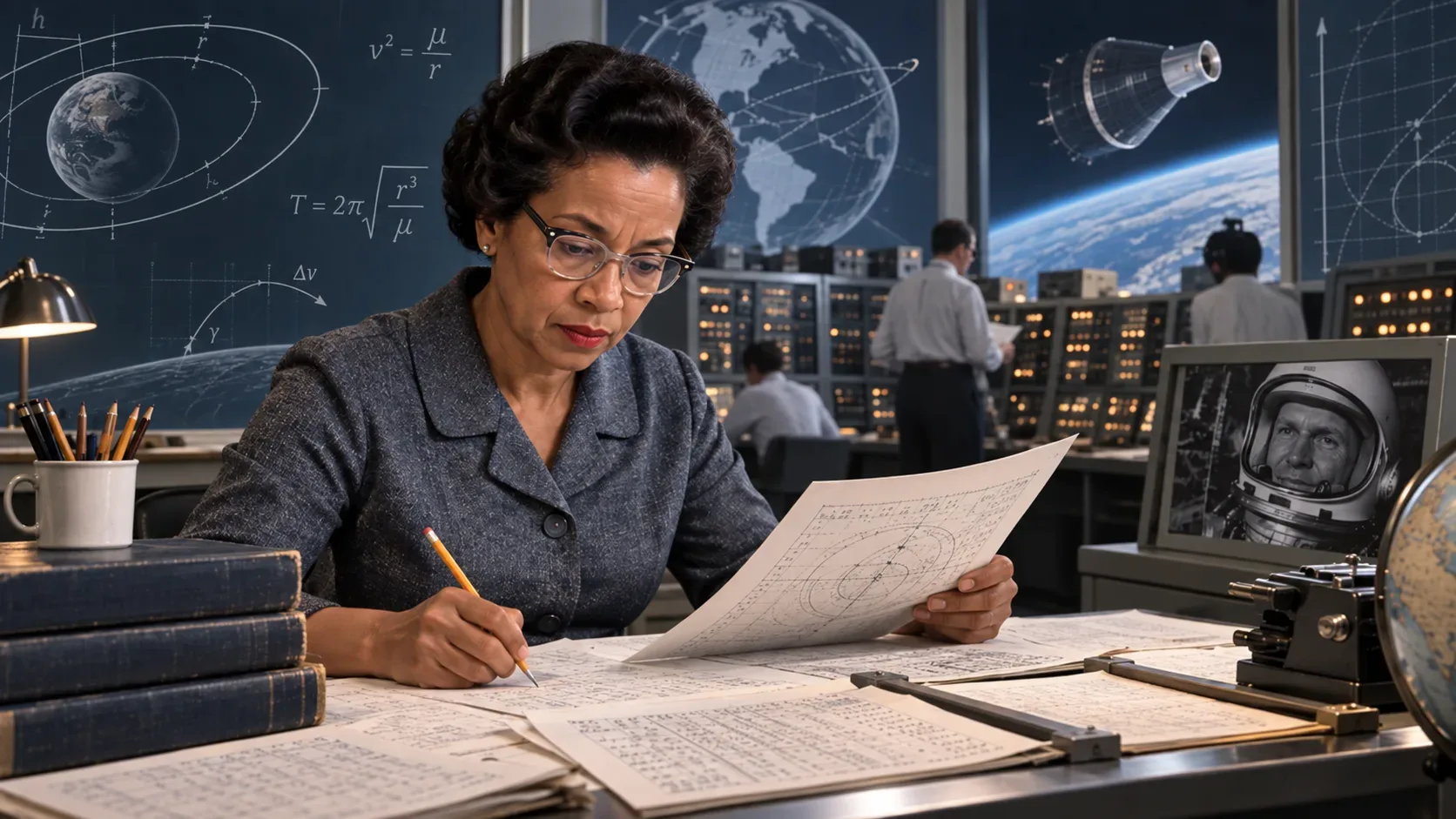
The episode associated with Johnson occurred during preflight preparation. According to NASA biographies, Glenn asked the engineers to call Johnson and have her run the same numbers through the same equations used in the computers. She performed that check on her desktop mechanical calculating machine. The purpose was to confirm, through an independent calculation path, that the electronic results were trustworthy before flight.
This also clarifies the phrase "checked by hand." It does not mean that every calculation was done only with pencil and paper, or that Johnson single-handedly replaced the mission's electronic infrastructure. It was a manual recomputation performed by an experienced mathematician using a mechanical calculating machine and the equations already adopted by the system.
So did she calculate John Glenn's orbit or not?
It depends on what the phrase is meant to imply. NASA describes Johnson as the person who verified the orbital equations and results used for Friendship 7's trajectory. It also documents that she worked with spacecraft and satellite trajectories and that her expertise was established before 1962.
What the documentation does not support is a reading in which Johnson alone conceived, calculated, and operated Glenn's entire orbit from start to finish. A crewed mission trajectory was the product of engineering, tracking, programming, calculations, testing, and operations distributed across many teams. Johnson's contribution was specific and technically significant: she provided an independent human verification of results that were increasingly being entrusted to electronic computers.
| Claim | What NASA sources support |
|---|---|
| "Johnson checked John Glenn's orbital calculations" | Yes. She reran the same numbers through the same equations programmed into the computers before the flight. |
| "Johnson worked on space trajectory calculations" | Yes. NASA records trajectory analysis for Alan Shepard, orbital mechanics research, and later Apollo work. |
| "Johnson alone calculated Glenn's entire orbit" | That wording erases the documented electronic infrastructure and collective work behind the mission. |
| "She only checked finished arithmetic and did no orbital work of her own" | No. Before Friendship 7, she had already performed trajectory analysis and coauthored technical research on orbital flight. |
Johnson's orbital work began before Friendship 7
Katherine Johnson arrived at Langley in 1953, when the institution was still part of NACA, NASA's predecessor. She began in the segregated West Area Computing section and moved into work in the Flight Research Division. During her early years, she analyzed flight-test data and participated in an investigation of an aircraft accident linked to wake turbulence.
As the space race accelerated, her work expanded. In 1960, Johnson and engineer Ted Skopinski coauthored the technical report Determination of Azimuth Angle at Burnout for Placing a Satellite Over a Selected Earth Position. The report presents mathematical relationships between a satellite's position in its orbital plane and projected latitude and longitude on a rotating Earth, along with a method for finding the azimuth angle needed for a vehicle to pass over a selected location.
The report matters for two reasons. First, it shows that Johnson was formally working on orbital mechanics problems before Glenn's flight. Second, NASA records that it was the first time a woman in the division received credit as an author of a research report.
Alan Shepard: here NASA explicitly says trajectory analysis
In May 1961, Alan Shepard flew Freedom 7, the first crewed U.S. spaceflight. Johnson's official biography states that she performed trajectory analysis for that mission. This is a different attribution from the 1962 Glenn episode and helps correct a common misunderstanding: Johnson's trajectory work did not begin with the Friendship 7 verification.
The Shepard case also explains why the broad statement "she calculated trajectories" is accurate as a description of her career, even though it is too imprecise when used to describe exactly what happened before Glenn's flight.
Human computers and electronic computers overlapped
Early in Johnson's career, "computer" was also a job title for people who performed mathematical calculations, turning raw test data into engineering parameters. NASA describes these groups of women mathematicians as an essential part of Langley's research work.
When electronic computers became central to Project Mercury, human calculation did not disappear overnight. The machines were much faster, but operational trust depended on confidence in programs, inputs, equations, and outputs. Glenn's request happened during that transition. Johnson's check served as an independent validation at a time when astronauts and engineering teams were still building confidence in electronic systems.
That is why the story is more revealing than a simple contest between "a mathematician" and "a computer." Johnson understood the mathematics that was also being encoded into the machines. Her authority came from being able to understand the physical and orbital problem, repeat the procedure, and judge whether the results made sense.
What she did after Project Mercury
Johnson's career continued far beyond Friendship 7. NASA records that she worked on calculations related to Project Apollo, including problems involving synchronization of the Lunar Module with the Moon-orbiting Command and Service Module. Another NASA biography also records trajectory calculation for Apollo 11 and the preparation of backup navigation charts for astronauts to use in the event of electronic failures.
She later worked on the Space Shuttle program, the Earth Resources Technology Satellite, later associated with the Landsat program, and other problems in dynamics, guidance, and control. Johnson retired from NASA in 1986 after 33 years at Langley.
A timeline that separates the different attributions
| Year | Documented work | Why it matters |
|---|---|---|
| 1953 | Joined NACA Langley and worked in mathematical computing and flight-data analysis. | Her expertise began in aeronautical research before NASA's space program. |
| 1960 | Coauthored NASA-TN-D-233 on azimuth and satellite orbital position. | Documents formal orbital mechanics work before Glenn. |
| 1961 | Trajectory analysis for Alan Shepard's Freedom 7 mission. | NASA explicitly attributes trajectory work to Johnson on this mission. |
| 1962 | Manual verification of the numbers and equations programmed into the computers for John Glenn's Friendship 7. | This is the famous episode tied to Glenn's personal request. |
| 1960s and later | Work on Apollo, backup navigation, and later the Space Shuttle and Earth-resources satellites. | Her contribution extended far beyond one flight or one calculation check. |
What popular retellings tend to compress
Katherine Johnson's story reached a huge public audience through Hidden Figures. The core episode is real and documented by NASA: Glenn requested a check by Johnson before flying. The historical care comes in not turning a critical verification into a claim of individual authorship over the entire mission, and not reducing a decades-long career to a single moment.
A source-grounded formulation is: Katherine Johnson was a NASA mathematician specializing in trajectories and orbital mechanics; before Friendship 7 she had already analyzed Alan Shepard's trajectory and published orbital research; for John Glenn, she manually reran the numbers from the equations programmed into the computers, providing an independent verification before launch.