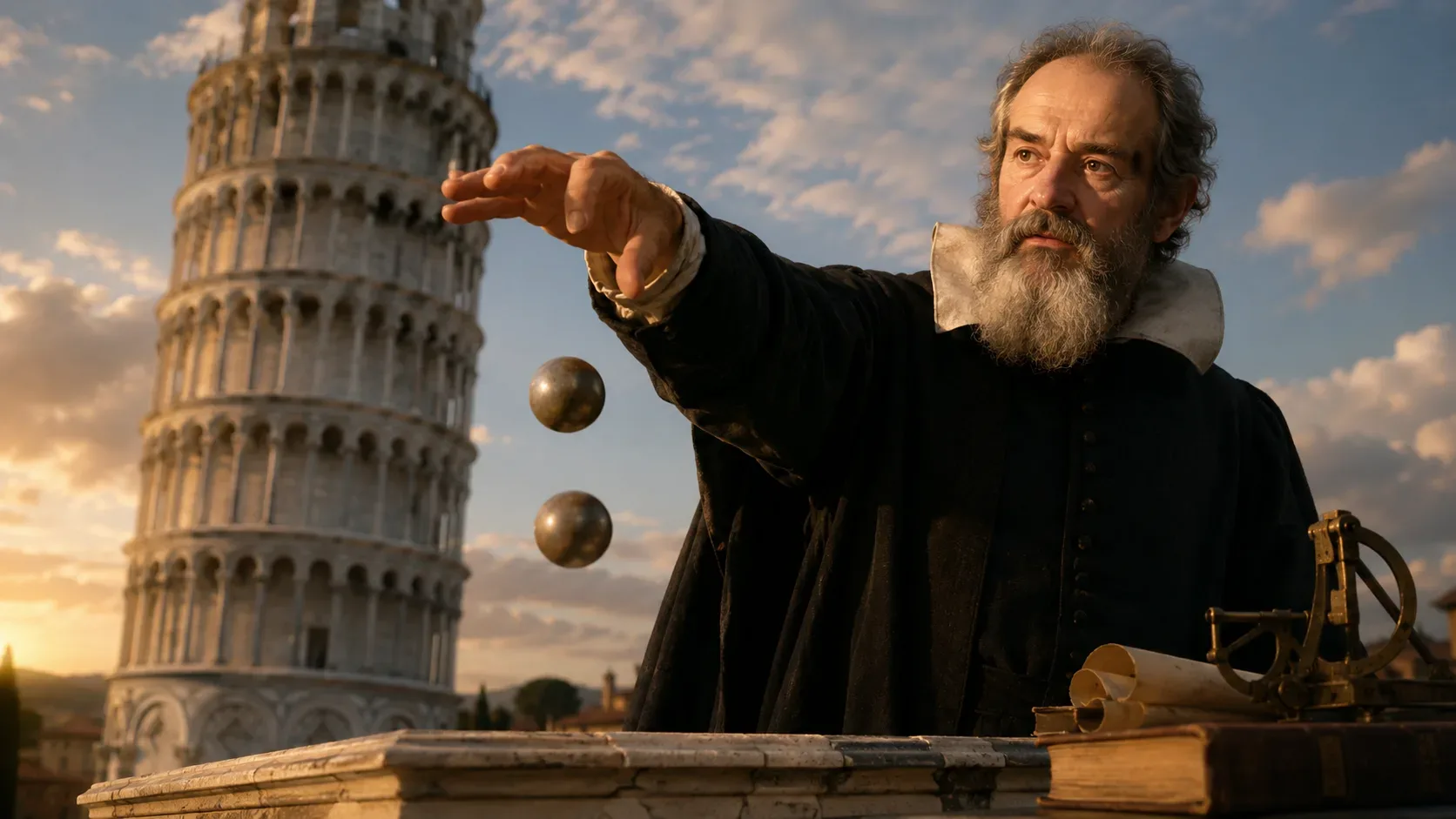
Short answer: we cannot state that Galileo carried out, exactly as the familiar school story says, a public demonstration from the Leaning Tower of Pisa in which he dropped two balls of different weights and saw them hit the ground at the same time. The detailed scene appears in a biography written by Vincenzo Viviani in 1654, twelve years after Galileo's death and more than six decades after his period as a professor in Pisa. Galileo's surviving writings do not record that celebrated demonstration. This does not mean that he never dropped bodies from high places: his early manuscripts mention tests of that kind. The problem is that those tests are not the same thing as the heroic scene fixed by tradition.
Where the Leaning Tower story came from
The main source for the anecdote is Vincenzo Viviani, Galileo's late pupil and biographer. The Museo Galileo states that his Racconto istorico della vita di Galileo was dated April 29, 1654 and remained unpublished during the author's lifetime, first appearing in print in 1717.
Viviani credited the young Galileo with repeated experiments from Pisa's bell tower, in front of professors and students, aimed at challenging conclusions associated with Aristotelian physics. That passage is the source of the image familiar today: the scientist at the top of the tower, two bodies of different masses in his hands, and an audience watching the decisive test.
The gap between the supposed event and the account matters. Viviani wrote after Galileo's death and long after the Pisa years. He said he had used memories, documents, letters and testimony, including information he had received from Galileo himself. His text therefore cannot simply be dismissed as an automatic fabrication. But neither is it a contemporary record of the experiment. Without a diary, letter, university record or description by Galileo of that specific demonstration, the anecdote remains historically possible but unproven.
Galileo did perform falling-body tests from heights — but that does not prove the famous scene
The most important nuance is that saying “Galileo never experimented from towers” would be an overcorrection. Historians of science note that in manuscripts from the De motu period, around 1590, Galileo reports drop tests from high places. In one example discussed in the literature, he compares lead and wood bodies and observes that the lead moves ahead during the fall.
That detail is almost the opposite of the simplified myth. In his early experiments, Galileo was still dealing with differences produced by the medium, material and air resistance. The celebrated demonstration of two similar-material balls arriving practically together, used to overturn an Aristotelian rule in one stroke, is the formulation recorded by Viviani decades later.
A historiographical study published in Annals of Science summarizes the tension: the tower narrative does not appear in Galileo's writings as the demonstration celebrated by Viviani, and historians disagree about whether some version of it took place. Some scholars, including Stillman Drake, argued that there was a demonstration; others consider it more likely that the episode was embellished or retrospectively reshaped.
Galileo's argument did not depend on climbing the Leaning Tower
In 1638, in the Discorsi e dimostrazioni matematiche intorno a due nuove scienze, usually known in English as Two New Sciences, Galileo presented an argument that became even more important to the history of physics. Instead of depending on a spectacular drop, it explores a contradiction in the idea that falling speed must increase directly with weight.
Imagine, in simplified terms, a heavy stone that would fall faster and a light stone that would fall more slowly. If the two are tied together, the light stone should slow the heavy one. Yet the combined object is heavier than the original heavy stone; under the Aristotelian rule, it should fall faster. The same hypothesis therefore yields incompatible predictions. The Stanford Encyclopedia of Philosophy highlights this episode as a classic example of Galileo's use of thought experiments.
This reasoning is not the same as a modern proof that all bodies have exactly the same acceleration in every situation. Its main force is to attack a simple proportionality between weight and falling speed. Real behavior also depends on the medium: in air, shape, area, density and drag can create observable differences.
Why the inclined plane matters more to the law of fall
The experimental problem with a short vertical fall is time. A body covers the distance quickly, and the clocks available in the early seventeenth century made small fractions of a second difficult to measure. The solution was to slow the phenomenon without abandoning its mathematical structure: use inclined planes.
The Museo Galileo credits Galileo with determining the law of constant acceleration for falling bodies, according to which, from rest, the distances traveled are proportional to the squares of the elapsed times. The museum also explains that devices such as the inclined plane made the motion slow enough to investigate.
This is where the history becomes more interesting than the legend. Galileo's science does not depend on one theatrical moment. It results from a combination of mathematics, comparisons of motions, experimentation, idealization and discussion of the medium's effects. Reducing it all to two balls dropped from a tower erases the very process that made his work influential.
Would two balls land at exactly the same time?
In a vacuum and under the same gravitational field, freely falling bodies have the same acceleration regardless of their mass. In air, however, resistance does not affect every object in the same way. Two compact spheres similar in shape and material but different in mass may reach the ground with only a small difference; it is not correct to turn “almost together” into “exactly together” without controlling the conditions.
The Museo Galileo notes that equality of gravitational acceleration was verified experimentally much more cleanly later with falls in evacuated tubes. This distinction helps separate Galileo's theoretical contribution from the kind of perfect demonstration suggested by the schoolroom story.
What is fact, what is plausible, and what is myth
| Claim | State of the evidence | Safest reading |
|---|---|---|
| Galileo seriously studied falling bodies. | Strongly documented. | Fact. |
| Galileo performed drop tests from high places. | There are references in his early manuscripts. | Fact in a general sense. |
| He dropped two differently weighted balls from the Leaning Tower of Pisa before professors and students. | The detailed narrative comes from Viviani in 1654, with no known contemporary record. | Possible, but unproven. |
| The two balls hit the ground at exactly the same time. | There are no contemporary data from the supposed test; in air, drag creates differences. | Too strong a formulation. |
| That single experiment overthrew Aristotle and produced the law of fall. | Galileo's development involved arguments, multiple experiments and inclined planes. | Simplifying myth. |
Why the story became so famous
The Leaning Tower of Pisa offers everything a teaching narrative wants: a recognizable setting, two objects, a visual outcome and a clash between ancient authority and observation. It is much easier to remember that scene than decades of manuscripts, measurements, arguments and revisions.
There is also a historiographical reason. Modern analysis of Viviani's biography suggests that the anecdote worked extremely well as a portrait of Galileo as a reformer of natural philosophy: he would not merely disagree with Aristotle, but publicly confront him through a visible experiment. That may help explain the story's appeal, but it does not prove that Viviani invented it. The careful conclusion is narrower: we have an important late source, no contemporary confirmation of the specific scene, and independent evidence that Galileo really did investigate falling bodies.
So did Galileo drop the balls or not?
The historically responsible answer is: some demonstration may have taken place, but the famous version cannot be treated as a documented fact. What we can say securely is that Galileo experimented with motion, recorded falling-body tests, developed arguments against simple Aristotelian explanations, and reached a much more sophisticated theory of acceleration.
The best antidote to the myth is not to replace one certainty with another. Rather than saying “it happened exactly like that” or “it never happened,” it is better to show the strength of the evidence behind each claim. The Leaning Tower story is a useful example of how the history of science is built: real experiments, theoretical arguments and later memories can end up compressed into an image sharper than the sources allow.
Sources and further reading
- Museo Galileo — Vincenzo Viviani's Racconto istorico della vita di Galileo
- Museo Galileo — Galileo's law of falling bodies
- Museo Galileo — Gravitational acceleration
- Stanford Encyclopedia of Philosophy — Galileo Galilei
- Annals of Science — historiographical discussion of the tower experiment
- Galileo Galilei — Dialogues Concerning Two New Sciences, historical open-access translation