No. The known school records do not support the story that Albert Einstein failed mathematics. The actual episode is more specific: in October 1895, at age 16, he did not pass the overall entrance examination for the Eidgenössisches Polytechnikum in Zurich, the institution that would later become ETH Zurich. ETH itself records, however, that his best results were precisely in mathematics and the natural sciences, while his insufficient performance was in linguistic and historical subjects.
A year later, the school records from Aarau make the distinction even clearer. On his 1896 maturity certificate, Einstein received the highest grade in algebra, geometry, descriptive geometry, and physics. That is why saying that he "failed math" mixes an overall failure on an entrance examination with a mathematical performance that appears strong in the preserved documents.
What happened in the 1895 entrance exam
Einstein came to the examination in an unusual situation. According to the ETH Library, he did not yet have a secondary-school leaving diploma and also did not meet the normally required entrance age of 18. Even so, the Polytechnic's director, Albin Herzog, granted an exceptional authorization for the 16-year-old to take the examination.
The exam took place in early October 1895. The historical summary maintained by ETH is direct: Einstein achieved the best results in mathematical and natural-science subjects, but performed unsatisfactorily in linguistic and historical subjects. Because the overall result was considered insufficient, he did not enroll at that time.
That completely changes the meaning of the popular phrase. It is correct to say that Einstein did not pass the 1895 entrance exam. It is not correct to turn that fact into "Einstein failed math," because the institution that administered the examination describes mathematics and science as the very areas in which he performed best.
The Polytechnic's response also helps explain the case. Rather than treating the result as evidence of scientific incapacity, the recommendation was that he complete his secondary education at the
Kantonsschule in Aarau. ETH also records that Friedrich Weber, a physics professor at the Polytechnic, invited him to attend his classes. His path to Zurich was postponed, not closed.
What the Aarau school record shows
Einstein entered the cantonal school in Aarau at the end of October 1895 and spent the following school year there. The documents from this period do not depend only on later biographical accounts. The inventory of the Albert Einstein-Archiv, preserved at the Swiss National Library, records copies of the 1896 maturity examinations, final grades, and other school materials from the period.
The documentary edition The Collected Papers of Albert Einstein separately catalogs the final grades from the Kantonsschule, dated September 5, 1896, and the maturity examinations taken in the following weeks. The State Archives of the Canton of Aargau also describes the 1896 file as containing grade tables by candidate and subject, as well as corrected examinations in geometry, algebra, chemistry, physics, and other subjects.
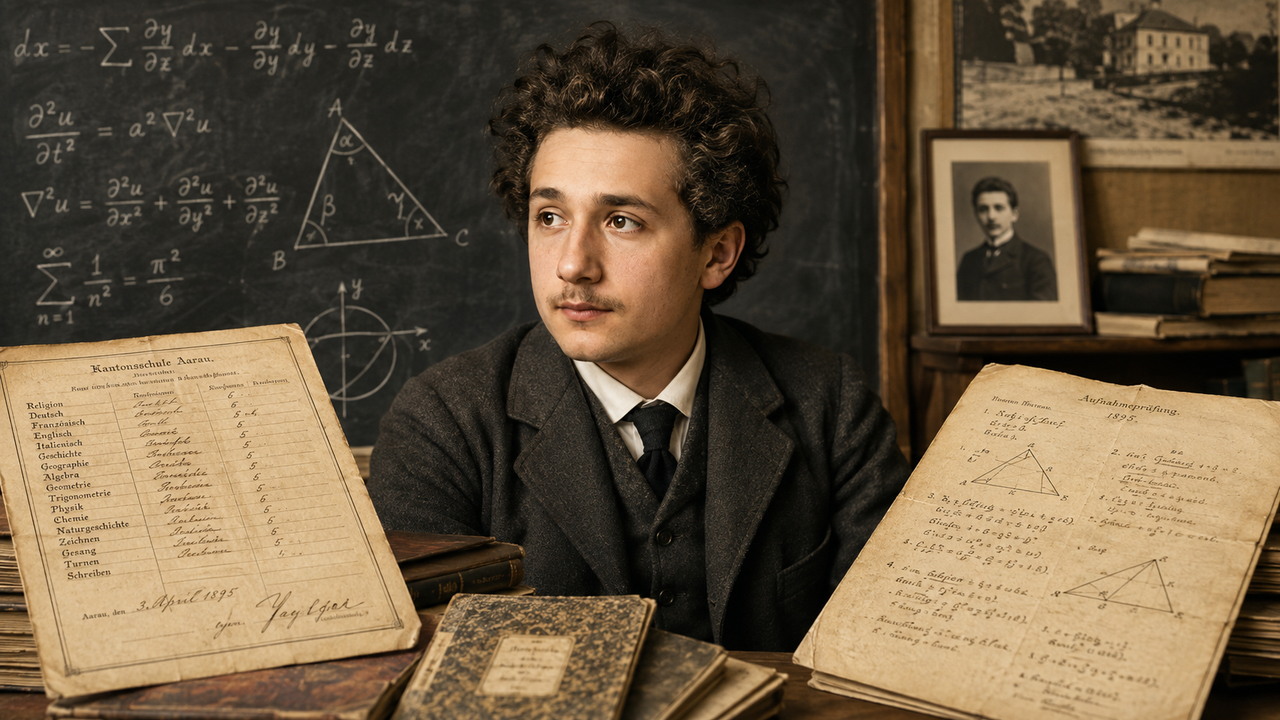
The best-known document is the maturity certificate issued on October 3, 1896, after written and oral examinations held in September. On it, Einstein received 6 in algebra, 6 in geometry, 6 in descriptive geometry, and 6 in physics. In chemistry, he received 5. The same certificate shows that his performance was not uniform across all areas: French appears with a 3 and geography with a 4. The Aargau State Archives itself summarizes that he completed the maturity qualification as the best in his class, despite the insufficient grade in French.
That contrast matters. Debunking the myth does not require turning Einstein into a perfect student in every subject. The records show something more interesting and more precise: he had exceptional performance in the areas that would become central to his scientific education, while at the same time posting much more modest results in some other subjects.
Why a grade of 6 does not mean a bad grade
Part of the modern confusion arises when an old document is viewed without knowing the grading scale. In the system used on the Aarau certificate, 6 was the highest grade, 5 corresponded to a good result, 4 was sufficient, and 3 was already weak. So Einstein's several 6s in mathematics and physics are not low grades: they are the maximum grades.
This also requires care when comparing school systems. In grading traditions where 1 may be the best grade and 6 the worst, reading the Swiss document with the wrong scale produces exactly the opposite interpretation. The difference in scale helps explain why images of the report card can be misunderstood when they circulate without context.
But there is no need to attribute the entire myth to a single reading error. There is another true fact ready to be distorted: the overall failure in the 1895 entrance exam. When "did not pass the exam" loses the qualifier about which subjects were strong and which were weak, the story can easily turn into "he was bad at math."
The myth was already circulating while Einstein was still alive
The version that Einstein had failed mathematics is not a recent invention of the internet. Walter Isaacson, in writing about the physicist's life, recorded that in 1935 a Ripley's Believe It or Not! column made a claim along those lines. Einstein saw the clipping and rejected the story, saying that he had never failed mathematics and recalling that he had studied calculus while still very young.
This episode shows that the legend was already established decades before social networks and short videos. The internet amplified a narrative that was attractive for obvious reasons: it offers a
simple redemption story in which a supposedly failing student becomes a genius. The problem is that the school records do not support that version.
The documented story is less cinematic but more useful. A teenager without the formal age and diploma requirements received an exceptional chance to take a difficult examination. He did very well in mathematics and science, performed poorly enough in other areas not to pass overall, completed his education in Aarau, and returned the following year with the required certificate.
The difference between "failed the exam" and "failed math"
The two phrases sound similar, but they make different claims. "Einstein did not pass the Polytechnic entrance exam in 1895" is a description supported by ETH. "Einstein failed math" assigns the failure precisely to the area in which the institutional record points to his best results.
This distinction also avoids another common exaggeration: saying that he was simply a "bad student." The Aarau certificate shows high grades in several subjects and lower grades in others. The picture is of an uneven student with very pronounced strengths, not of someone academically incapable who later surprised the world in an inexplicable way.
In other words, the 1895 exam and the 1896 certificate do not contradict each other. They complement each other. The first shows that excellence in some areas did not guarantee success on a broad examination. The second shows that, after a year in Aarau, Einstein completed his secondary education with the highest marks precisely in algebra, geometry, and physics.
What can be stated with confidence
If the question is "Did Einstein fail math?", the answer supported by the documents is no. If the question is "Did Einstein ever fail an exam?", the answer is yes: he did not pass the general entrance examination for the Zurich Polytechnic in 1895. And if the question is whether that failure happened because he was weak in mathematics, the records point in the opposite direction.
The strongest source for the 1895 episode is ETH Zurich itself, which preserves and summarizes the history of his admission. For 1896, the Aarau documentary record appears in the Albert Einstein-Archiv and in the critical edition of his papers, which includes final grades and maturity examinations. These records make it possible to separate popular memory from evidence without relying only on anecdotes.
The Einstein myth works because it compresses a story full of details into one memorable sentence. The archive does the opposite: it restores the details. And once they are back in view, the conclusion is simple. Einstein failed a broad entrance examination at age 16; mathematics was not the problem.